All species › Passerines › Thrushes and allies › Rufous-backed Robin
Rufous-backed Robin | Turdus rufopalliatus
Roestruglijster | Zorzal dorsirrufo
The Rufous-backed Robin is the thrush of the western Mexican lowlands: grey on the head and belly, with a rusty mantle and orange-brown flanks. It is resident in Mexico and reaches the United States only as a winter wanderer in the border states, usually around fruiting shrubs in gardens and along streamside woodland.
Voice
The song is an unhurried, rich warble of short rounded phrases, each repeated two or three times before the bird moves on to the next; the structure recalls American Robin, but the notes are fuller and the pauses longer. There is also a drawn-out plaintive whistle that bends up and down, and in disturbance a dry clucking chuck-chuck and a thin high seee. Song is heard mainly at the onset of the rainy season.
Recording: Manuel Grosselet — CC BY-NC-SA 4.0 · Guadalupe Hidalgo, San Lorenzo Cacaotepec, Oaxaca, Mexico · xeno-canto
Identification
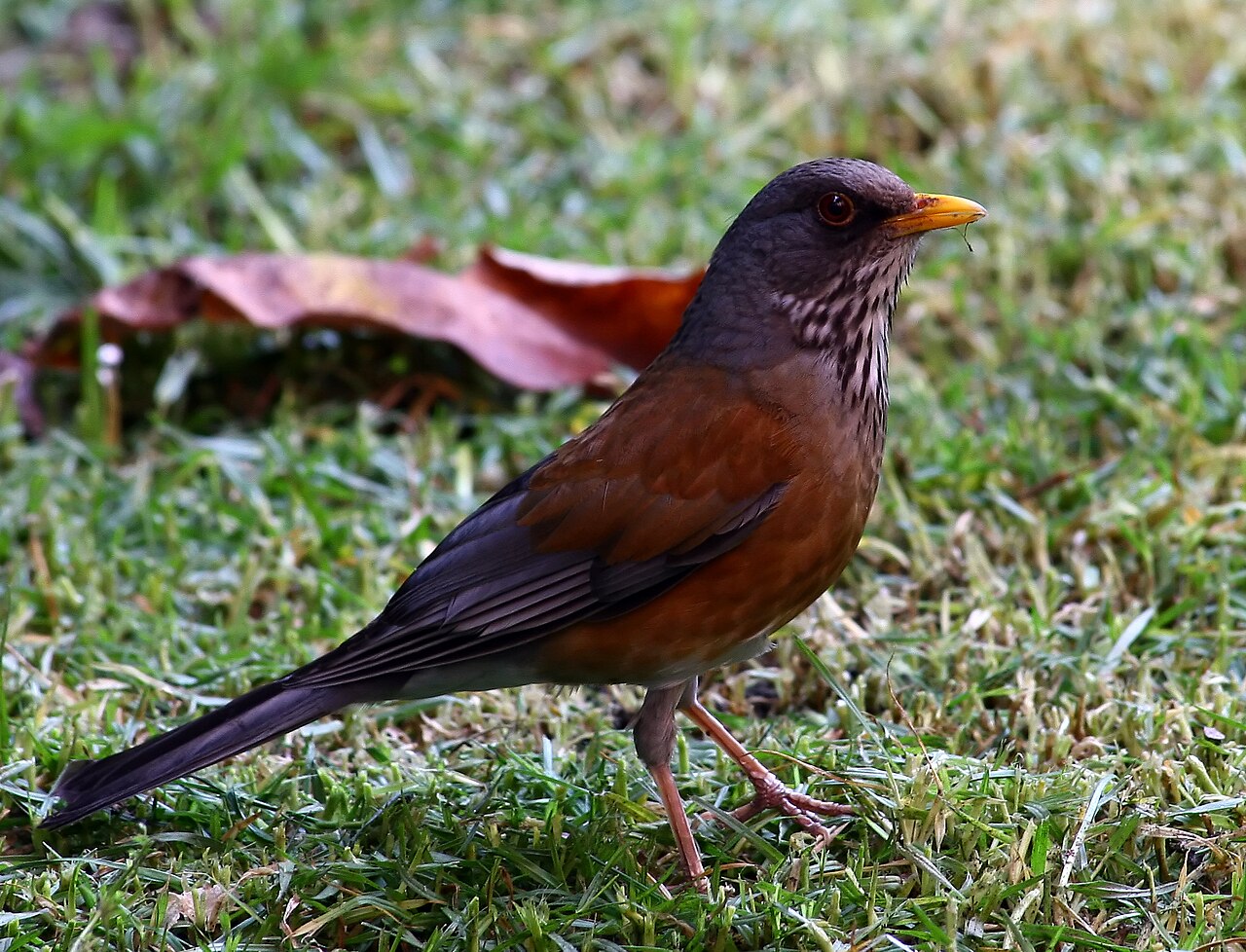
A medium-sized thrush with a long tail. The head is grey with black lores and a yellow eye-ring, the mantle and wing coverts dull chestnut, and that rufous colour carries into the breast and flanks; the throat is white with dark streaks and the belly white. The bill is yellow, the legs flesh-coloured. The female is duller than the male; young birds have pale stipples above and dark mottling below. In flight the contrast between the rufous back and the grey tail is what shows.
Confusion species
American Robin has a plain grey back without rufous, white tail corners and a dark head with a broken eye-ring; the difference holds in winter too, since in Rufous-backed the mantle and the flanks share the same rusty colour. Clay-colored Thrush is uniformly dull buff-brown with no rufous at all and has a pale greenish-yellow bill. White-throated Thrush has a white throat patch, a grey back and a narrow orange eye-ring. Birds of the Tres Marías Islands, now often treated as a separate species, are paler and greyer on the flanks.
Habitat
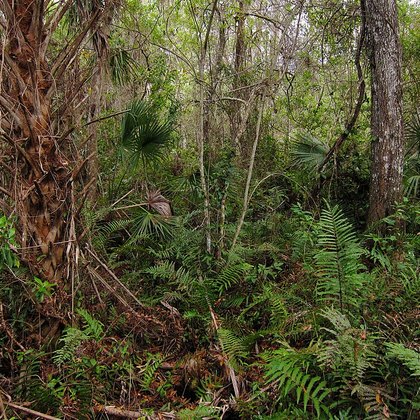
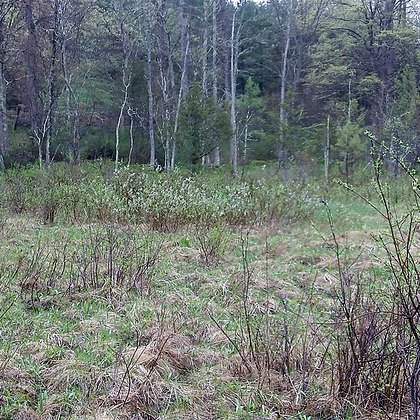
Arid to semi-humid country in the tropical and subtropical zone up to about 2500 metres: deciduous forest that stands bare in the dry season, thorn forest, gallery woodland along streams, plantations, gardens and village edges. Its centre of gravity is semi-open ground with fruiting trees; closed evergreen rainforest it avoids. In cities such as Guadalajara and Mexico City it breeds in parks and gardens.
Where the bird is most often found, arranged by the USNVC — the vegetation classification of the United States and Canada — and CMECS for sea and coast.




Range and movements
Endemic to Mexico, along the Pacific slope from Sonora south to Oaxaca and inland through the Balsas basin to Puebla and Morelos; during the twentieth century it extended east into the Valley of Mexico, where it is now a common city bird. The Tres Marías Islands hold a form of their own. The species does not migrate but wanders outside the breeding season. In the United States it is an irregular visitor from October to April: southeastern Arizona has most records, with others in southern California, south-central New Mexico and West Texas.
- Resident
- Breeding (summer)
- Winter
- dark = core range, pale = thinly spread
Where and when to look
In the border states it pays to work the fruiting shrubs in winter that also draw migrant thrushes: pepper tree, mistletoe and hackberry in streamside woods and gardens. The bird often feeds on the ground in shade and flies off low when disturbed — then the contrast between the rufous back and the grey tail is the first thing to register.
Conservation
The IUCN lists the species as Least Concern (LC); the population is put at at least 500,000 mature birds and the trend is regarded as stable, with no identified threats. The species benefits from gardens, orchards and planted parts of cities and has extended its range as a result. It is taken locally as a cage bird in Mexico, but not on a scale that demonstrably depresses numbers.
Scientific name
Turdus rufopalliatus | de Lafresnaye, 1840
Frédéric de Lafresnaye described the species in 1840 as Turdus rufo-palliatus. The type locality was first given as Monterey, California; Bangs and Penard corrected this in 1919 to Acapulco, Mexico. Turdus is Latin for thrush; rufopalliatus combines rufus 'reddish-brown' and palliatus 'cloaked', from pallium 'cloak' — thus 'with a rufous mantle'. The Dutch, English and Spanish names all say the same thing.