All species › Woodpeckers and allies › Woodpeckers › Red-cockaded Woodpecker
Red-cockaded Woodpecker | Leuconotopicus borealis
Kokardespecht | Pico de Florida
The Red-cockaded Woodpecker is the woodpecker of the open, fire-maintained pine forests of the south-eastern United States, and the only North American woodpecker that excavates its cavities exclusively in living pines. It lives in family groups in which young birds help for years to raise new broods. After a century of forest loss it became one of the best-known protected birds in the country, and thanks to intensive management the population is growing again.
Voice
Red-cockaded Woodpeckers are noisy mainly in groups. The usual call is a rasping, rather nasal sklit or shrit, often heard in quick succession when the group leaves the roost cavities in the morning or returns in the evening. They also give a soft, rolling churr. They drum little; the sound of birds tapping and flaking bark high in the pines is often the first sign of their presence.
Recording: Scott Gravette — CC BY-NC-SA 4.0 · Coleman Lake, Talladega National Forest, Cleburne Co., AL, United States · xeno-canto
Identification
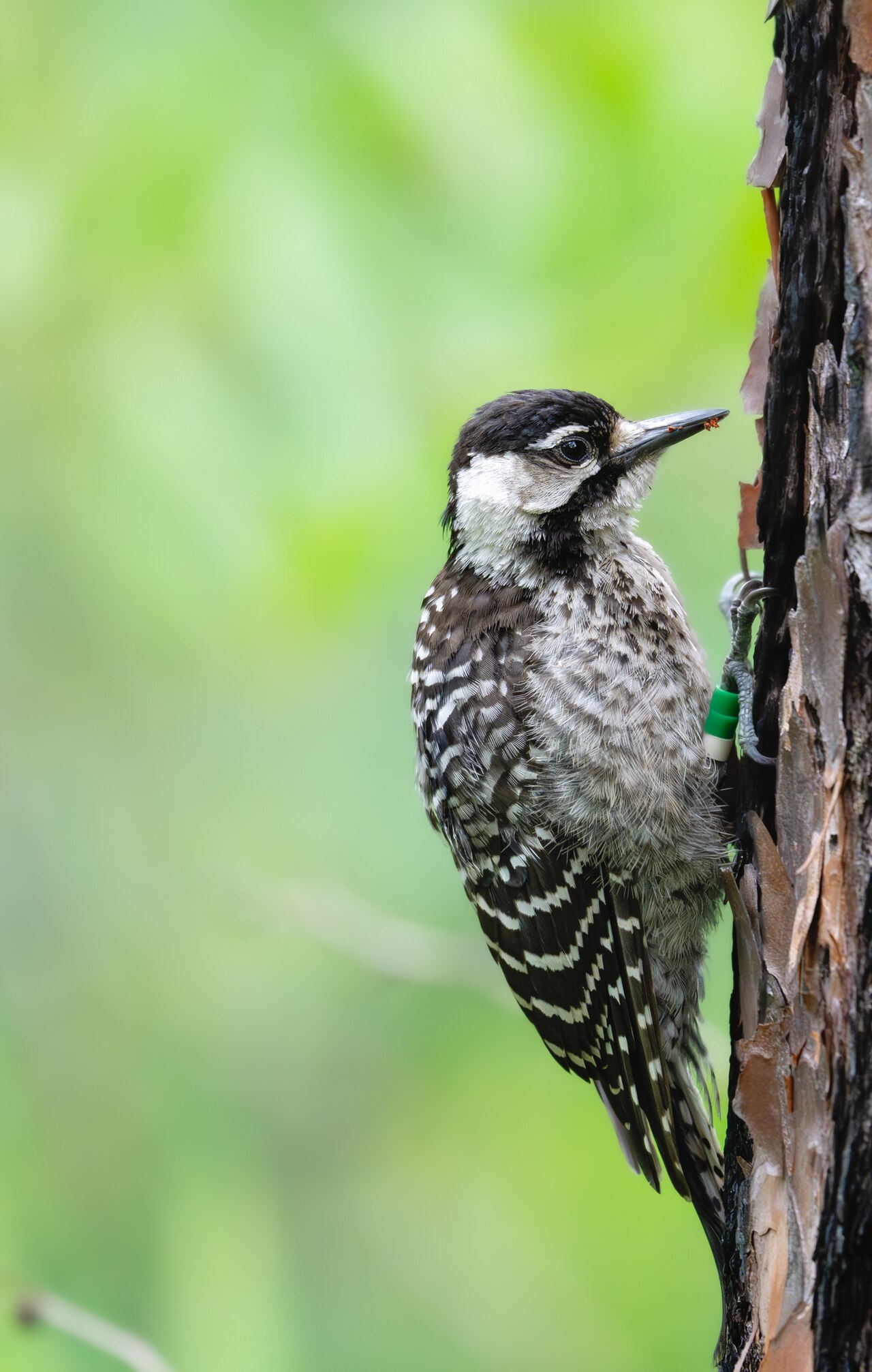
A small to medium-sized woodpecker of 20 to 23 centimetres with a black cap and nape, a large white cheek patch and a black moustachial stripe that runs back to the side of the neck. The back is black with narrow white bars, the underside white with small black spots on the flanks. The male has a tiny red streak on each side of the cap, above the cheek patch, the cockade, which is rarely visible in the field. Young males have a red patch in the centre of the crown in their first months.
Confusion species
Downy Woodpecker and Hairy Woodpecker have a white back stripe instead of a barred back, and a black stripe through the face that divides the white cheek in two. Red-bellied Woodpecker also has a barred back, but a pale head without a black cap, and a red nape. The small Brown-headed Nuthatch, which lives in the same pine forests and also clambers about high in the pines, can cause confusion at a distance, but is much smaller and lacks the black and white of head and back.
Habitat
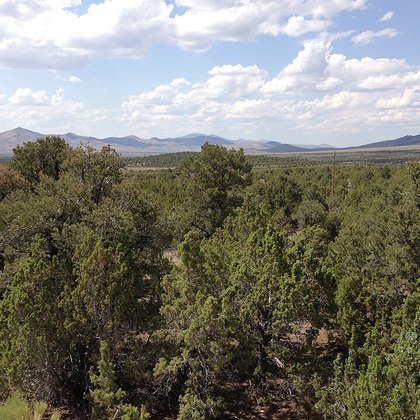
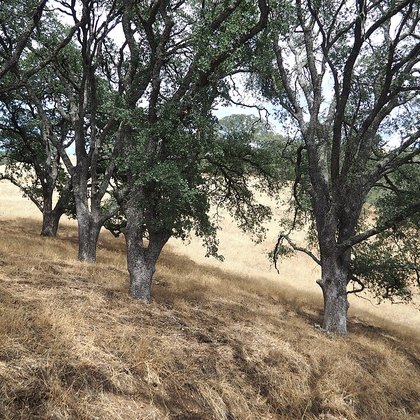
Old, open pine forest with a grassy understorey kept open by regular fires, preferring longleaf pine but also loblolly, shortleaf and slash pine. For its nest cavity it chooses living pines usually more than eighty years old whose heartwood has been softened by a fungus (red heart rot). Excavating a cavity in living wood can take months to years; a group often uses a cluster of such cavity trees for decades.
Where the bird is most often found, arranged by the USNVC — the vegetation classification of the United States and Canada — and CMECS for sea and coast.
Range and movements
Resident in the south-eastern United States, in eleven states from southern Virginia to Florida and west to East Texas, Arkansas and south-eastern Oklahoma. It formerly occurred from New Jersey and Maryland to Florida and west to Missouri and Oklahoma; it has disappeared from Kentucky, Maryland, Missouri, New Jersey and Tennessee. Most large populations now lie on public land, such as national forests and military installations. The species does not occur in Mexico.
- Resident
- Breeding (summer)
- Winter
- Passage
- dark = core range, pale = thinly spread
Where and when to look
Visit a known cavity cluster in a national forest or wildlife refuge and be there at sunrise or shortly before sunset, when the group leaves or returns to its roost cavities. Cavity trees can be recognised by the shiny, sticky streaks of resin running down the trunk from the entrance: the birds peck small resin wells around the cavity, and the resin keeps rat snakes out. Managers often mark cavity trees with a white band of paint.
Conservation
The IUCN rates the species as Near Threatened (NT). Clear-cutting, conversion of longleaf forest to plantations and fire suppression reduced the population to a fraction of its original size; by the 1970s about 1,470 groups remained. Prescribed burning, artificial cavities and translocation of birds raised that to about 7,800 groups, and in October 2024 the species was reclassified under the Endangered Species Act from endangered to threatened. Partners in Flight puts the population at about 19,000 breeding birds.
Scientific name
Leuconotopicus borealis | (Vieillot, 1809)
Louis Pierre Vieillot described the species in 1809 as Picus borealis. He believed the bird came from the northern United States, hence borealis, Latin for 'northern', an unfortunate name for a southern species; Wetmore later fixed the type locality at Mount Pleasant in South Carolina. Because the species has been placed in another genus, author and year stand in parentheses; it now sits in Leuconotopicus ('white-backed woodpecker'). The English name refers to the male's red cockade.