All species › Woodpeckers and allies › Woodpeckers › Ladder-backed Woodpecker
Ladder-backed Woodpecker | Dryobates scalaris
Ladderspecht | Pico mexicano
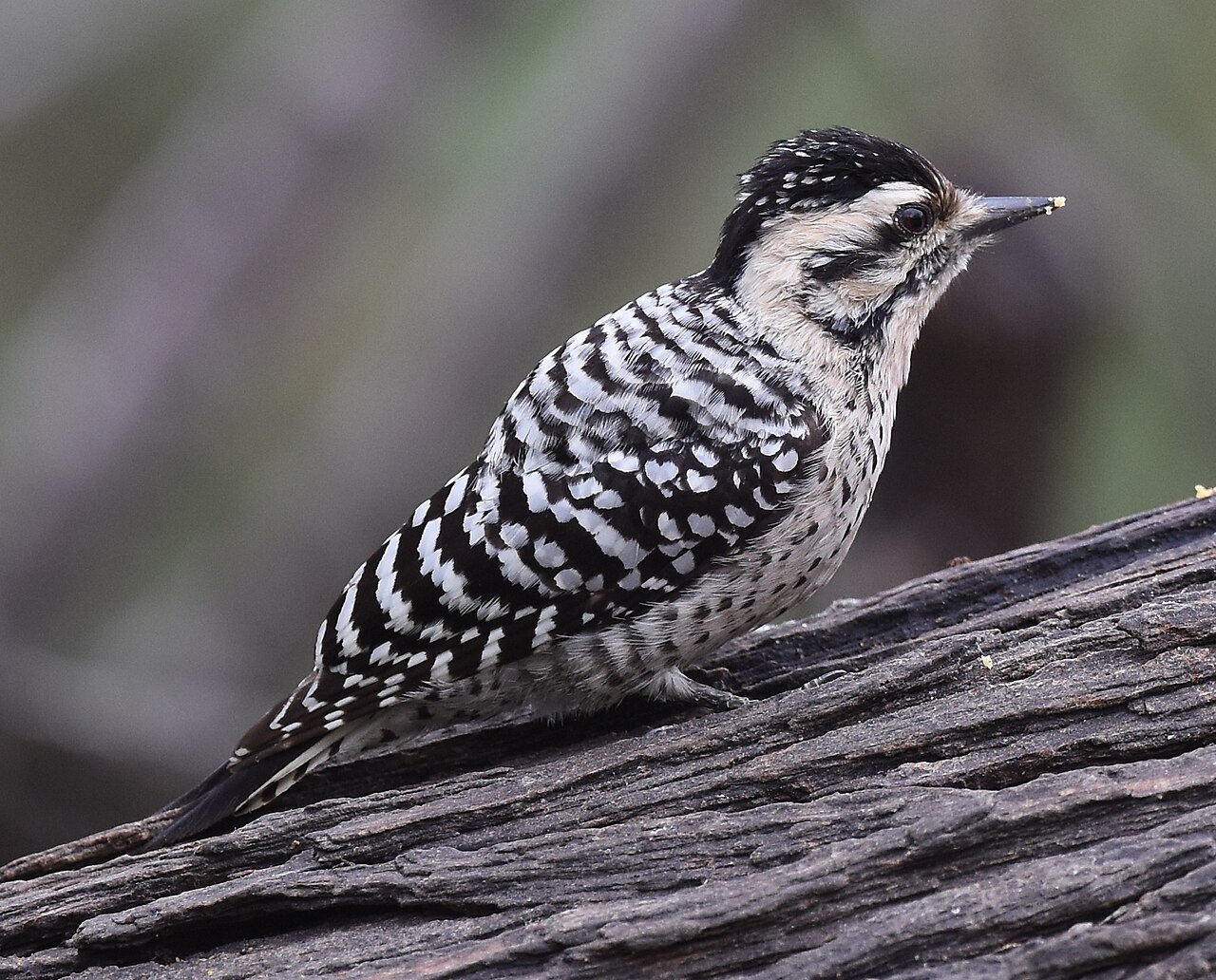
The Ladder-backed Woodpecker is the small black-and-white woodpecker of the deserts and thorn scrub of the south-western United States and Mexico. Its back is finely barred black and white from nape to rump, like the rungs of a ladder, and the male has a red crown. It copes where there are hardly any trees and forages nimbly on mesquite, yuccas, agave stalks and cacti, often hanging upside down from thin twigs.
Voice
The call is a sharp, dry pik, somewhat higher and sharper than the Downy Woodpecker's, and often the first thing you hear of the bird. When excited it gives a fast, ringing rattle that drops in pitch and slows slightly at the end, similar to the Downy's 'whinny'. The drum consists of short, rapid rolls on dead branches, posts and agave stalks.
Recording: Scott Olmstead — CC BY-NC-SA 4.0 · Ironwood Forest NM southeast of Waterman Mtns, Pima County, Arizona, United States · xeno-canto
Identification
A small woodpecker of 16 to 19 centimetres with a finely barred black-and-white back and wings, without a white back stripe. The face is white with black stripes that together form a triangle around the white cheek. The underside is off-white to buffy brown, with small black spots and streaks on the breast sides and flanks; the outer tail feathers are barred black. The male has a red crown reaching from the forehead to the nape, speckled white at the front; the female has a black crown.
Confusion species
Nuttall's Woodpecker, which overlaps with the Ladder-backed only in southern California and northern Baja California and hybridises with it there, shows more black: a largely black upper back with narrower white bars, a blacker head and a whiter underside; in the male the red is confined to the hindcrown. Downy Woodpecker and Hairy Woodpecker have a white back stripe. Gila Woodpecker is larger, with a plain greyish-brown head, and Arizona Woodpecker has a plain brown back.
Habitat
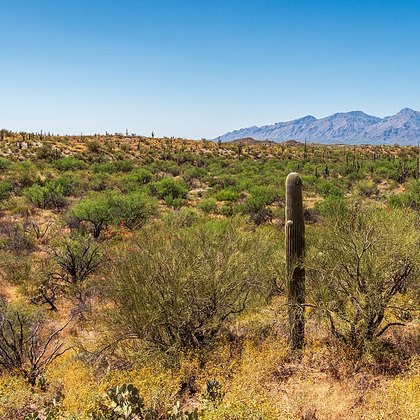
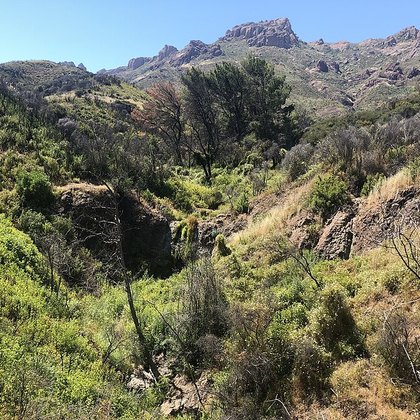
Dry, scrubby country with few trees: desert scrub with mesquite, paloverde, yucca and cacti, Joshua tree woodland, thorn forest and the edges of dry oak woodland, from sea level to about 2,300 metres. Where its range meets that of related woodpeckers it chooses the drier sites and largely leaves riparian woodland to them. The male excavates the nest cavity in a Joshua tree, willow, cottonwood, agave stalk or even a fence post, usually no more than a few metres up.
Where the bird is most often found, arranged by the USNVC — the vegetation classification of the United States and Canada — and CMECS for sea and coast.
Range and movements
Resident from south-eastern California, southern Nevada and Utah, Arizona, New Mexico, south-eastern Colorado, south-western Kansas, western Oklahoma and much of Texas, south across almost all of Mexico, including Baja California, and locally through Central America to Nicaragua. About ten subspecies are recognised, differing in size, bill length and the tone of the underside; southern birds are smaller and more buffy brown.
- Resident
- Winter
- Passage
- dark = core range, pale = thinly spread
Where and when to look
In desert scrub listen for the sharp pik and then do not search only on tree trunks: Ladder-backed Woodpeckers often forage low down, on yuccas, agave flower stalks and mesquite twigs, twisting and balancing with wings spread. In southern California check the distribution of black and white on the upper back of every black-and-white woodpecker to separate it from Nuttall's Woodpecker.
Conservation
The IUCN rates the species as Least Concern (LC). Partners in Flight puts the world population at about 5.9 million breeding birds, and according to the Breeding Bird Survey the population in the United States remained stable between 1966 and 2015. The species is on no watch list. Locally, suitable habitat is lost to urbanisation and the clearing of desert scrub, but because it makes do with sparse, low vegetation it is less sensitive to this than forest woodpeckers.
Scientific name
Dryobates scalaris | (Wagler, 1829)
Johann Georg Wagler described the species in 1829 as Picus scalaris, from a specimen from Mexico; Oberholser restricted the type locality to central Veracruz in 1911. Because the species has since been moved to another genus, author and year stand in parentheses. Dryobates, introduced by Friedrich Boie in 1826, is from Greek drus 'tree' and batēs 'climber'; scalaris derives from Latin scalae 'ladder' and, like the English and Dutch names, refers to the barred back pattern.