All species › Pigeons and doves › Doves and pigeons › Red-billed Pigeon
Red-billed Pigeon | Patagioenas flavirostris
Roodsnavelduif | Paloma Piquirroja
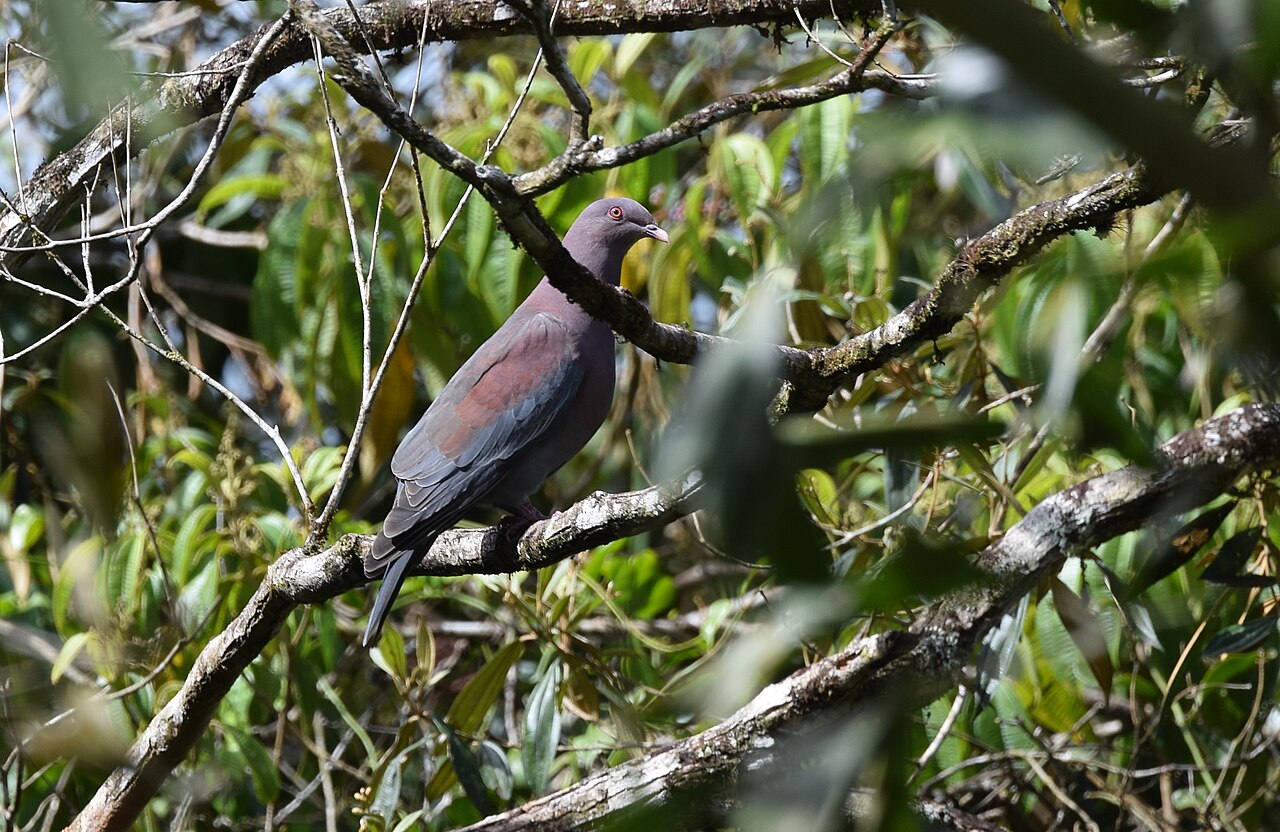
Red-billed Pigeon is a large dark pigeon with a maroon head and breast and a red bill with a pale tip. Within the area of this guide it lives only along the last hundred kilometres of the Rio Grande, where it is scarce and declining. It sits high and motionless in the crowns of riverside woodland and almost always gives itself away by voice first.
Voice
The song opens with a long, high, sustained coooo and passes into a three-syllable cup-a-coo repeated three times. The sound carries far across the river valley and comes almost always from the top of a tall tree, from March into the summer. On take-off the wings clap audibly. Outside the breeding season it is largely silent, and then it is rarely detected in the riverside woods.
Recording: Alain Malengreau — CC BY-NC-SA 4.0 · Provincia de Cartago, Costa Rica · xeno-canto
Identification
A large dark pigeon with no pale mark at all in wing or tail. Head, neck, breast and the forward wing coverts are deep maroon to purplish brown, the rest of the plumage is slate grey and the tail is uniformly grey. The bill is red with a pale yellowish tip, the eye pale with an orange ring around it. The female is duller than the male; juveniles are greyish brown and lack the maroon entirely. In flight it looks uniformly dark and travels fast and straight.
Confusion species
Rock Pigeon is about the same size but almost always shows a pale rump, black bars across the wing and a pale underwing, and has a grey bill. Band-tailed Pigeon of the mountains has a yellow bill with a black tip, a narrow white crescent on the nape and a broad pale band across the tail tip. White-crowned Pigeon, which meets it only along the Caribbean coast, is just as dark but wears a white crown. At long range the uniform, unbanded tail remains the most useful mark.
Habitat
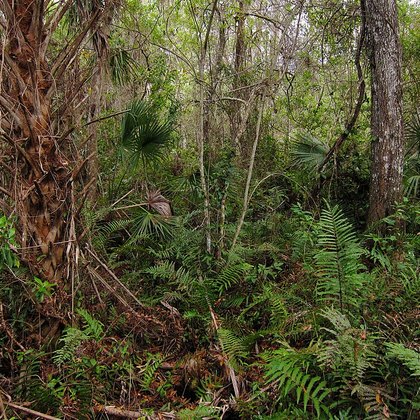
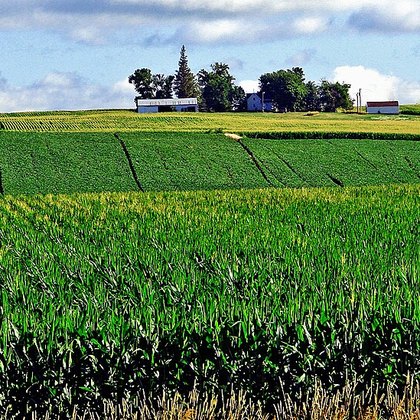
In Texas it belongs to tall, old riverside woodland along the Rio Grande, with ebony, hackberry, huisache and mesquite (a thorny pod-bearing shrub of the Southwest that forms dense thickets), often on the islands in the river itself. Further south it uses tropical deciduous forest, gallery forest along rivers and half-open woodland with tall trees. It avoids humid rainforest, and open desert and treeless farmland as well. It feeds high in the canopy, picking fruit, berries, acorns and buds; outside the breeding season it also visits sorghum and maize fields.
Where the bird is most often found, arranged by the USNVC — the vegetation classification of the United States and Canada — and CMECS for sea and coast.


Range and movements
The range runs from the far south of Texas down both mountain slopes of Mexico and on through Central America to Costa Rica, which falls outside the guide area. In Mexico and Central America it is resident; in Texas it is chiefly a summer bird, from March to September, and rare in winter. The Texas birds are confined to the riverside woods of Starr and Zapata counties — Salineño, Chapeño and San Ygnacio are the best-known places. Their numbers have fallen as the original riverside forest was cleared for farming and bank works.
- Resident
- Breeding (summer)
- Winter
- Passage
- dark = core range, pale = thinly spread
Where and when to look
Stand on the bank of the Rio Grande at sunrise in April or May and listen first: the long, high coo gives the bird away before it is seen. Then scan the bare tops of the tallest trees on the far side; it perches motionless for long spells and only the red bill catches the light. By about nine o'clock it falls silent and the chance is gone.
Conservation
The world population is estimated at around two million birds and the species is listed as Least Concern (LC). In Texas the picture is different: there it is a small number of pairs that shifts with the riverside woodland and has been declining for decades. In Mexico and Central America hunting presses on numbers, and everywhere the felling of old woodland with tall trees is the main cause of decline.
Scientific name
Patagioenas flavirostris | (Wagler, 1831)
Wagler described the species in 1831 as Columba flavirostris; the American pigeons now stand in the genus Patagioenas, and so author and year go in parentheses. The species name flavirostris means 'yellow-billed' — not for the red bill itself, but for its pale yellow tip. Wagler gave only 'Mexico' as the origin; van Rossem restricted the type locality to the state of Veracruz in 1930.