All species › Pigeons and doves › Doves and pigeons › White-crowned Pigeon
White-crowned Pigeon | Patagioenas leucocephala
Witkapduif | Paloma Coroniblanca
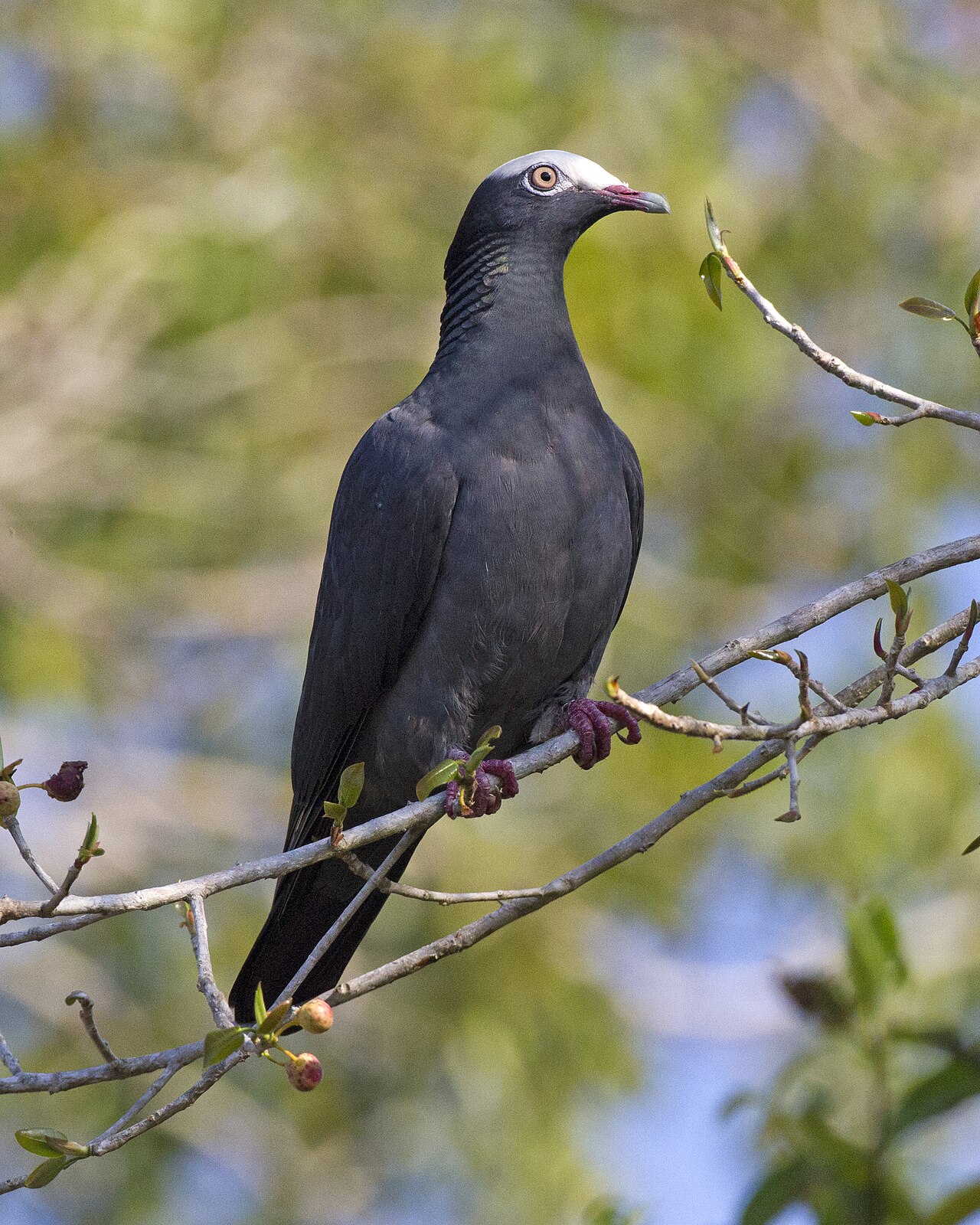
White-crowned Pigeon is a large slate-grey to almost black pigeon with a gleaming white crown, and the only pigeon in North America that nests on mangrove islets and flies across open water to its food every day. In the United States it lives only in the far south of Florida and in the Keys, where the state lists it as threatened. It eats almost nothing but fruit and so depends entirely on the tropical hardwood forest of the islands.
Voice
The call is a deep, owl-like cooing of three syllables, coo-cura-COO, which carries far across water. The male repeats the phrase slowly, with long silences between, usually from the crown of a mangrove or of a tall tree in the forest. It is heard mostly in the early morning between May and September, when the colonies are occupied. Outside the breeding season the species is silent.
Recording: GABRIEL LEITE — CC BY-NC-SA 4.0 · Mayagüez, Isla de Mona e Islote Monito, Mayagüez, Puerto Rico · xeno-canto
Identification
A heavy pigeon, wholly slate-grey to almost black, with a sharply defined white crown that is bright white in the male and greyish white in the female. The nape carries a patch of green iridescent feathers with white edges that at close range looks like fine scaling. The eye is white to pale yellow with a red ring around it; the bill is red with a pale tip and the legs are red. Juveniles are browner and duller, with a greyish brown crown and a dark eye. In flight it is uniformly dark, with broad wings and a fairly long tail, crossing low over the water with strong, steady beats.
Confusion species
Rock Pigeon is the same size but never uniformly dark: it almost always shows a pale rump, black bars across the wing and a pale underwing, and its bill is grey. In the Antilles White-crowned Pigeon can be confused with Patagioenas squamosa, an equally dark pigeon that lacks the white crown and carries a broad red ring around the eye. Young White-crowned Pigeons with barely any pale on the crown look at a distance like a dark city pigeon; then watch for the red bill with its pale tip and for the uniformly dark underwing.
Habitat
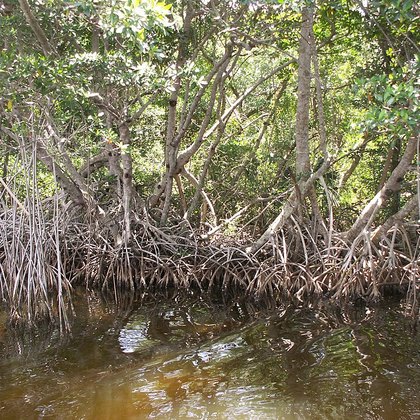
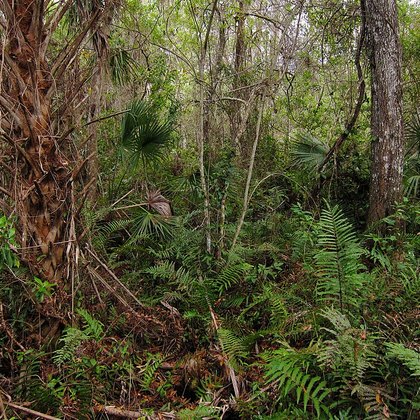
It nests and roosts on uninhabited mangrove islets in Florida Bay, Biscayne Bay and among the Keys, in dense red and black mangrove that the water protects from rats and raccoons. It feeds elsewhere: in the tropical hardwood forest of higher ground, where it takes figs, pigeon plum (a south Florida hardwood of the hammocks), cocoplum and the fruit of poisonwood (Metopium toxiferum, likewise a south Florida hardwood of the hammocks). Between roost and feeding wood it makes daily journeys that can run to tens of kilometres. It does not use conifer forest, open pasture or the interior of the peninsula.
Where the bird is most often found, arranged by the USNVC — the vegetation classification of the United States and Canada — and CMECS for sea and coast.
Range and movements
Its core range is the Caribbean islands: the Bahamas, Cuba, Jamaica, Hispaniola, the Cayman Islands, Puerto Rico and further east, together with the Caribbean coast of Central America and the islands off Yucatán. Within the guide area it breeds only in southern Florida, from Florida Bay and Biscayne Bay out to the last of the Keys, with a breeding season from May to September. Part of that population crosses to Cuba and the Bahamas in autumn; a smaller part stays through the winter. During the twentieth century it disappeared from much of southern Florida as the tropical hardwood forest was cleared for building.
- Resident
- Breeding (summer)
- Winter
- Passage
- dark = core range, pale = thinly spread
Where and when to look
At first light in the Keys, take a point with a view over open water and follow the flight lines: the birds leave their mangrove islets in small parties and cross low and fast towards the forest. When one turns, the white crown lights up against the dark body — the one moment when that mark really works at a distance. The chance is greatest between May and September.
Conservation
The Red List lists it as Near Threatened (NT), with a world population estimated at over half a million breeding birds and a falling trend. Florida lists it as threatened; the causes are the loss of tropical hardwood forest, disturbance of the nesting islets, and collisions with buildings and masts. On the Caribbean islands hunting weighs heavily on numbers, and a hurricane can wipe out both the nesting islets and the fruiting trees in a single season.
Scientific name
Patagioenas leucocephala | (Linnaeus, 1758)
Linnaeus described the species in 1758 as Columba leucocephala; because the American pigeons were later placed in the genus Patagioenas, introduced by Reichenbach in 1853, author and year stand in parentheses. The species name leucocephala is Greek for 'white-headed'. The type locality is the Bahamas: Linnaeus relied on the plate and description of Mark Catesby, who had seen the bird there.