All species › Passerines › Thrushes and allies › Puaiohi
Puaiohi | Myadestes palmeri
Kleine Kauailijster | Solitario puaiohi
The Puaiohi is a solitaire confined to the high rainforest of Kauaʻi, along the steep stream ravines of the Alakai plateau. With an estimated 400 to 600 birds it is one of the rarest songbirds in the United States; it nests on ledges in the wet rock walls above the streams.
Voice
The song opens with a short introductory whistle, runs into a drawn-out trill and ends in a few sharp descending notes; the quality is thin and squeaky and carries over the noise of the stream. Males sing all year, with a peak in April and May. The call note is a dry, rasping hiss. Because the birds sit almost always in dense, wet understorey, the song is usually the only lead.
Recording: Melissa Hafting — CC BY-NC-SA 4.0 · Kauai County, Hawaii, United States · xeno-canto
Identification
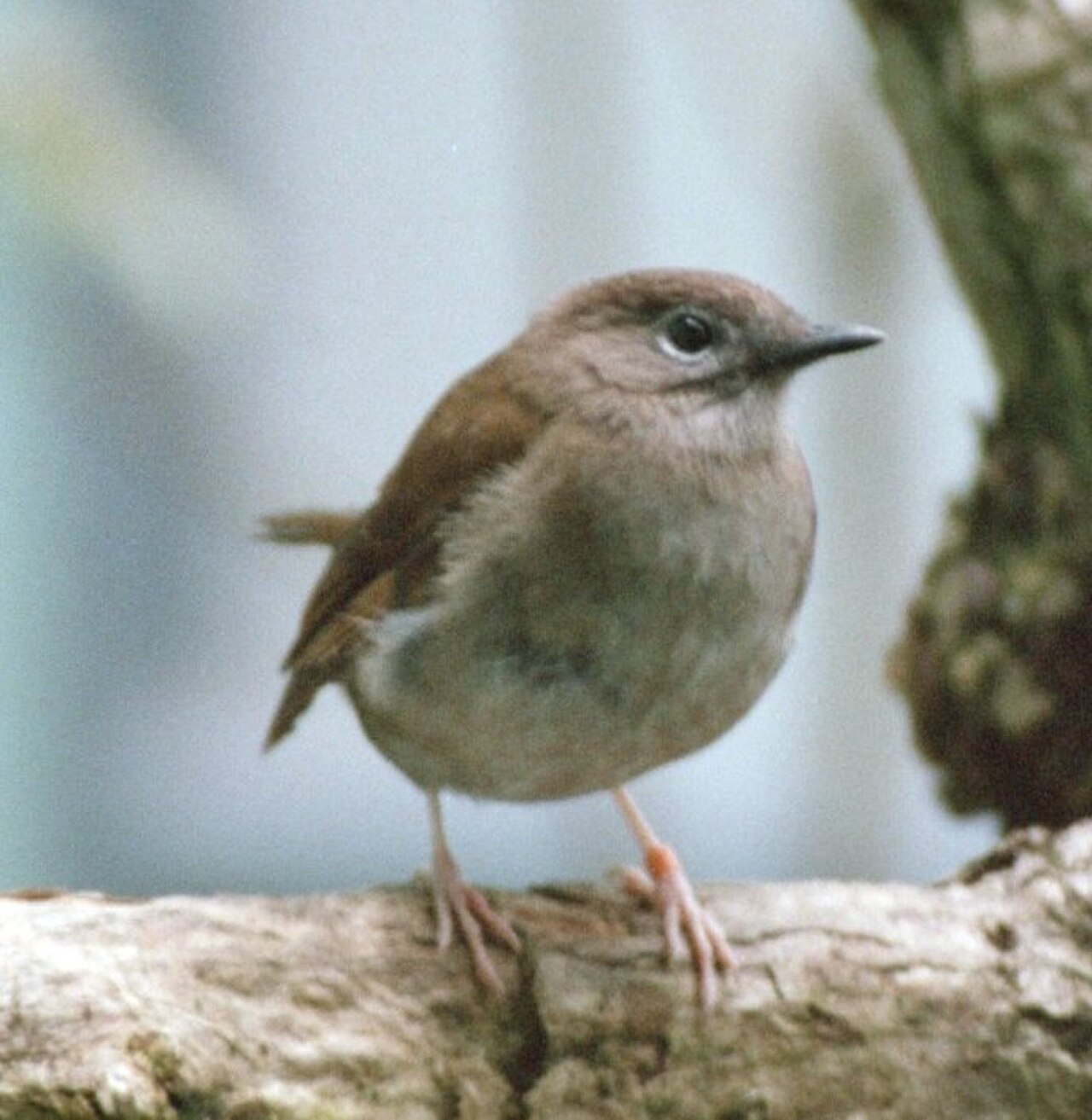
A slim, long-legged thrush, slaty brown above and light grey on breast and belly, with a prominent white eye-ring, a black bill and pale pink legs. Weight is around 40 grams. It perches upright on a low branch or rock ledge and moves in short, abrupt hops; like the other solitaires it quivers its wings. Juveniles show spotting and scaling on the breast and wing coverts.
Confusion species
On Kauaʻi no other species of this size and shape remains: the Kamao, the larger solitaire of the same island, has not been recorded since the 1980s and is regarded as extinct. The ʻOmaʻo of Hawaii Island has shorter legs and tail, is more olive-brown above and has dark legs and a much fainter eye-ring, but the two never occur together. From the introduced Warbling White-eye, common on Kauaʻi, it differs in size, in the pink legs and in the straight black bill.
Habitat
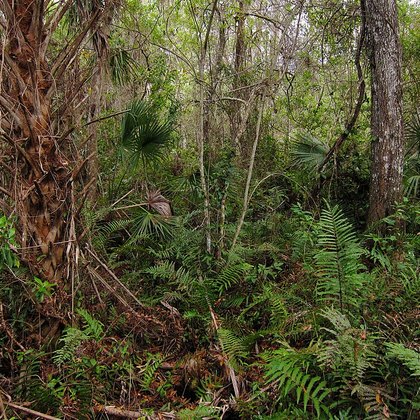
Wet montane ohia forest with a dense understorey of ferns, olapa and kanawao, in steep ravines above about 1050 metres. The nest site is the limiting factor: it builds on narrow mossy ledges and in niches of near-vertical stream walls, where rats reach it less easily. Fruit of native shrubs and invertebrates taken on the ground make up the diet. Parts of the forest heavily rooted by pigs or overgrown with ginger and other invasive plants are avoided.
Where the bird is most often found, arranged by the USNVC — the vegetation classification of the United States and Canada — and CMECS for sea and coast.

Range and movements
The entire range lies in the central and southern Alakai plateau of Kauaʻi, an area of a few tens of square kilometres; it occurs nowhere else. It formerly reached lower down the valleys, into forest that has since been largely converted or made uninhabitable by mosquitoes. The population has been put at roughly the same level since 1973, but after hurricanes Iwa and Iniki and in dry years numbers fell sharply in places.
- Resident
- dark = core range, pale = thinly spread
Where and when to look
Seeing one means a walk on the muddy trails of the Alakai Wilderness Preserve, best in April or May at first light, when the males are singing. Sit down by a stream ravine and listen for the introductory whistle followed by the trill; then search the rock face rather than the canopy, because the bird stays low. The terrain is wet and slippery and the numbers are small, so even in good conditions a sighting may not come.
Conservation
The species is listed as Critically Endangered (CR) by the IUCN and has been federally protected since 11 March 1967; recent estimates range from 414 to 580 birds. The threats are avian malaria and avian pox carried by the introduced mosquito, which rising temperatures now bring onto the Alakai plateau, predation by rats, damage to the understorey by feral pigs and goats, displacement of native plants by invasive species, and drought and hurricanes that can remove a large share of the nests in a single season. Between 1999 and 2017 more than two hundred captive-reared birds were released; the breeding programme begun in 1995 was later ended after inbreeding depression was found. Management now centres on rat control around the nesting walls, fencing against ungulates and mosquito control.
Scientific name
Myadestes palmeri | (Rothschild, 1893)
Rothschild described the species in 1893 as Phaeornis palmeri, from a specimen from Halemanu on Kauaʻi; because it was later placed in Myadestes, author and year stand in parentheses. The species name honours Henry C. Palmer, the collector Rothschild had sent to Hawaii. The genus name Myadestes means 'fly-eater', from Greek muia 'fly' and edestes 'eater'. Puaiohi is the Hawaiian name; the Dutch name separates the species from the larger Kamao, which also lived on Kauaʻi.