All species › Passerines › New World warblers › Prairie Warbler
Prairie Warbler | Setophaga discolor
Prairiezanger | Reinita galana
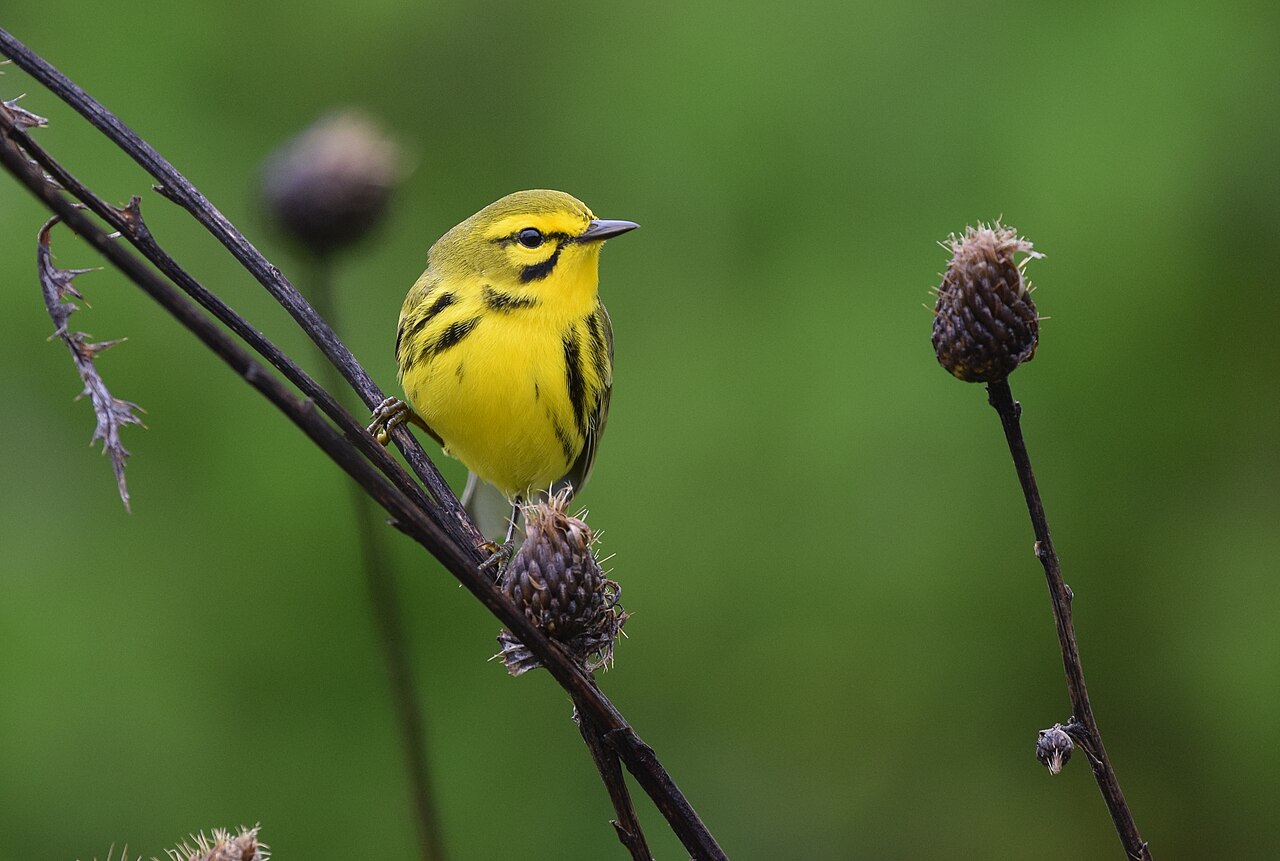
The Prairie Warbler does not live on prairie but in young scrub: abandoned fields growing in, clear-cuts, pine scrub and the sandy shrublands of the Southeast. It is recognised by the yellow face with two black stripes and by the habit of bobbing its tail almost continuously.
Voice
The song is a series of eight to fourteen sharp buzzy zee notes rising steadily in pitch without a break, like a ladder. A second song type uses clear rather than buzzy notes, lower and slower, and is heard mainly in disputes at territory boundaries. The call is a dry tsip; in the half-light around sunrise, loud check notes follow one another rapidly.
Recording: Mario Reyes Jr — CC BY-NC-SA 4.0 · Raven Run, Fayette County, Kentucky, United States · xeno-canto
Identification
The underparts are yellow with a row of black streaks along the flank. A black line runs through the eye and a second black line runs down from the base of the bill along the side of the throat; together these two stripes make the face recognisable. The back is olive-green, in the male with chestnut streaks visible only at close range. The wing bars are weak and yellowish. The tail is long, with white spots on the outer feathers, and moves up and down almost without pause. Females and young birds are duller, with fainter face markings.
Confusion species
Magnolia Warbler is also yellow with black streaks, but shows a white band across the tail and no black stripe from the bill. Yellow-throated Warbler has a grey back and a white neck patch and works along branches rather than in low scrub. Palm Warbler is browner above with a chestnut crown and a yellow-green rump. The tail-bobbing together with the use of low shrubs is usually enough; in autumn the plumage resembles that of other young Setophaga closely, and then the two black face stripes remain the anchor.
Habitat
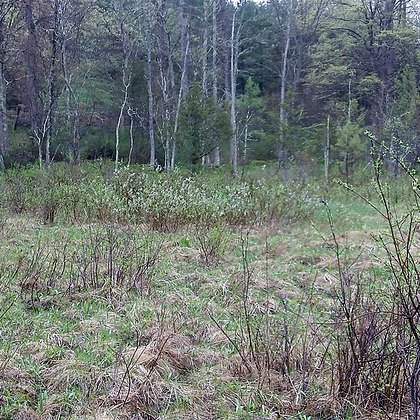
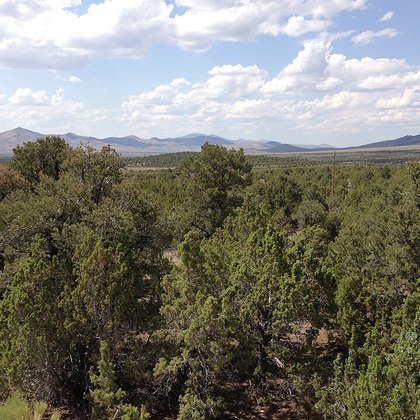
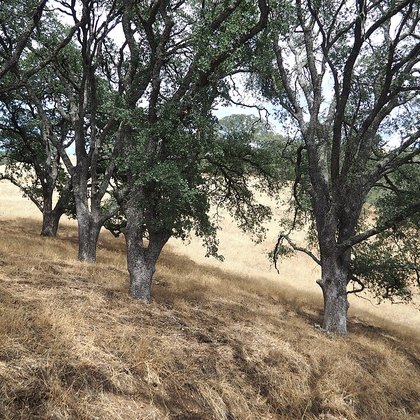
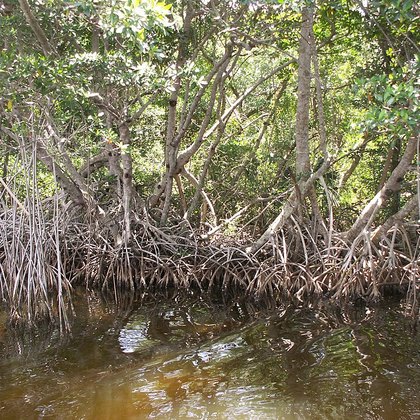
Scrub at an early stage: fields growing in, young clear-cuts, pine regrowth, sandy oak scrub and neglected orchards and Christmas tree plantations. What matters is vegetation two to five metres high; once the canopy closes, the bird goes. Along the Florida coast a separate subspecies uses mangrove, where it stays all year. In winter, in the Caribbean, it occupies dry scrub woodland, mangrove edge and gardens.
Where the bird is most often found, arranged by the USNVC — the vegetation classification of the United States and Canada — and CMECS for sea and coast.

Range and movements
It breeds in the eastern United States with its centre in the Southeast, west to Kansas and East Texas, north to Michigan, southern Ontario and New England. Migration in August and September takes it to southern Florida, the Bahamas and the Greater Antilles; a smaller share reaches the Caribbean coast of Yucatán, Belize and Honduras. The Florida mangrove subspecies stays year-round in that narrow coastal strip.
- Resident
- Breeding (summer)
- Winter
- Passage
- dark = core range, pale = thinly spread
Where and when to look
Look for it in May or June in an overgrown field or a young clear-cut and listen for the rising buzzy ladder; the bird often sings from a projecting twig at eye level. Once you see it, watch the tail: the bobbing continues while it forages and gives the bird away even when the face is in shadow.
Conservation
The species is globally assessed as Least Concern (LC), but numbers have fallen by fifty to seventy per cent across Appalachia and the Southeast since a peak in the 1940s and 1950s. The cause is the loss of young scrub: nineteenth-century farmland abandoned and left to itself is now closed forest, and elsewhere it has been built on. Management that keeps scrub open — periodic cutting, burning or mowing — holds local populations up. On the breeding grounds it is also a frequent host of the Brown-headed Cowbird.
Scientific name
Setophaga discolor | (Vieillot, 1809)
Vieillot described the species in 1809 as Sylvia discolor; because it was later moved to Setophaga, author and year stand in parentheses. The genus Setophaga was introduced in 1827 by William Swainson, from Greek sēs 'moth' and -phagos 'eating'. The species name discolor is Latin for 'of different colours' and refers to the contrast between the yellow underparts and the black markings. The English name Prairie Warbler dates from a time when the open shrublands of Kentucky were called barrens or prairies; the species has nothing to do with true prairie. The specimen described came from the Antilles.