All species › Waterfowl › Ducks, swans and geese › Taiga Bean-Goose
Taiga Bean-Goose | Anser fabalis
Taigarietgans | Ánsar campestre de la taiga
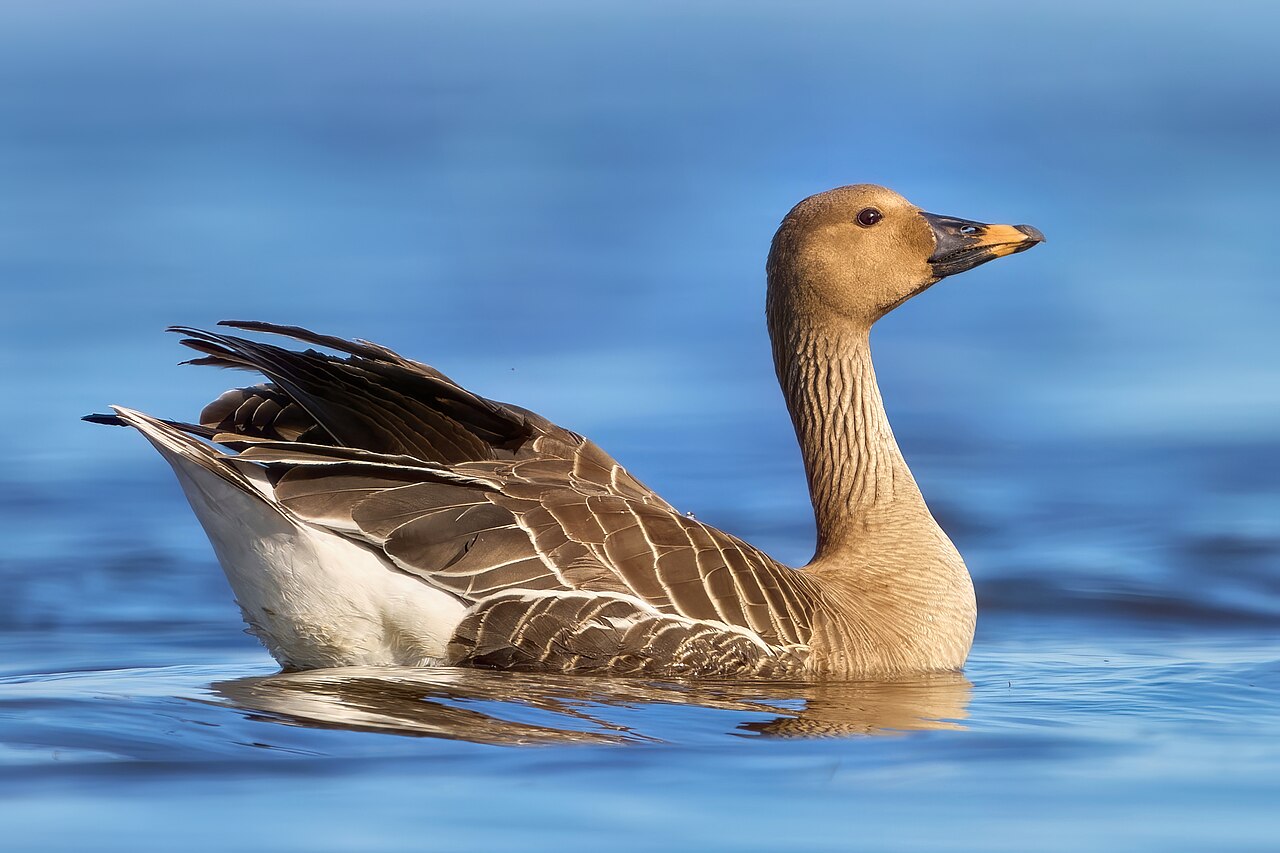
The Taiga Bean-Goose breeds in wet bogs and by lakes in the coniferous forest belt from northern Europe to eastern Siberia and normally winters in western and eastern Europe and East Asia. In North America it is, like the closely related Tundra Bean-Goose, a scarce vagrant seen mainly in spring on the islands of the Bering Sea. Its long neck and long, gradually tapering bill with extensive orange give it a slimmer look than its tundra-breeding relative.
Voice
The call is a deep, drawn-out honk that rises slightly in pitch toward the end: a repeated, resonant oenk-oenk. When disturbed or taking flight it gives a shorter, harder series of two or three notes. The call carries far over open country and is usually the first sign of a flock passing overhead, even at night. Among foraging birds a softer, murmuring sound can be heard.
Recording: Stanislas Wroza — CC BY-NC-SA 4.0 · Ivalo, Finland · xeno-canto
Identification
A large, long-necked grey goose with a dark brown head and upper neck that shades into a lighter brown breast and flanks with faint pale feather fringes. The bill is long, with a straight to slightly concave lower mandible, and carries an extensive, variably shaped orange band between black at the base and tip. The legs are orange. The sexes are alike, the male noticeably larger and heavier. In flight the species looks slim, with a relatively long neck and steady, deep wingbeats.
Confusion species
Tundra Bean-Goose (Anser serrirostris) is the most similar species: it has a shorter, deeper bill with a narrow, sharply defined orange band rather than an extensive and more diffusely bordered orange patch, and a shorter neck. Greylag Goose (Anser anser) is paler and greyer, with an entirely orange to pink bill and no black. Greater White-fronted Goose (Anser albifrons) altogether lacks the black-and-orange bill pattern and shows a white blaze in adults. Birds of the eastern subspecies middendorffii, the form most often reaching Alaska, are even larger and darker than European birds and are sometimes mistaken for Greylag Goose as a result.
Habitat
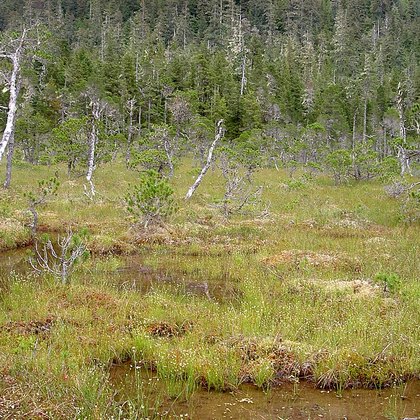
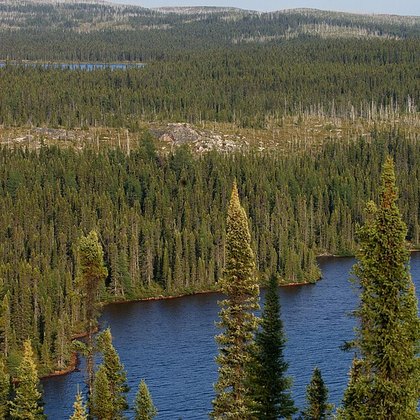
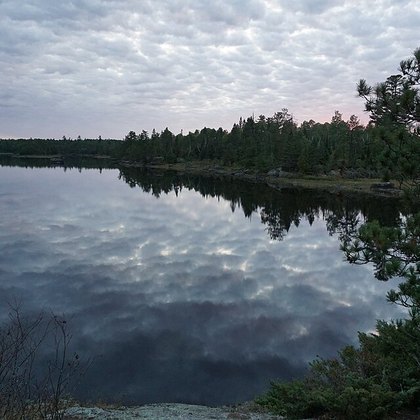
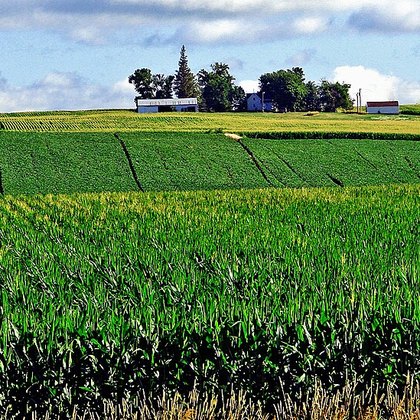
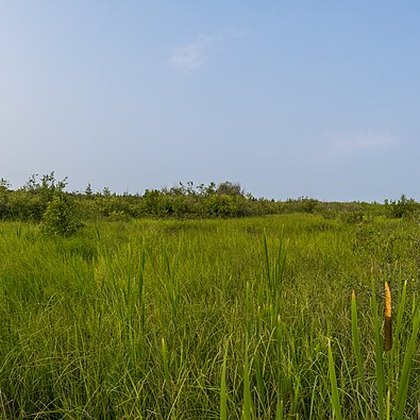
Breeds in and around the bogs, mires and lakes of the taiga, from open peatland to the edge of coniferous forest, nesting among low vegetation near water. Outside the breeding season it seeks farmland, wet grassland and marshes, often alongside other grey geese, and roosts on lakes or sheltered river mouths. It does not use dense, unbroken conifer forest, and it does not breed on open tundra — that is the domain of its shorter-billed relative. Vagrants in Alaska are seen mainly on coastal grassland and shallow pools.
Where the bird is most often found, arranged by the USNVC — the vegetation classification of the United States and Canada — and CMECS for sea and coast.
Range and movements
Breeds from Scandinavia, across northern Russia, deep into eastern Siberia, split among three subspecies that replace one another from west to east and grow progressively larger. Western birds winter mainly in Denmark, Germany, the Netherlands, Britain and France; the eastern subspecies middendorffii winters in eastern China, Korea and Japan. That explains why almost all North American records — a handful most years on the Aleutians and Bering Sea islands since the 1990s — involve this eastern form: birds that overshoot too far east during spring migration from East Asia toward Siberia. Elsewhere on the continent, as far as Washington State, it remains an occasional record.
Where and when to look
Look for it, like the Tundra Bean-Goose, among flocks of Snow Geese and Greater White-fronted Geese on the coastal grassland of the western Aleutians and the Bering Sea islands, in May. Watch for the long neck and bill and the extensive, diffusely bordered orange on the bill — on an isolated bird that is often clearer than the more subtle differences in length. A second or third bird in the same flock is, unlike with Tundra Bean-Goose, not an unusual sight for this species.
Conservation
The international Red List assesses the species, at the level of Anser fabalis in the broad sense, as Least Concern (LC). The European breeding population is estimated at several tens of thousands of pairs and has been largely stable in recent decades, though hunting remains open in part of the wintering range. In North America, where the species has no established population, conservation has no practical bearing.
Scientific name
Anser fabalis | (Latham, 1787)
John Latham described the species in 1787 as Anas Fabalis, among the ducks; because it was later placed in another genus, author and year stand in parentheses. The genus Anser was introduced by Brisson in 1760 and is the Latin word for 'goose'. fabalis is Latin for 'of the bean', after the species' habit of foraging on harvested bean and pea fields — the origin of the English name 'Bean Goose'. The type locality lies in Great Britain, where Latham knew only wintering birds; the breeding range in the Siberian taiga was established much later.