All species › Passerines › Cardinals and allies › Painted Bunting
Painted Bunting | Passerina ciris
Purpergors | Azulillo sietecolores
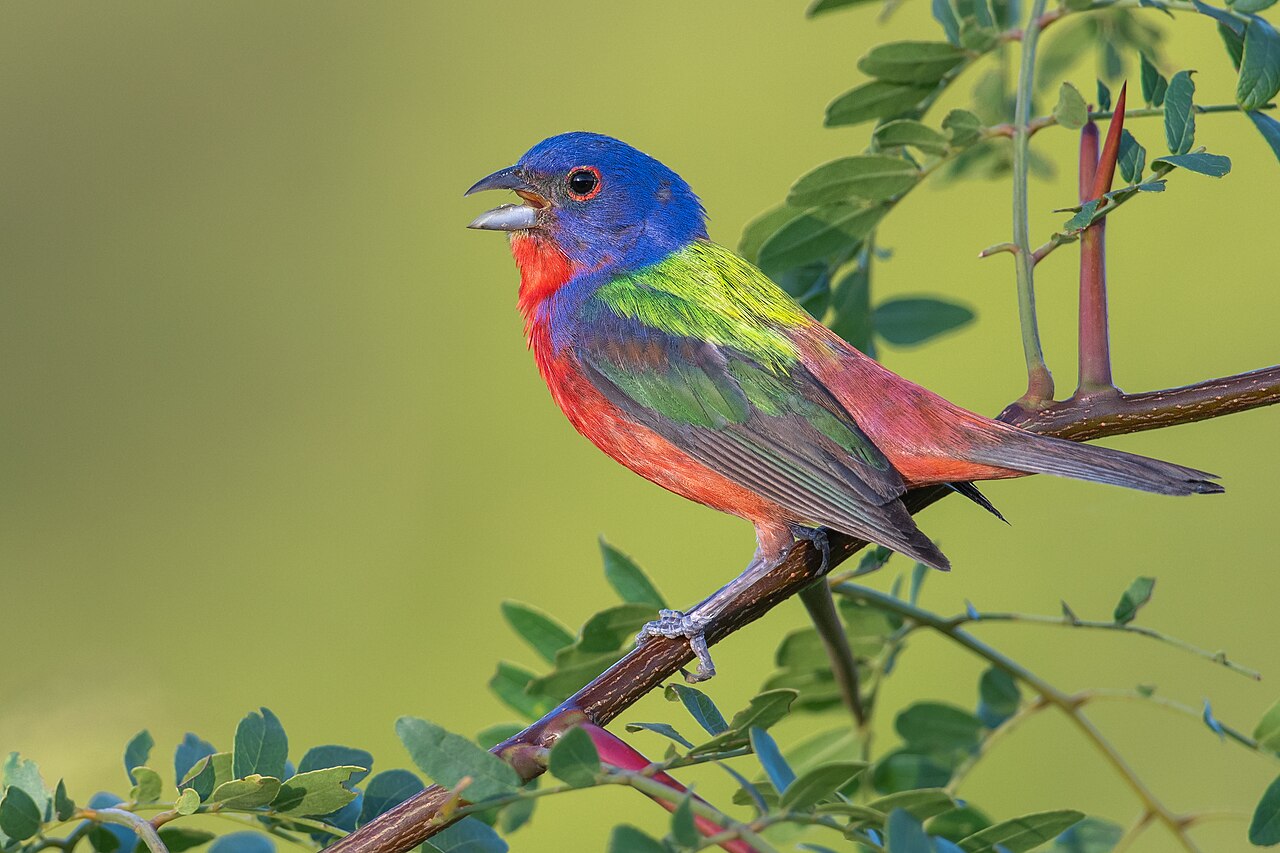
The Painted Bunting is a small seed-eater whose male has a blue head, a green back and a red rump and underparts; females and young birds are plain green to yellow-green. The species breeds in two separate areas — the southeastern coastal strip and the southern Great Plains — and is still trapped for the cage-bird trade on its wintering grounds.
Voice
The song is a short, rapid, slightly jangling series of clear syllables, about two seconds long, which sounds like a run of loose little phrases. The male sings from an open branch, a wire or the top of a bush, mainly in the early morning from April to July. The call is a sharp, metallic chip, usually the only handle on the bird in dense scrub.
Recording: Sue Riffe — CC BY-NC-SA 4.0 · Peveto Woods Sanctuary, Cameron Par., LA, United States · xeno-canto
Identification
The male in full plumage has a blue-violet head and neck, a yellow-green mantle, a red rump and red underparts from the throat down, and a narrow red eye-ring. That plumage is reached only in the second calendar year; first-year males are still green like the females. The female is green above and yellow-green below, with a pale eye-ring; it is the only green songbird of this size in the breeding range. The bill is short and conical. The birds stay low and largely in cover.
Confusion species
Green females and young birds can be taken for the yellow females of other small seed-eaters, but those are duller and usually streaked or greyer; a Painted Bunting is a brighter, plain green with a distinct pale eye-ring. The male in full plumage cannot be confused with any other North American songbird, given the combination of blue head, green back and red underparts. First-year males with the first blue feathers on the head are, however, easily taken for females.
Habitat
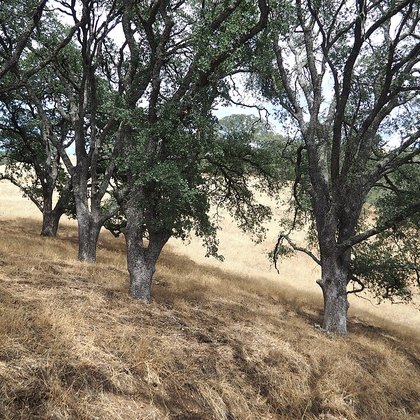
Scrub and second growth with a dense lower layer. The coastal population uses scrub behind the dunes, palmetto thickets, edges of maritime hammock, hedges, yards, fallow fields and old citrus groves; the inland population uses abandoned farms, strips of woodland between overgrown fields, brushy roadsides and streamsides. In winter it keeps to the edge of tropical forest and to densely vegetated savanna, and appears at feeders and in weedy fields.
Where the bird is most often found, arranged by the USNVC — the vegetation classification of the United States and Canada — and CMECS for sea and coast.




Range and movements
Two separate breeding ranges. The eastern one lies along the coast of North Carolina, South Carolina, Georgia and northeastern Florida; the south-central one covers Texas, Oklahoma, Kansas, Arkansas, Louisiana, southern Missouri, western Mississippi, New Mexico and southeastern Arizona, and continues into northern Mexico. Wintering takes place in southern Florida, on Cuba and the Bahamas, along both coasts of Mexico and through much of Central America. Western birds begin the autumn migration before moulting and replace their feathers in northern Mexico; eastern birds moult on the breeding grounds.
- Resident
- Breeding (summer)
- Winter
- Passage
- dark = core range, pale = thinly spread
Where and when to look
In May and June the song is the surest way in: find a scrubby edge along a sandy road in the southeastern coastal strip and wait for the male to come up on top of a bush. At feeders stocked with white millet in southern Texas and southern Florida it shows well in winter. Watch the cover for plain green birds as well — those are females and young, and they outnumber the coloured males.
Conservation
The species is listed as Least Concern (LC). Partners in Flight puts the breeding population at about 15 million birds and scores the species 10 out of 20 on the Continental Concern Score. The Breeding Bird Survey shows a decline of roughly 0.8 per cent per year between 1966 and 2019, about a third in total. Loss of scrub in swampy coastal thickets and of riverside growth in Arizona and northwestern Mexico is the main pressure. Capture for the cage-bird trade has been illegal since the Migratory Bird Treaty Act of 1918, but continues illegally in Mexico, Central America and the Caribbean, and to a lesser extent in Florida.
Scientific name
Passerina ciris | (Linnaeus, 1758)
Linnaeus described the species in 1758 as Emberiza ciris; because it later moved to Passerina, author and year stand in parentheses. The genus Passerina was introduced by Vieillot in 1816, from Latin passer 'sparrow'. The species name ciris is the Latin name of a bird from mythology, from Greek keiris, an unidentified bird. The specimen described came from Carolina, no farther than eighty kilometres from the sea, later restricted to South Carolina. The English name Painted Bunting and the Spanish azulillo sietecolores ('of the seven colours') both refer to the many-coloured plumage of the male.