All species › Passerines › Crows, jays and magpies › Mexican Jay
Mexican Jay | Aphelocoma wollweberi
Noord-Mexicaanse gaai | Chara pechigris
The Mexican Jay is the jay of pine-oak woodland in the mountains of northern Mexico and the border states. It lives year-round in flocks of five to twenty birds in which several individuals help at a single nest — cooperative breeding, studied here without a break since the 1960s.
Voice
The standard sound is an upslurred, slightly nasal wink or shreenk, which holds the flock together and is usually the first sign of their presence at a distance. There are also rattles, a rich chattering at close range and harsh alarm notes at a raptor. The rattle call differs between the three subspecies groups: that of the Mexican plateau birds is higher pitched than that of the western and eastern groups. There is no song in the ordinary sense.
Recording: David Tattersley — CC BY-NC-SA 4.0 · Willow Canyon, Pima County, Arizona, United States · xeno-canto
Identification
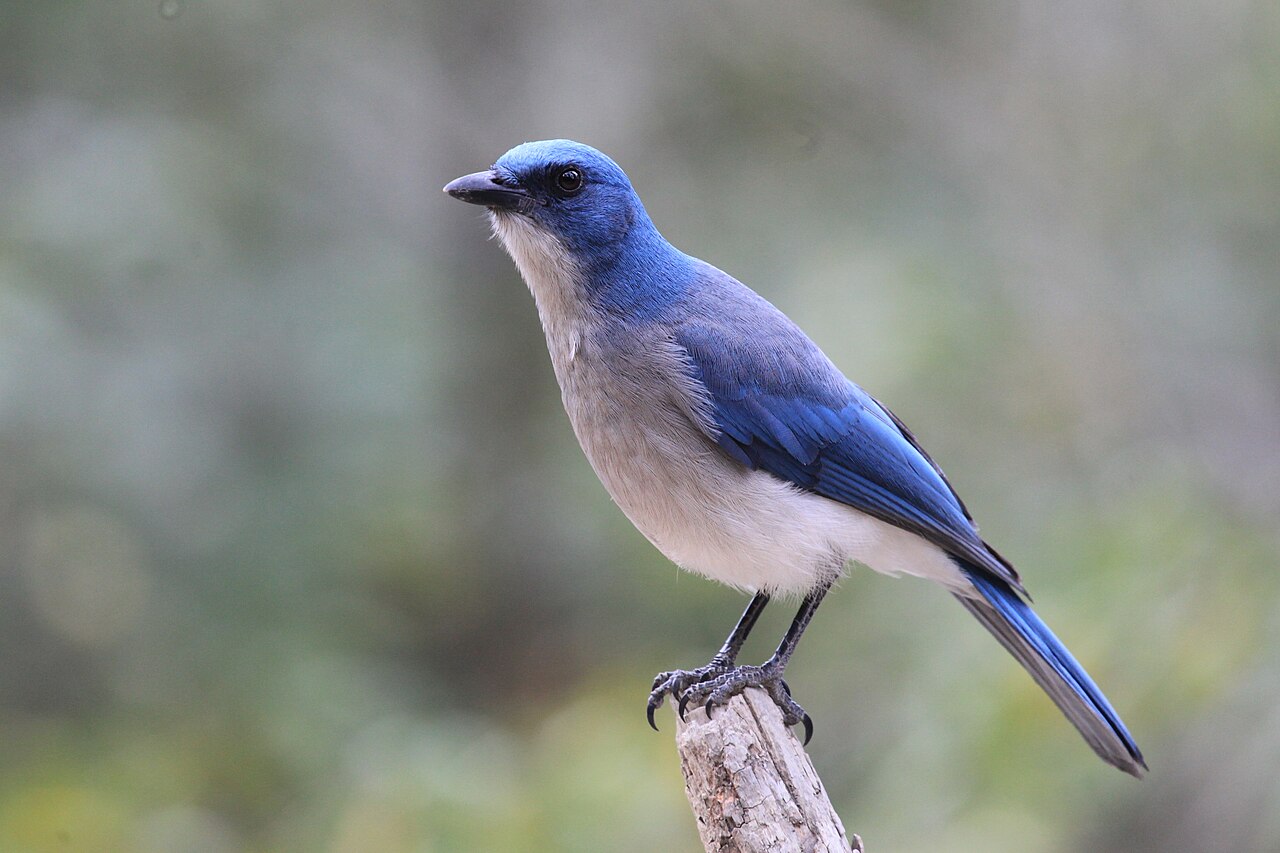
A large, crestless jay with a blue head, blue-grey mantle, blue wings and tail and pale grey underparts. Throat and breast are plain grey: there is no white throat patch, no necklace and no streaking. The eyebrow is missing too. The tail is proportionally shorter and the wing longer than in the scrub-jays, which makes the flight more direct. Young birds are duller and have a pink to pale bill, which turns black over the first to third year; within a flock they can be picked out by it.
Confusion species
Woodhouse's Scrub-Jay overlaps in Arizona, New Mexico and western Texas, but has a dingy white throat patch bounded by a faint blue necklace, a pale eyebrow and a longer tail, and occurs in pairs, not flocks. The plain grey throat and breast is the decisive character here. Pinyon Jay is smaller, entirely grey-blue without grey underparts, short-tailed and with a pointed, dagger-shaped bill, and flies in larger, dense flocks. Steller's Jay has a black crested head. South of this range the Transvolcanic Jay replaces this species; it was split off as a separate species in 2011.
Habitat
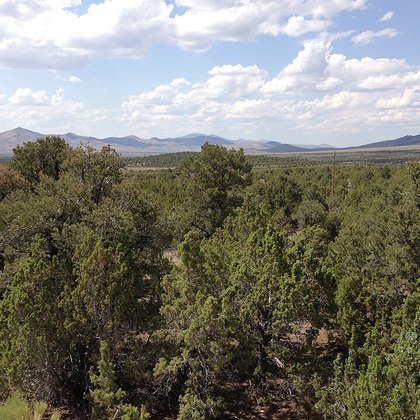
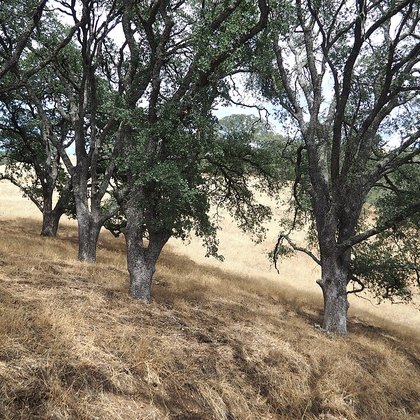
Open pine-oak and oak woodland in mountains and canyons, roughly between 1500 and 2500 metres, often where the oaks of the canyon floor give way to the pines of the slopes. The emphasis is on oaks: acorns and pine seeds are buried individually in the ground in autumn and recovered through winter and spring. In summer insect food is added, along with lizards, snakes, eggs and nestlings.
Where the bird is most often found, arranged by the USNVC — the vegetation classification of the United States and Canada — and CMECS for sea and coast.



Range and movements
Resident, with no migration to speak of. In the United States confined to southeastern Arizona, southwestern New Mexico and western Texas, where the Chisos Mountains in Big Bend form the eastern outpost. In Mexico along the Sierra Madre Occidental and the Sierra Madre Oriental and across the northern plateau, from Sonora and Chihuahua south to about Jalisco, Guanajuato and Querétaro. The three subspecies groups — western, eastern and plateau — differ in call and in shade.
- Resident
- Breeding (summer)
- Winter
- Passage
- dark = core range, pale = thinly spread
Where and when to look
In the canyons of the Huachuca, Chiricahua and Santa Rita Mountains of southeastern Arizona flocks are normally found within a morning, all year; at the campgrounds they come up to the picnic tables. If you hear a single wink, stand still: the rest of the flock usually follows through the crowns within a minute.
Conservation
The species is listed as Least Concern (LC), with a large range and a population regarded as stable, though local declines have been reported. The main factors are the loss of pine-oak woodland to logging and grazing in Mexico and, in the border mountains, very hot fires that destroy the oak stand rather than renewing it. The population in the Chiricahua Mountains is one of the longest-monitored bird populations in North America, which makes the trend there well measured.
Scientific name
Aphelocoma wollweberi | Kaup, 1855
Johann Jakob Kaup described the species in 1855 as Aphelocoma wollweberi, from material from Mexico; Pitelka restricted the type locality in 1951 to the Valparaíso Mountains in Zacatecas. Author and year stand without parentheses because the genus has not changed. The species name honours the collector Wollweber, who supplied the material. Aphelocoma comes from Greek apheles 'simple, smooth' and komē 'head of hair', after the plain, unbarred plumage. Until 2011 the Transvolcanic Jay (Aphelocoma ultramarina) was included in this species; at the split the name ultramarina stayed with the southern birds, so the northern ones became wollweberi.