All species › Passerines › Crows, jays and magpies › Brown Jay
Brown Jay | Cyanocorax morio
Bruine gaai | Chara papán
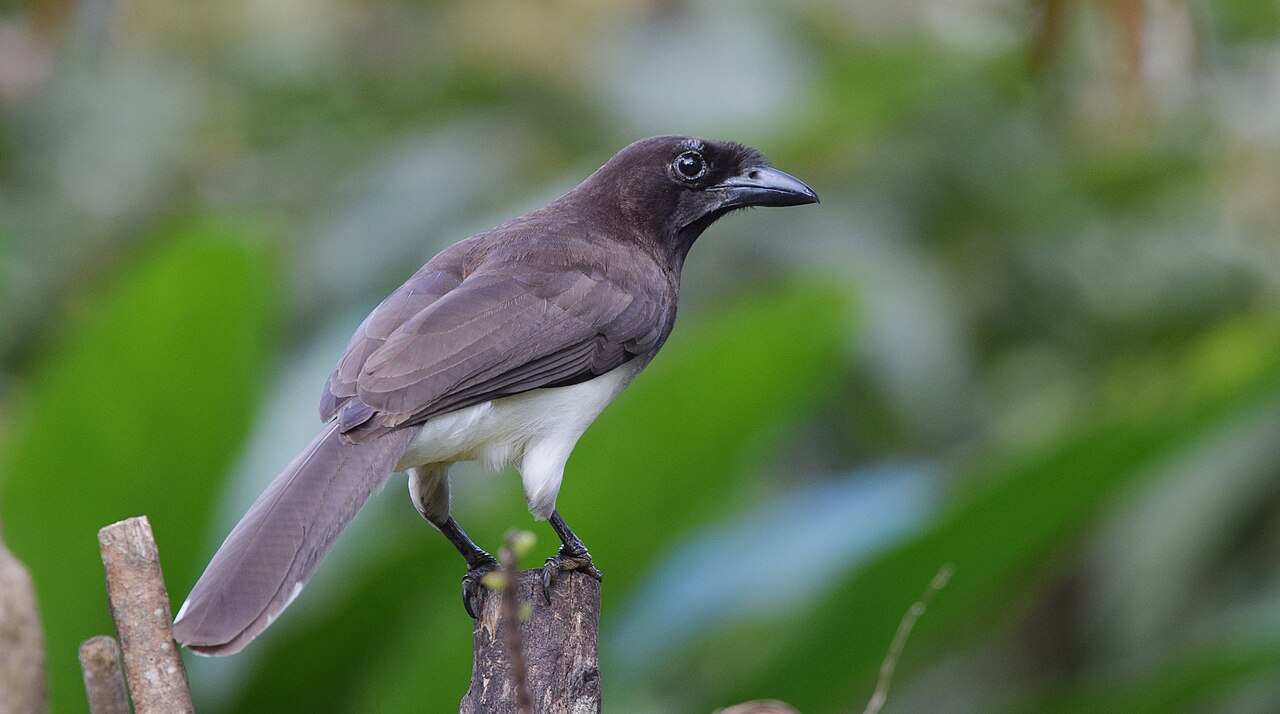
The Brown Jay is the largest jay in North America: over forty centimetres, entirely dark brown and with no blue in the plumage. It belongs to the Gulf slope of Mexico and Central America, and reached the United States only along a short stretch of the Rio Grande in Starr County, Texas, where it is now seen only sporadically.
Voice
The voice is loud and low: a far-carrying pee-ah, varied in pitch and length to suit the situation. Flocks call over one another when flushing and when disturbed, producing a ringing chorus audible across a whole valley. There is also a hard, short alarm at a raptor and, in some birds, a hollow popping sound produced with the throat pouch. There is no song in the ordinary sense.
No recording with a suitable Creative Commons licence has been found for this species yet; what to listen for is described below.
Identification
A large, long-tailed jay. Northern birds, including those of Texas and northeastern Mexico, are almost entirely dark brown with paler underparts; southern birds have a white belly and broad white tail tips. Adults have a black bill, black legs and a black eyering. Young birds have a yellow bill, yellow legs and a yellow eyering, which turn black over two to three years; a flock therefore holds yellow-billed and black-billed birds side by side. In flight the broad, rounded wings and long tail stand out, with a heavier, more undulating flight than other jays.
Confusion species
Within the northern part of the range there is no other all-brown jay, so confusion is mainly a matter of judging size. Green Jay, also in the Texas Rio Grande valley, is smaller and green with a yellow-and-black head. In flight and against the light a Brown Jay can suggest a crow, but the tail is longer and more wedge-shaped and the wingbeats slower. In young birds the yellow bill settles it: no other large bird of this area combines plain brown plumage with a yellow bill and yellow legs. Until recently the species stood in its own genus Psilorhinus.
Habitat
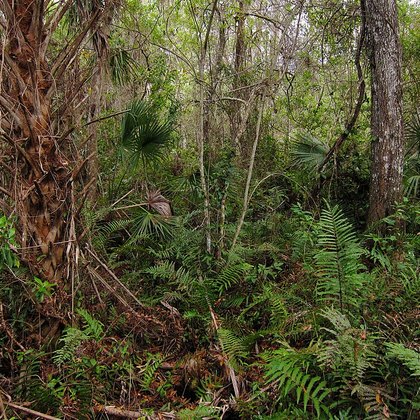
Open woodland, forest edge and second growth in the lowlands, and beyond that gallery forest along rivers, coffee and cacao plantings with shade trees, horticultural plots and village edges. In Texas it was the mesquite (a thorny pod-bearing shrub of the Southwest that forms dense thickets) and ebony woodland along the Rio Grande with tall trees. The species forages in the crowns and on the ground, taking insects, other invertebrates, lizards, nectar, fruit and eggs.
Where the bird is most often found, arranged by the USNVC — the vegetation classification of the United States and Canada — and CMECS for sea and coast.





Range and movements
Resident on the Gulf slope of Mexico, from Tamaulipas south through San Luis Potosí, Veracruz, Oaxaca, Tabasco and Chiapas, and on through Belize, Guatemala, Honduras and Nicaragua to western Panama; scarcer on the Pacific slopes. In the United States the first nest was found west of Roma in 1974; by 1975 some 40 to 50 birds were present along the Rio Grande between Falcon Dam and Fronton, breeding annually. After fieldwork for the Texas Breeding Bird Atlas from 1987 to 1992, fewer than a dozen remained. The remaining birds around Chapeño and Salineño cross back and forth over the river; records in Texas are now rare and draw many observers.
- Resident
- Winter
- Passage
- dark = core range, pale = thinly spread
Where and when to look
On the American side the chance is slim and confined to Salineño and Chapeño in Starr County, where the feeding station by the river gives the best view. Anyone wanting the species with certainty should look in northeastern Mexico or Belize, along forest edges and orchards. Listen for the pee-ah: flocks almost always announce themselves first and then cross an opening one bird at a time.
Conservation
Worldwide the species is listed as Least Concern (LC), with a large range and high numbers in Central America; it does well in second growth and in shade-tree plantings. The United States population is a different matter: it was always small and at the extreme northern edge of the range, and has all but vanished since the 1970s. The direct causes have not been established; the loss of riparian woodland along the Rio Grande, the altered water regime of the river and the small starting number are the factors named.
Scientific name
Cyanocorax morio | (Wagler, 1829)
Johann Georg Wagler described the species in 1829 as Pica morio, from material from Mexico that Stresemann in 1954 assigned to Alvarado in Veracruz; because it has since changed genus, author and year stand in parentheses. Cyanocorax comes from Greek kuanos 'dark blue' and korax 'raven'. The species name morio is Latin for 'jester', a word used in bird names for dark, blackish-brown species. The bird long stood in the separate genus Psilorhinus — from Greek psilos 'bare' and rhis 'nostril', after the unfeathered nostrils; genetic work showed that this left Cyanocorax paraphyletic, after which the two genera were merged.