All species › Falcons › Falcons and caracaras › Merlin
Merlin | Falco columbarius
Smelleken | Esmerejón
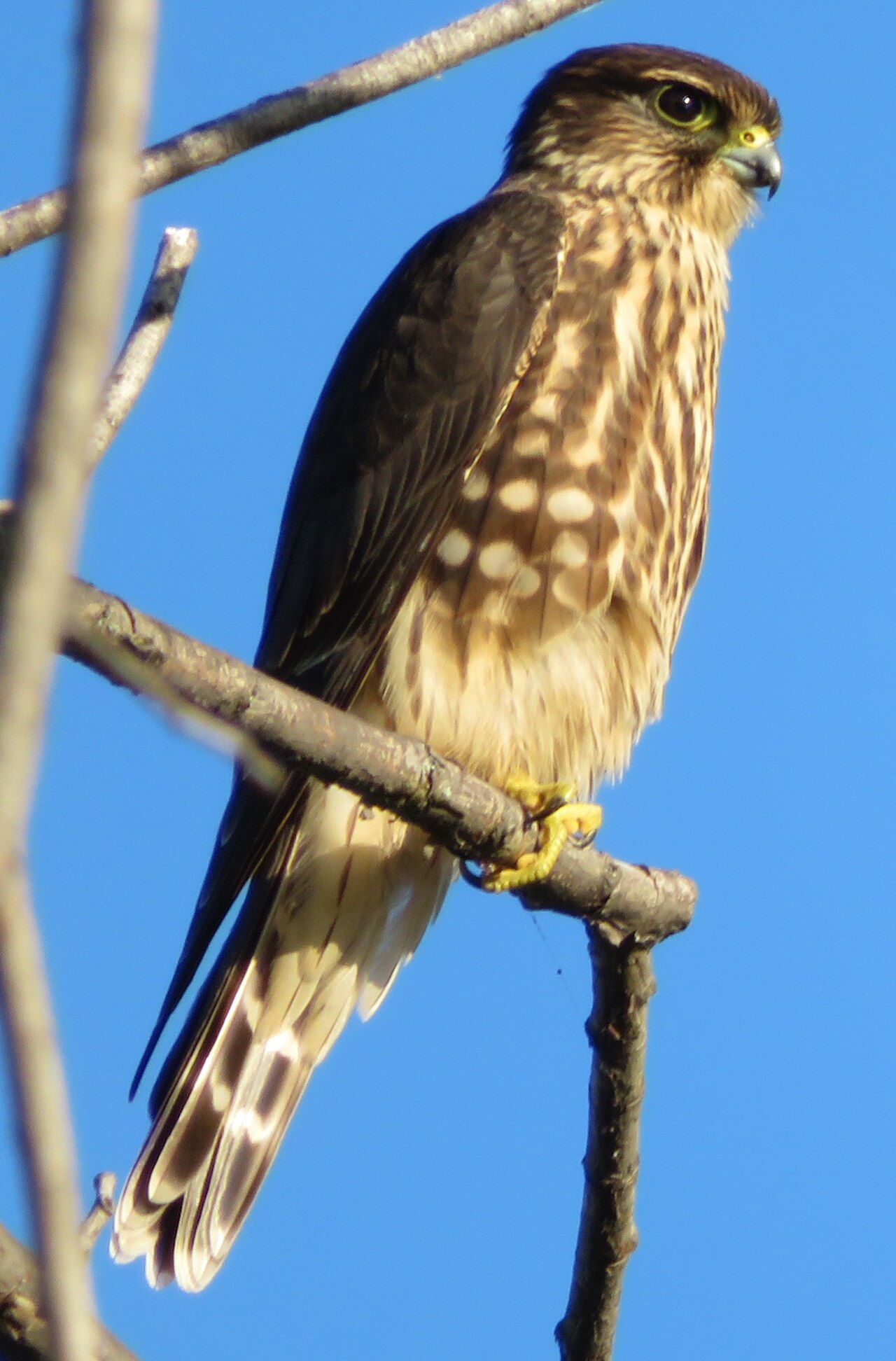
The Merlin is a compact, fast falcon of open boreal forest and the taiga edge, catching small songbirds in short, direct pursuits low over the ground. Three visibly distinct plumage types occur in North America, from nearly black birds on the Pacific coast to pale individuals from the northern prairies.
Voice
At the nest the Merlin gives a rapid, chattering series, sharper and higher-pitched than that of the Peregrine Falcon. Outside the breeding season the species is largely silent and gives itself away by flight rather than sound.
Recording: Don Profota — CC BY-NC-SA 4.0 · South Bozeman, Gallatin County, Montana, United States · xeno-canto
Identification
A stocky, broad-chested falcon, smaller than the Peregrine Falcon but more heavily built than the American Kestrel, with faint facial markings and no distinct moustache. Males are slate-blue-grey above, females and juveniles browner; both sexes have densely streaked underparts and a black-and-white banded tail. Three subspecies range from nearly black in the northwest to pale on the interior prairies.
Confusion species
American Kestrel is smaller and slimmer with a clear double black facial stripe and hunts by hovering, whereas the Merlin hunts low over terrain in fast, direct flight. Peregrine Falcon is larger with a broad, unbroken moustache and a wholly different, anchor-shaped flight silhouette. Sharp-shinned Hawk has rounded rather than pointed wings and a flap-and-glide rather than steady wingbeat.
Habitat
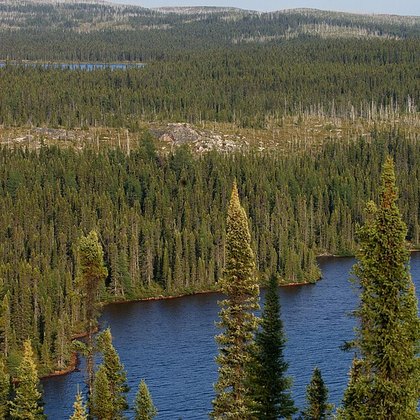
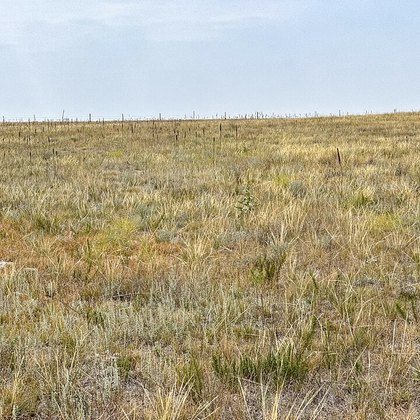
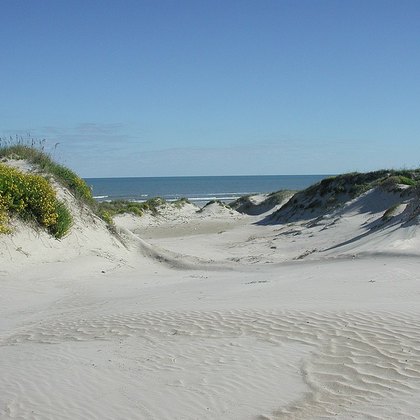
As a breeder the Merlin occupies open coniferous forest and the edge of the boreal taiga, taking over old crow or magpie nests. Outside the breeding season it moves to open grassland, salt marsh and especially the coast, where large flocks of shorebirds and small songbirds provide abundant prey.
Where the bird is most often found, arranged by the USNVC — the vegetation classification of the United States and Canada — and CMECS for sea and coast.

Range and movements
Breeds across boreal North America from Alaska to Newfoundland, with an isolated population on the northern prairies. Most birds migrate south in autumn to the southern United States, Mexico and Middle and South America; a small proportion of prairie birds remain year-round near the breeding grounds. The migration is especially visible along coastlines, where the Merlin hunts low over the beach among passing shorebirds.
- Resident
- Breeding (summer)
- Winter
- Passage
- dark = core range, pale = thinly spread
Where and when to look
In autumn, watch a busy stretch of coast or a salt marsh with many shorebirds: a sudden, simultaneous flush of hundreds of birds often signals a hunting Merlin cutting low and fast through the flock. In winter Merlins also stay in prairie cities such as Saskatoon and Edmonton, hunting sparrows and Bohemian Waxwings among the houses.
Conservation
After a low point caused by DDT in the mid-twentieth century, the North American population has since increased substantially and expanded its breeding range into suburbs with open tree lines. The species is listed as Least Concern (LC); no major threats are currently identified.
Scientific name
Falco columbarius | Linnaeus, 1758
Linnaeus described the species in 1758 as Falco Columbarius; the genus has remained unchanged since, hence no parentheses around author and year. Falco is Latin for 'falcon'; columbarius means 'of doves' and takes over Catesby's English name Pigeon Hawk, presumably after a resemblance in flight to a pigeon. Linnaeus based the species on Catesby's description and illustration from Carolina, so the type locality 'America' is taken to be South Carolina. The Dutch name, smelleken, goes back to an older form smerlekîn, a diminutive of Middle Dutch smeerle, related to Old Norse smyrill and, through Old French esmerillon, to the English merlin.