All species › Passerines › New World warblers › Louisiana Waterthrush
Louisiana Waterthrush | Parkesia motacilla
Louisianawaterlijster | Chipe de agua sureño
The Louisiana Waterthrush is the larger of the two waterthrushes and is tied to clear, running water: a stream with a stony bed in hilly deciduous forest. It returns from the wintering grounds in late March, weeks earlier than most New World warblers.
Voice
The song opens with three or four clear, high, descending whistles, followed by a hurried, tumbling jumble: swee-swee-swee, chidderidalee. It is delivered above the noise of the stream and carries through it. The call is a loud, hard chink, slightly lower and fuller than that of Northern Waterthrush. The male sings from a branch over the water and repeats the phrase from one bend of the stream to the next.
Recording: Bobby Wilcox — CC BY-NC-SA 4.0 · Tama (near Burlington), Des Moines, Iowa, United States · xeno-canto
Identification
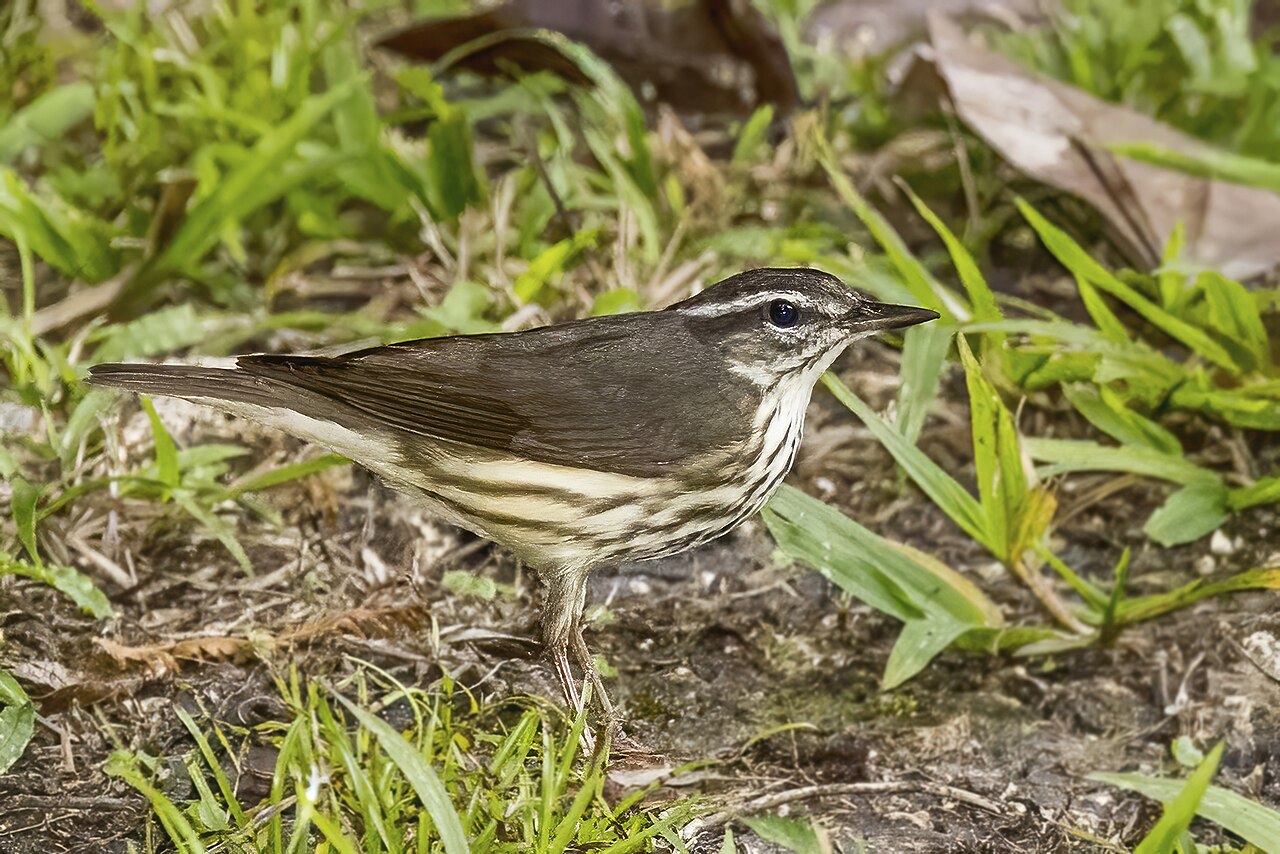
Plain greyish brown above, white below with black streaking on breast and flanks. The throat is white and unstreaked. The broad white eyebrow stripe starts narrow at the bill and widens towards the rear, extending past the ear. The flanks and undertail coverts are buff, giving a warm tone to otherwise cold greyish-white underparts. The legs are bright pink. This species too walks over wet stones with the rear body bobbing, but in a slower, more sweeping motion than Northern Waterthrush.
Confusion species
Northern Waterthrush is smaller and colder in tone, with a narrow eyebrow stripe that tapers to the rear and is often yellowish, a finely streaked throat, dark legs and no buff on the flanks. Habitat helps: running stream in hill country against standing swamp water. On migration the two do overlap, and then the shape of the eyebrow, the white throat and the pink legs are the most reliable features. Ovenbird has an orange crown stripe and an eye-ring instead of an eyebrow stripe.
Habitat
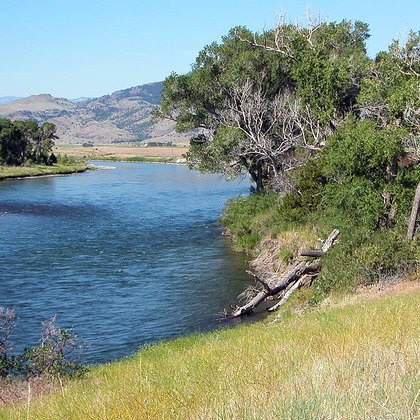
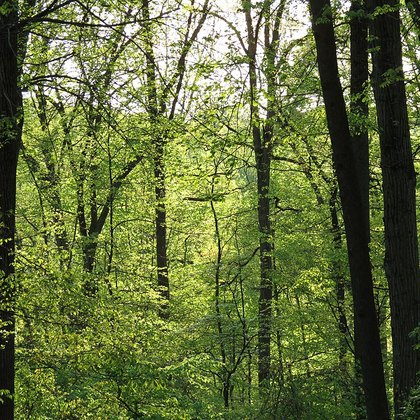
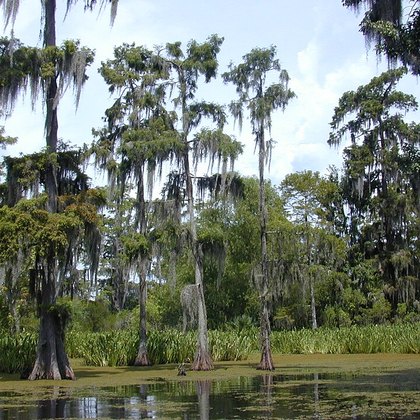
Fast-flowing, clear, permanent streams with stones and fallen trunks, in mature deciduous or mixed forest, usually in hills and low mountains. In the south also along woodland streams in cypress swamp and bottomland forest. Clearcuts, young plantation and turbid or acidified water are avoided; the territory is a ribbon along the stream, from a hundred metres to more than a kilometre long. In winter it forages along small streams, mangrove edge and even parks and gardens with running water.
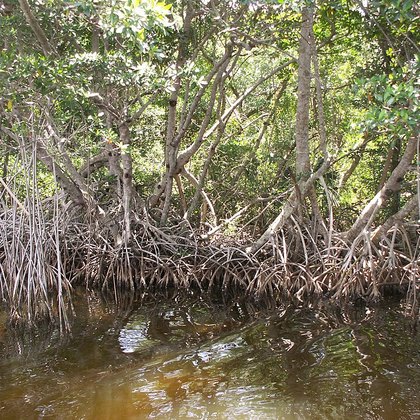
Where the bird is most often found, arranged by the USNVC — the vegetation classification of the United States and Canada — and CMECS for sea and coast.

Range and movements
Breeds in the eastern United States, from eastern Nebraska, eastern Kansas and eastern Texas to New England, and north to southern Michigan, southern Wisconsin and a narrow strip of southern Ontario. Much of the Gulf Coast and Florida are not occupied. Migration is early in both directions: back on territory from late March, out of the north already in August. It winters from northern Mexico through Central America to northwestern South America, and in the Greater Antilles.
- Resident
- Breeding (summer)
- Winter
- Passage
- dark = core range, pale = thinly spread
Where and when to look
Walk a stream in hilly woodland in early April and listen for the three clear opening whistles — in those weeks it is almost the only warbler singing there. Stand still on a bridge or a bank and wait: the bird works the stream and will come past on its own.
Conservation
The species is listed as Least Concern (LC). Partners in Flight puts the breeding population at about 450,000 birds, with an increase of some 34 per cent since 1970; the Continental Concern Score stands at 12 out of 20, rated low concern. The species is sensitive to the water quality of its breeding stream: acidification, mine drainage and silt reduce the supply of aquatic insects and with it the breeding success. Stream channelisation and fragmentation of streamside forest are the other pressures. Because of that dependence on clean running water the species is used as an indicator of stream condition.
Scientific name
Parkesia motacilla | (Vieillot, 1809)
Vieillot described the species in 1809 as Turdus motacilla; because it was later moved to another genus, author and year stand in parentheses. The genus Parkesia was introduced in 2008 by George Sangster, after the American ornithologist Kenneth Carroll Parkes. The species name motacilla is the Latin name for the wagtail, from motare 'to move to and fro'; it refers to the bobbing of the tail, the same behaviour that gave the wagtail its name. The Dutch and English names refer to Louisiana, where Vieillot believed the described material came from, although the type locality lies in Kentucky.