All species › Pelicans, herons and ibises › Herons, egrets and bitterns › Little Blue Heron
Little Blue Heron | Egretta caerulea
Kleine blauwe reiger | Garceta Azul
The Little Blue Heron is a medium-sized heron that as an adult is a uniform slate blue with a maroon head and neck, yet spends its entire first year pure white as a juvenile. That contrast, and the blotchy transitional birds in between, make it one of the trickiest herons in North America to age at a glance. It nests in mixed colonies with other herons and ibises, usually on islands that keep ground predators out.

Voice
The Little Blue Heron is a largely silent bird; away from the colony there is rarely more than an occasional hoarse croak or squawk when it is startled. More telling than the voice is bill-clacking: paired birds do it softly and rattling as a greeting, while an intruder near the nest is driven off with loud, forceful snapping. Chicks in the nest beg with a steady, hoarse peeping.
Recording: Valerie Heemstra — CC BY-NC-SA 4.0 · Blue Heron Nature Park (near Deltona), Volusia County, Florida, United States · xeno-canto
Identification
Adults are uniform slate blue from head to tail, with a dark maroon head and neck most obvious in the breeding season, a grey-blue bill with a black tip, and greenish legs. Juveniles, by contrast, are entirely white, sharing the same grey-blue, black-tipped bill and greenish legs as a clue against other white herons. During the moult into the second calendar year a blotchy, mottled transitional phase appears — known as 'calico' or 'piebald' — with blue and white feathers mixed together; it lasts a few months and, once recognised, cannot be confused with any other North American heron. In every plumage the bird wades slowly and deliberately, neck held straight forward and bill angled down.
Confusion species
White immatures are most often confused with Snowy Egret (Egretta thula): that species has a black bill with a yellow lore and black legs with sharply contrasting yellow feet ('golden slippers'), against the Little Blue Heron's grey-blue bill and greenish legs, and hunts far more actively, running and flicking its wings, where the Little Blue Heron wades slowly and patiently. Adults are confused with Tricolored Heron (Egretta tricolor): that species has a sharply contrasting white belly and a white stripe down the foreneck, whereas the Little Blue Heron is uniformly dark from head to tail. The dark morph of Reddish Egret (Egretta rufescens) is larger, with a shaggy, unkempt neck and an active, dancing hunting style different from the Little Blue Heron's calm.
Habitat
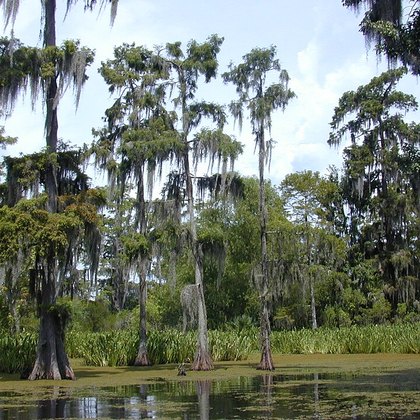
The species uses a wide range of shallow waters — marshes, ponds, streams, lagoons, tidal flats, canals, ditches and flooded fields — wherever there is calm, shallow water to wade in. Breeding colonies sit in low shrubs and small trees, preferably on islands out of reach of ground predators. Outside the breeding season it also moves into mangroves, salt ponds and coastal mudflats. It avoids fast-flowing or deep water, as well as busy open farmland without water bodies.
Where the bird is most often found, arranged by the USNVC — the vegetation classification of the United States and Canada — and CMECS for sea and coast.




Range and movements
Breeds from Missouri and Virginia south through nearly the whole southeastern United States, with its largest colonies in the lower Mississippi Valley, and is present year-round in Florida and along the Gulf Coast. After breeding, adults and young disperse in every direction, including north into Canada, before moving south in autumn; ringed birds have been recovered as far as South America. Outside the United States the species breeds on through Mexico, Central America, the Caribbean and South America to Uruguay and southern Brazil. The North American population has fallen sharply since the mid-twentieth century, even as climate models predict further northward range expansion this century.
- Resident
- Breeding (summer)
- Winter
- Passage
- dark = core range, pale = thinly spread
Where and when to look
In late summer, search shallow creeks and marsh edges in the southeast for blotchy 'calico' birds — they give themselves away not only by colour but by hunting with a slightly clumsy, hesitant manner compared to confident adults. Before calling any white heron a Snowy Egret, check bill and legs first: greenish legs and a greyish bill base are enough to confirm a juvenile Little Blue Heron.
Conservation
The North American population has fallen by roughly half since 1966, mainly through loss of marshland and altered water regimes, and the species is listed as of concern in several states. Worldwide, counting the large populations in Central and South America, the IUCN nonetheless rates the species as Least Concern (LC). Human disturbance of breeding colonies locally causes nest abandonment.
Scientific name
Egretta caerulea | (Linnaeus, 1758)
Linnaeus described the species as early as 1758 as Ardea caerulea, in the genus that then held almost every heron; it has since been moved to another genus, hence the parentheses around author and year. Forster introduced the genus Egretta in 1817, a name derived from the Provençal French aigrette, a diminutive of aigron, 'heron'. The epithet caerulea is Latin for 'sky blue' or 'dark blue', after the adult's plumage — not the white juvenile plumage, which Linnaeus therefore cannot have known from the same specimen. The type locality is North America, later restricted to South Carolina, based on Catesby's description and plate.