All species › Waders, gulls and terns › Skimmers, noddies, terns and gulls › Lesser Black-backed Gull
Lesser Black-backed Gull | Larus fuscus
Kleine mantelmeeuw | Gaviota sombría
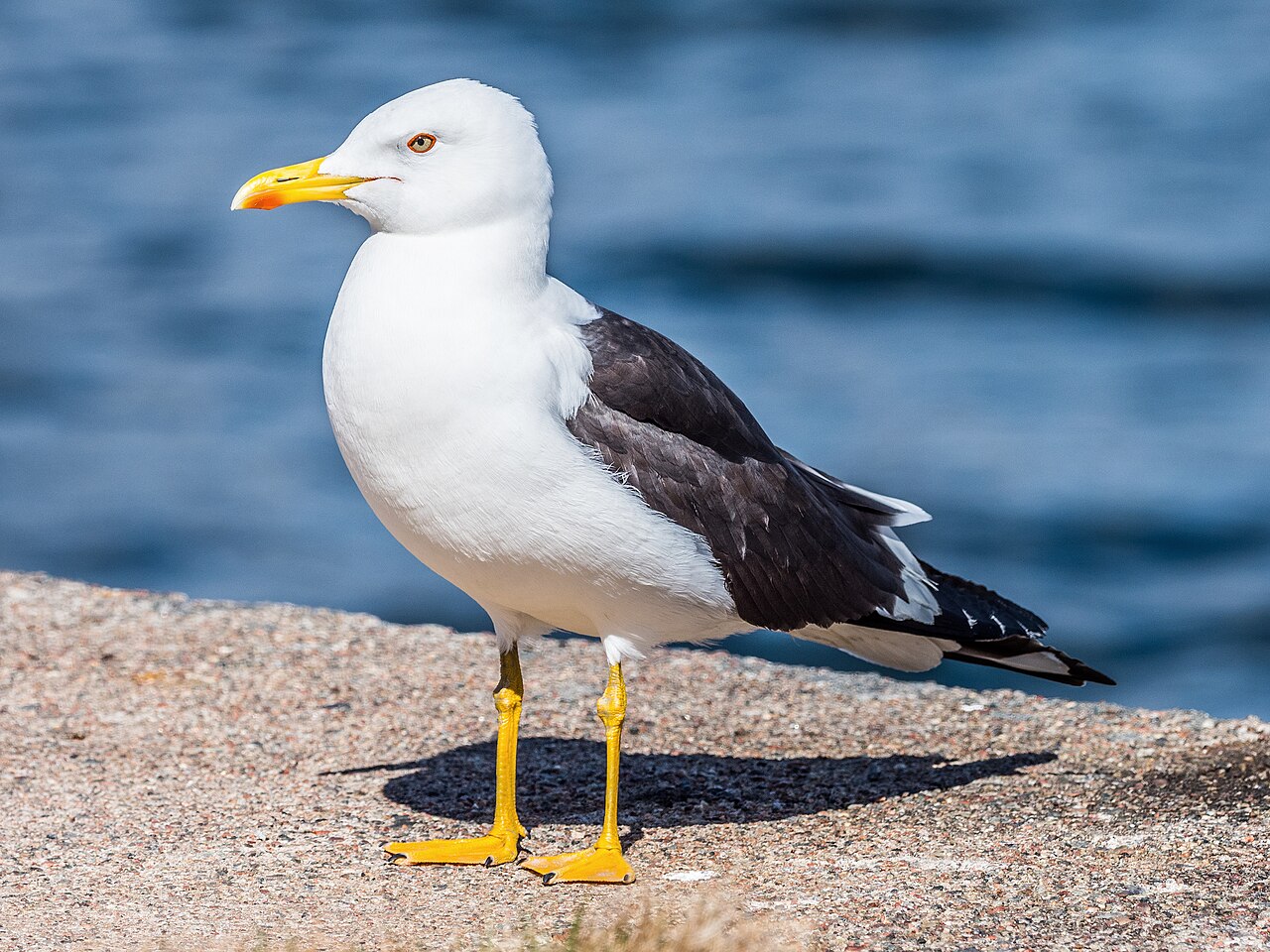
Lesser Black-backed Gull is a European gull in the act of settling into North America: slate-grey mantle, yellow legs, long narrow wings. The first was seen in 1934 on the New Jersey coast; it has now been recorded in every state and province, and on some Florida beaches dozens stand together in winter.
Voice
The usual call is a low, nasal khow, also given in short series and clearly heavier in tone than that of the American Herring Gulls beside it. The long call is a series of notes that starts high and grows shorter and lower as it runs on, the same shape as an American Herring Gull's but with a nasal edge. In the European colonies both male and female call, in courtship and in threat, and the sound of hundreds of birds swells the moment a fox or a person walks past. In North America it is seldom heard: the birds that reach the continent are winter visitors and are mostly silent.
Recording: Francesco Sottile — CC BY-NC-SA 4.0 · Corigliano-Rossano (near Schiavonea), Province of Cosenza, Calabria, Italy · xeno-canto
Identification
The adult has a slate-grey mantle — darker than the herring gulls, paler than the black of Great Black-backed Gull — and bright yellow legs, which together with the yellow red-spotted bill is the quickest combination. The eye is pale yellow with a red ring, and the wingtip is black with a small white mirror. Perched, the wingtips project far beyond the tail: the bird looks longer and slimmer than a herring gull of the same size. In winter the head and neck are heavily streaked, down onto the breast. Young birds are dark and sharply checkered above, with a whitish head, blackish-brown primaries, a crisp black tail band and an all-black bill; adult plumage comes only in the fourth year.
Confusion species
Great Black-backed Gull (Larus marinus) is far bigger and heavier-billed, with a slate-black rather than slate-grey mantle, pink legs and large white mirrors in the wingtip. American Herring Gull (Larus smithsonianus) has a pale grey mantle and pink legs; a dark-looking American Herring Gull in shadow is the commonest mistake, and then leg colour settles it. California Gull (Larus californicus) also has yellow legs, but is smaller, paler-mantled, dark-eyed and carries both a black and a red mark on the bill. On the west coast add Western Gull (Larus occidentalis), which is much heavier built, pink-legged and thick-billed with a bulging gonys. In all cases look first at the combination of yellow legs, slate-grey mantle and long wing projection.
Compare gulls: legs, head, bill and wing tip side by side
Habitat
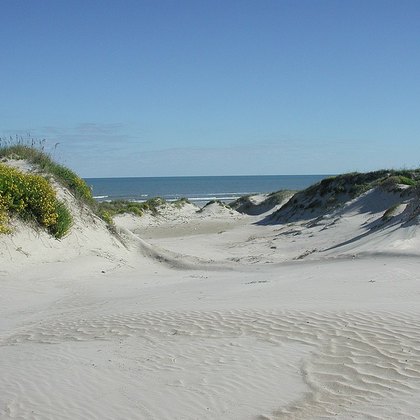
In North America it uses the same places as the other large gulls: sandy beaches and inlets, estuaries and mudflats, harbour moles, landfills, and the large reservoirs and fish ponds inland. It also walks on ploughed fields and on the grass beside car parks, often in company with Ring-billed Gulls. On the European breeding grounds it uses islands, dunes, moorland and, increasingly, flat roofs in towns. What it avoids is the open ocean far offshore; at sea it is seen mainly behind ships.
Where the bird is most often found, arranged by the USNVC — the vegetation classification of the United States and Canada — and CMECS for sea and coast.




Range and movements
Breeds from Iceland and western Europe east into Siberia, and since about 1990 in southwest Greenland as well, where numbers have risen steadily. On the North American side it began with a single bird in New Jersey in 1934; it remained a rarity into the 1980s, then numbers rose, and after 2000 the increase became rapid — it coincides with the growth of the Greenland breeding population, which appears to be the source of most birds. It is now an annual winter visitor along the whole Atlantic coast, on the Gulf of Mexico, on the Great Lakes and in small numbers far inland and on into Mexico and the Caribbean. It does not yet breed here on its own: the known cases are mixed pairs with American Herring Gull, at Juneau in Alaska in 1993 and on Appledore Island off New Hampshire in 2007.
- Resident
- Breeding (summer)
- Winter
- Passage
- dark = core range, pale = thinly spread
Where and when to look
The best months are November to March, and the best places are the inlets and beaches of Florida and the Carolinas, the harbours and landfills of the Great Lakes, and anywhere American Herring Gulls stand in hundreds. Walk the sleeping line and look at the legs: yellow among dozens of pairs of pink legs is enough to pick the bird out, after which the darker mantle confirms it. In first-year birds the differences are much smaller; then look for the dark primaries and the finely checkered back.
Conservation
The world population is put at about one million breeding birds and the species is listed as Least Concern (LC); in western Europe and Greenland numbers are rising. Not everywhere is doing well: the eastern, darkest population around the Baltic fell by roughly three quarters between 1970 and 2013, with pesticide poisoning and predation the main causes. In North America the species is too new for a trend in the counts, but the number of winter records still rises every decade.
Scientific name
Larus fuscus | Linnaeus, 1758
Linnaeus described the species in 1758 as Larus fuscus; it still stands in the genus in which he placed it, and for that reason author and year carry no parentheses. Larus is the Latin form of Greek laros, an unspecified seabird in the classical writers. fuscus is Latin for 'dark' or 'blackish brown', after the mantle. Linnaeus gave Europe as the origin; the type locality was later restricted to Sweden. The birds reaching North America are usually assigned to the western, palest-mantled subspecies Larus fuscus graellsii.