All species › Waders, gulls and terns › Skimmers, noddies, terns and gulls › California Gull
California Gull | Larus californicus
Prairiemeeuw | Gaviota californiana
California Gull is the gull of the dry interior west: it breeds on bare islets in salt lakes and reservoirs far from the sea, and only after the breeding season moves to the Pacific. It is the state bird of Utah, because tradition holds that flocks of gulls ate the crickets threatening the settlers' first harvest in 1848; a monument in Salt Lake City records it.
Voice
The voice is hoarse and scratchy, a series of aow notes with a low uh-uh-uh between them, pitched exactly between the high Ring-billed Gull and the deep American Herring Gull. The long call begins with the neck bowed and turns into loud cries as the head is thrown steeply up. At the nest comes the choking call, breast on the ground and head jerking up and down, and at danger a series of sharp ha-ha-ha notes from the air. In a large colony the calling goes on all night.
Recording: Richard E. Webster — CC BY-NC-SA 4.0 · Bear River Migratory Bird Refuge, Box Elder County, UT, United States · xeno-canto
Identification
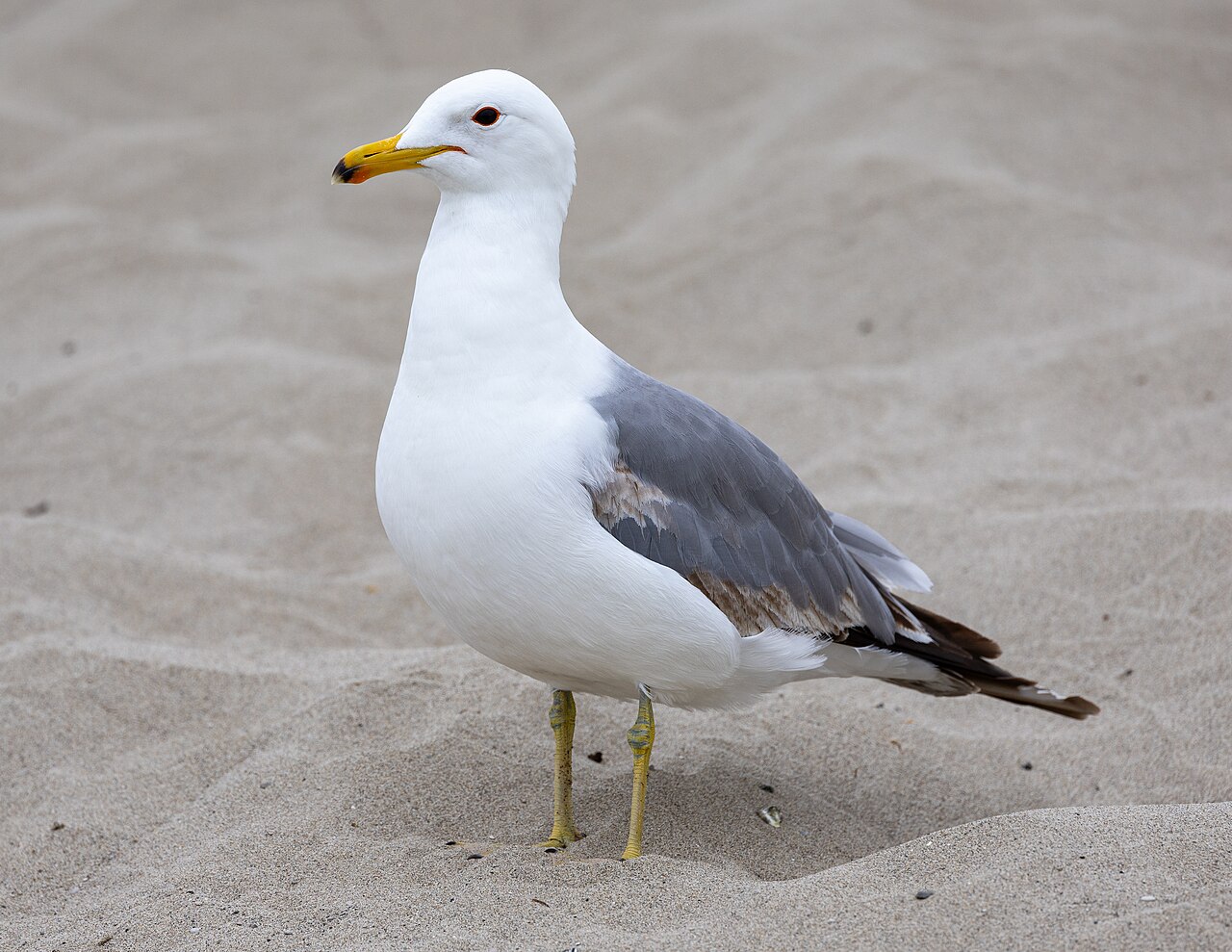
A medium-sized gull with a medium grey mantle, white head and black wingtips with white mirrors; the best combination is the dark eye, the yellow-green legs and the bill, which is yellow with both a black band and a red spot. In winter the head and neck are finely streaked brown, most heavily on the hindneck. The bill is slimmer and the wing longer than in American Herring Gull, giving the bird a more elongated silhouette in flight. First-year birds are evenly mottled brown with a pink black-tipped bill and pink legs; in the second year grey comes in on the back and the legs turn bluish grey, and adult plumage arrives in the fourth year. The sexes look alike.
Confusion species
Ring-billed Gull (Larus delawarensis) is smaller and paler-mantled, with a pale eye, yellow legs and a clean black ring on the bill with no red spot. American Herring Gull (Larus smithsonianus) is larger and heavier, with pink legs and a pale eye. Short-billed Gull (Larus brachyrhynchus) is much smaller, with a small unmarked yellow bill and a soft, dove-like head. Western Gull (Larus occidentalis) of the coast is stoutly built, darker-mantled, pink-legged and thick-billed with a bulging gonys. For the adult, remember the three marks together: dark eye, yellow-green legs, and black as well as red on the bill.
Compare gulls: legs, head, bill and wing tip side by side
Habitat
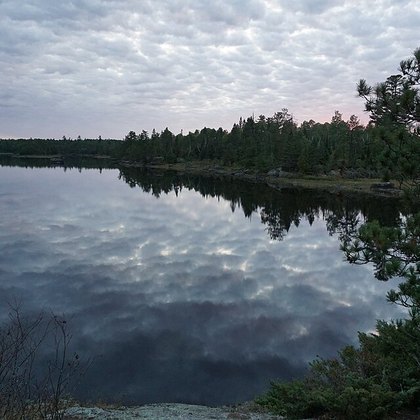
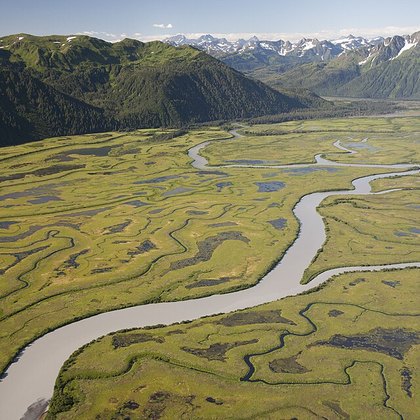
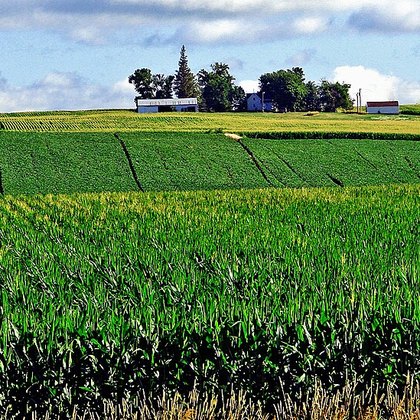
For breeding it uses bare, sparsely vegetated islands and levees in salt lakes, alkaline lakes and reservoirs of the interior, from sea level to high in the mountains. To feed it will fly tens of kilometres to fields, meadows, grasshopper swarms, landfills and the mown grass around buildings. Outside the breeding season it is a coastal bird: sandy beaches, mudflats, river mouths, harbours and the surf line itself. It does not enter deep forest or closed country.
Where the bird is most often found, arranged by the USNVC — the vegetation classification of the United States and Canada — and CMECS for sea and coast.


Range and movements
Breeds in the interior of western North America, from Great Slave Lake and the prairie provinces south to Great Salt Lake in Utah and Mono Lake in California, with the largest colonies on the islands in those salt lakes. From July onward the birds move west to the Pacific, where they winter from British Columbia to Baja California and the west coast of Mexico. The species has settled in San Francisco Bay: from twenty-four birds in 1980 the colony there grew to more than fifty thousand around 2014. A few reach the states east of the Rockies every year, but the centre of gravity stays firmly in the west.
- Resident
- Breeding (summer)
- Winter
- Passage
- dark = core range, pale = thinly spread
Where and when to look
In July and August the birds are on Pacific beaches, having just come off their breeding lakes: among the Ring-billed Gulls look for a slightly larger gull with dark eyes and greenish-yellow legs. Inland, any large salt lake or reservoir between April and June will do, and the colony can be heard from far off. In case of doubt always look at the eye first: the dark eye gives the bird a soft expression no other medium-sized western gull has.
Conservation
The breeding population is estimated at over four hundred thousand birds and the surveys show no clear continent-wide rise or fall since the 1960s; the species is listed as Least Concern (LC). Locally there is concern: the colonies depend on the water level of a handful of salt lakes, and if it drops too far, predators walk across the dry bed to the islands. In San Francisco Bay the gull's own growth has become a problem for other breeding birds, because it takes the eggs and chicks of avocets, plovers and terns; moving the largest colony in 2010 immediately improved the survival of tern chicks.
Scientific name
Larus californicus | Lawrence, 1854
George Newbold Lawrence, a New York merchant and ornithologist, described the species in 1854 as Larus Californicus — with a capital letter, as was usual in the nineteenth century for species names taken from place names. Because it still stands in the same genus, author and year carry no parentheses. Larus is the Latin form of Greek laros, an unspecified seabird in the classical writers. californicus means 'from California'; the type locality lies near Stockton, California, inland rather than on the sea, which suits a gull that breeds on salt lakes.