All species › Waders, gulls and terns › Auks, puffins and murres › Kittlitz's Murrelet
Kittlitz's Murrelet | Brachyramphus brevirostris
Kittlitz' alk | Mérgulo piquicorto
Kittlitz's Murrelet is the glacier bird among the auks: it fishes in the turbid meltwater right in front of a glacier face and lays its single egg kilometres inland on bare rock rubble high in the mountains, without a nest and without neighbours. Where other auks sit in dense colonies on cliffs, it breeds alone, at densities so low that in more than a century only a few dozen nests have been found. Now that the glaciers are retreating, the water in which it finds its food is going with them.
Voice
It is one of the most silent of auks; the sound heard most often is a low, hoarse, drawn-out groan or croak, aaahrr or urrhn, which carries far over still fjord water. On the water there is also a shorter, compressed urgh, usually between two birds feeding together. Over the breeding grounds in the mountains it is all but mute, which is what makes searching for nests so nearly hopeless. Anyone who hears it, therefore, is almost always hearing a bird at sea and not a bird at the nest.
No recording with a suitable Creative Commons licence has been found for this species yet; what to listen for is described below.
Identification
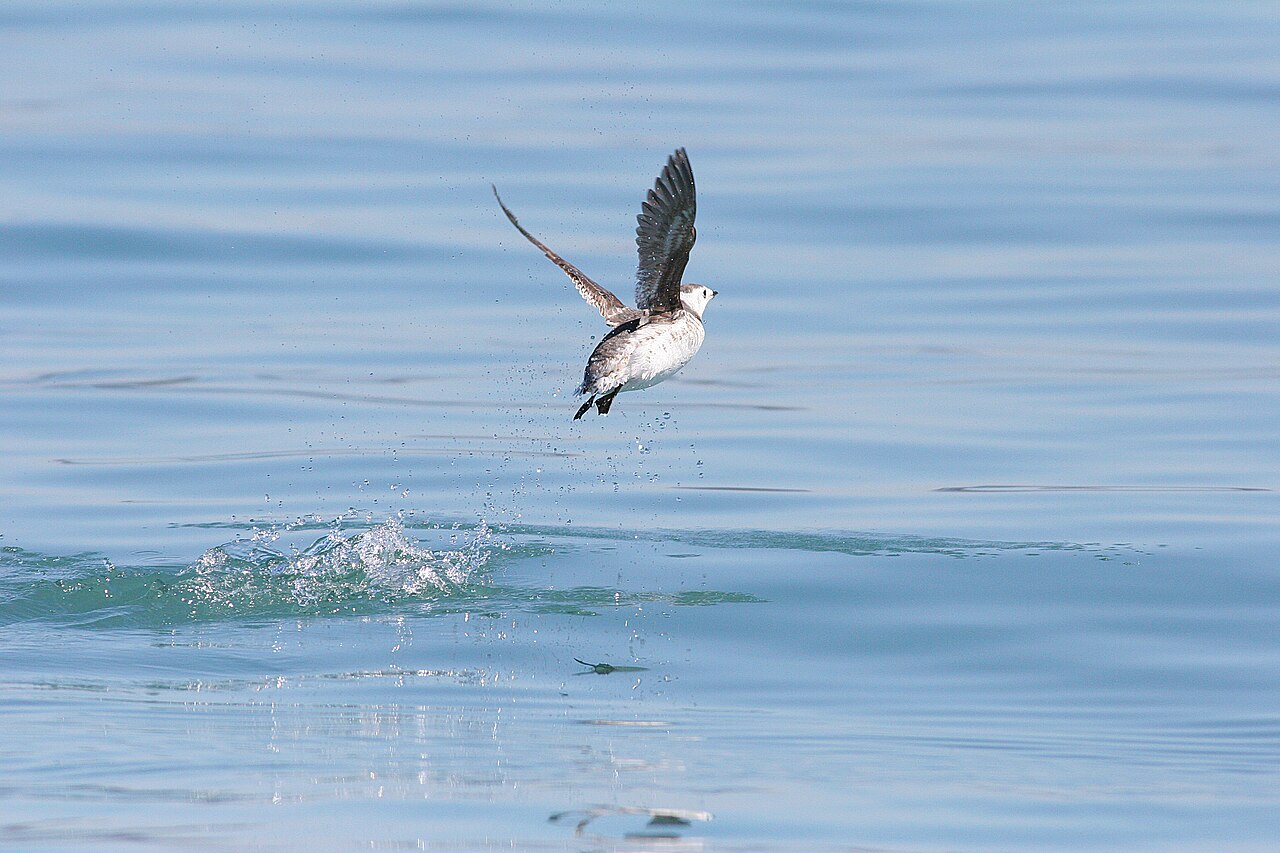
A small, squat auk with a large-looking head, a short bill and a short tail, which makes it look more compact than its only relative. In summer plumage it is pale sandy and mottled: brown, grey and golden on head, back and wings, the underparts whitish with brown speckling and streaking, and the face clearly paler than the rest. In winter plumage it is blackish-grey above with white-fringed scapulars, and pure white on face, throat and underparts, with only a small dark spot in front of the eye; the dark eye therefore sits like a dot in a white face. The outer tail feathers are white, showing in flight as a pale edge to the tail. It leaves the water quickly and flies low over the waves on whirring wings.
Confusion species
Marbled Murrelet (Brachyramphus marmoratus) is the only real pitfall and overlaps with it from southeast Alaska to the Aleutians. In summer the Marbled Murrelet is a warmer, darker brown with a dark face, while Kittlitz's Murrelet is pale and sandy with a light face; the bill of the latter is visibly shorter. In winter the difference is clearest on the head: on B. marmoratus the dark crown runs down through the eye and there is a white collar, while on Kittlitz's Murrelet the eye stands free in a white face. Watch also for the white outer tail feathers, which the Marbled Murrelet lacks. At long range, against the light or in fog, many birds of this pair stay unnameable; they are then recorded simply as Brachyramphus.
Habitat
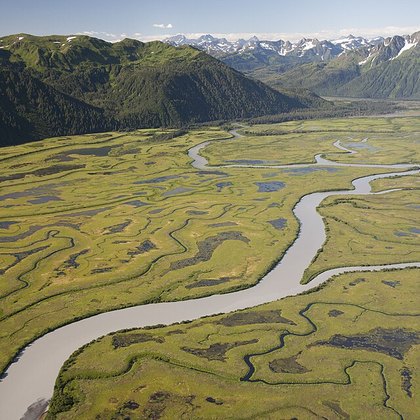
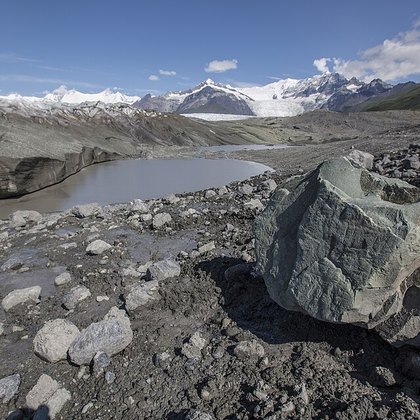
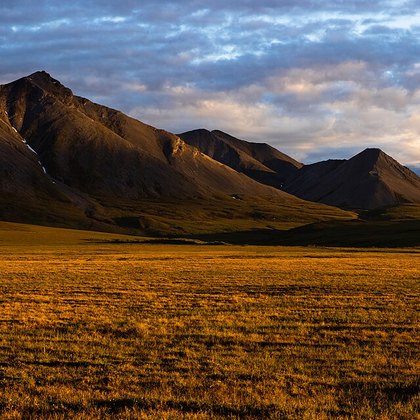
At sea it keeps to sheltered bays and fjords with glacial water, where the meltwater is cold and turbid and sand lance, capelin and herring gather; it likes to forage among floating ice and off the mouths of glacial streams. It breeds far from that water: on steep unvegetated mountain slopes, scree and moraine above the tree line, up to seventy-five kilometres inland and over two thousand metres high. The egg lies on bare grit or among lichens, with no cup and no others of its kind nearby. Wooded country, dense vegetation and the open ocean far from land it does not use.
Where the bird is most often found, arranged by the USNVC — the vegetation classification of the United States and Canada — and CMECS for sea and coast.

Range and movements
The range lies around the northern Pacific: from Wrangel Island, Chukotka, Kamchatka and the northern Sea of Okhotsk in Russia eastward across the Bering Sea and the Aleutians to southeast Alaska. Within the guide area Alaska is the only area where it occurs regularly, with the largest concentrations in Prince William Sound, Kenai Fjords and Glacier Bay. It hardly migrates: most birds stay all year in the bays of their breeding area and move out only where the sea freezes over in the far northwest. Over recent decades the occupied area has shrunk as glaciers have withdrawn from the fjords.
- Breeding (summer)
- Passage
- dark = core range, pale = thinly spread
Where and when to look
The best chance is a boat trip in June or July in Prince William Sound, Kenai Fjords or Glacier Bay, right up to the glacier face where the water is milky with rock flour. Search that turbid water for small auks singly or in twos, and note the pale head and the short bill; compare every bird with the Marbled Murrelets that are usually there too. Take your time and photograph if you can, because the distinction rests on colour and bill length and not on a single mark.
Conservation
Estimates range from just over forty thousand to about eighty thousand birds, a small number for a seabird, and the trend is downward; the IUCN treats the species as Near Threatened (NT). In the core areas of Prince William Sound, Glacier Bay and Kenai Fjords counts fell by tens of per cent between the 1980s and the early years of this century. The main threat is the retreat of the glaciers, which takes with it the turbid, food-rich meltwater; besides that, birds drown in gill nets, and the Exxon Valdez oil spill of 1989 is estimated to have killed five to ten per cent of the world population.
Scientific name
Brachyramphus brevirostris | (Vigors, 1829)
Nicholas Aylward Vigors described the species in 1829 as Uria brevirostris; because it was later placed in another genus, author and year stand in parentheses. The genus name Brachyramphus comes from Greek brakhus, 'short', and rhamphos, 'bill'; the epithet brevirostris says the same in Latin, from brevis, 'short', and rostrum, 'bill'. The type locality was first given as San Blas in Mexico, but that rested on a mix-up; the origin was later corrected to the northern Pacific Ocean. The English and Dutch names honour Friedrich Heinrich von Kittlitz, a Prussian naturalist who travelled the northern Pacific with a Russian expedition in the 1820s.