All species › Waders, gulls and terns › Auks, puffins and murres › Marbled Murrelet
Marbled Murrelet | Brachyramphus marmoratus
Marmeralk | Mérgulo jaspeado
The Marbled Murrelet is the seabird that breeds in the forest: not a colony on a cliff but a single egg on a thick, moss-covered limb, high in a centuries-old conifer as much as eighty kilometres inland. Not until 7 August 1974, in Big Basin Redwoods State Park in California, was the first nest found, by a tree surgeon who met a downy chick on a branch forty-six metres up. Where the old forest has gone the bird has gone with it over large parts of its range; it stands as Endangered (EN) on the Red List.
Voice
The characteristic sound is a high, penetrating keer-keer, given over the forest at dusk as the birds fly in from the sea to their nest tree. In the earliest morning and the last light of evening they call on the wing, often in twos and threes, so that the sound passes above the canopy without the bird ever being seen. On the water it is far quieter, keeping to low groans and thin whistles between partners. Anyone searching the coastal conifer forests for this species is in practice searching with the ears.
Recording: Paul Driver — CC BY-NC-SA 4.0 · Orick, Humboldt County, California, United States · xeno-canto
Identification
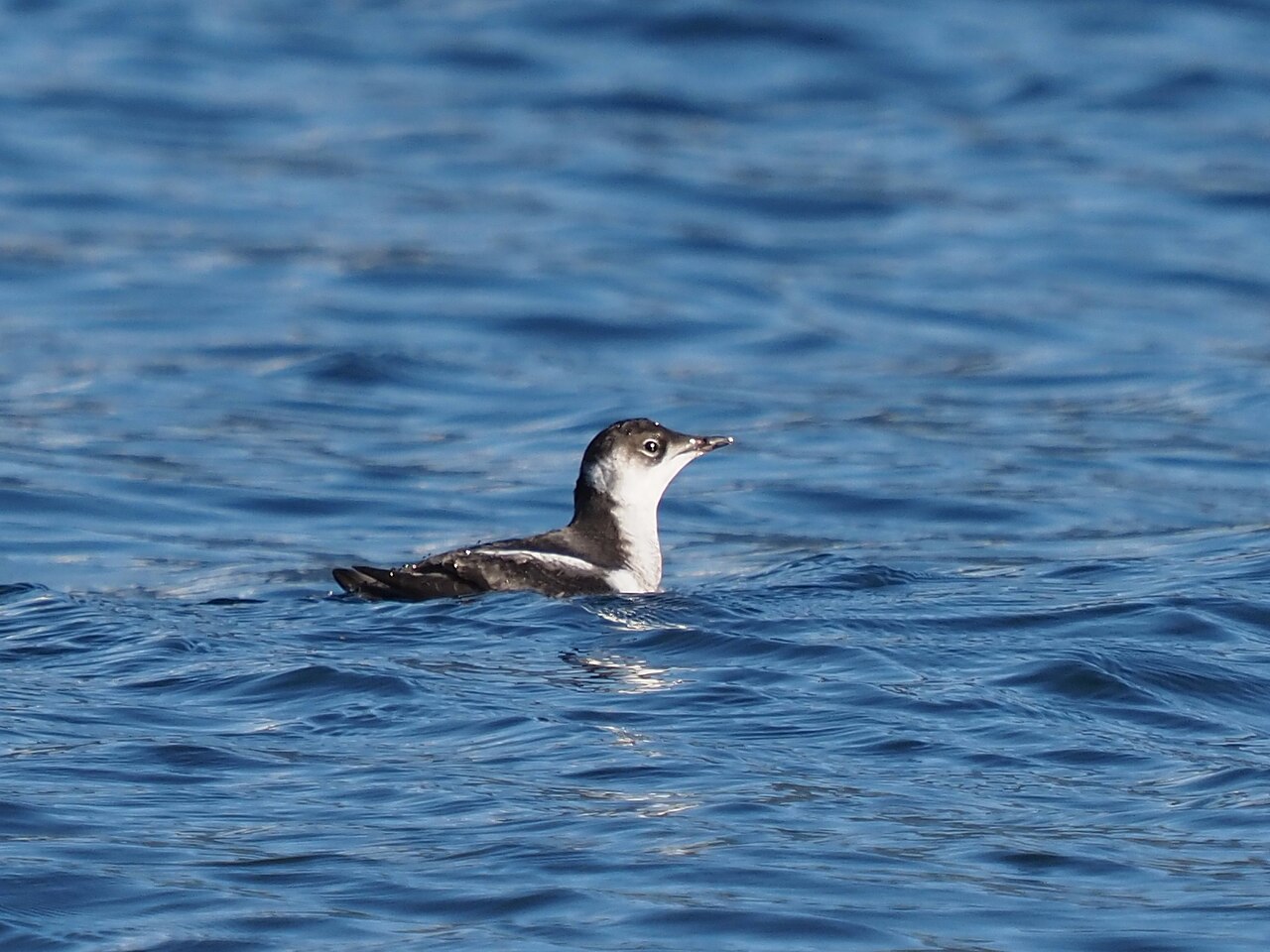
A small, squat seabird with a short neck and short tail, which gives the body a blocky outline, with a thin pointed bill and relatively long narrow wings. In breeding plumage it is warm brown: dark brown on back, wings and crown, and brown below with white and cinnamon speckling, from which it takes its name. In winter plumage it is dark grey above and white below, with a white patch between bill and eye, a white bar on the shoulder and a white collar that separates the dark crown from the dark back. Juveniles resemble the winter adult but carry fine dark streaking over the white underparts. The flight is fast and low over the water, on whirring wings and on a zigzagging line, so that it suggests an oversized bumblebee rather than a seabird.
Confusion species
Kittlitz's Murrelet (Brachyramphus brevirostris) is the hard one: in summer it is sandier and paler with a lighter face, has a noticeably shorter bill and white outer tail feathers, and in winter its eye sits as a dark spot in a white face, while the Marbled Murrelet has a dark crown running down through the eye. The Asian B. perdix is larger and longer-billed and in winter plumage lacks the white collar; it appears only very rarely on this side of the Pacific. The small murrelets of the genus Synthliboramphus are cleaner black and white; most belong much further south, and Ancient Murrelet has a black throat and grey back. In summer plumage confusion is barely possible: no other auk of this coast is marbled brown from head to tail.
Habitat
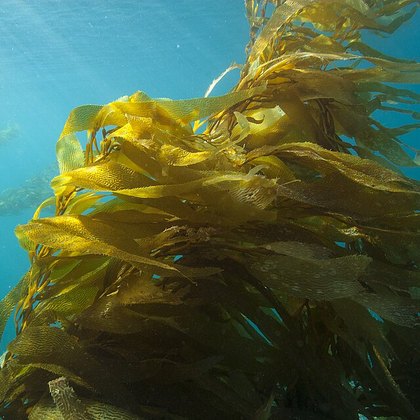
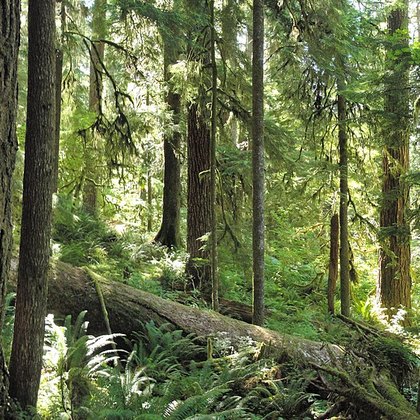
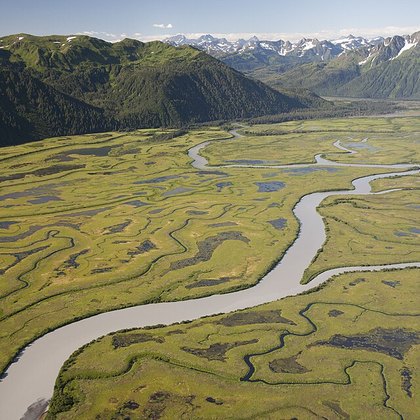
It feeds close inshore, often within half a kilometre of land, in sheltered bays, straits and fjords and over shallow kelp-covered bottom where sand lance and herring gather; now and then it also dives in freshwater lakes just behind the coast. It breeds in old and original conifer forest, on a broad horizontal limb with a thick pad of moss, usually in the upper half of an old spruce, hemlock or Douglas-fir. In the north of its range, where such forest is missing, it lays the egg on the ground among rock talus on a bare mountain slope. Young, planted and thinned forest it does not use: it needs branches heavy enough to carry a cup of moss.
Where the bird is most often found, arranged by the USNVC — the vegetation classification of the United States and Canada — and CMECS for sea and coast.

Range and movements
It occupies a narrow coastal strip from the Aleutians and southern Alaska through British Columbia, Washington and Oregon to central California, and seldom stays further than a hundred kilometres from the sea. Most birds remain in the same waters all year; only from the northernmost areas do they withdraw in winter when the ice comes, and part of the population then shifts south to off southern California. During the twentieth century the range became badly fragmented in the south: in California only a few forest blocks still hold breeding birds, and between northern California and Oregon there are gaps where forest once stood. In Alaska, where most of the old forest still stands, the species remains widespread.
- Resident
- Breeding (summer)
- Passage
- dark = core range, pale = thinly spread
Where and when to look
Look for it not in the forest but on the water: go out at first light over a sheltered bay in southeast Alaska, the Salish Sea or Monterey Bay, and look for pairs lying close together on the surface and diving in unison. To meet it in the forest, stand in a clearing in old coastal conifer forest half an hour before sunrise and listen for the keer-keer high above the canopy. Expect no view: it is the sound and a silhouette that is gone in seconds.
Conservation
The world population runs to a few hundred thousand birds, but the trend is downward and the centre of gravity lies in Alaska; in California, Oregon and Washington it is a matter of a few tens of thousands, protected as Threatened under United States law since 1992. The main cause is the loss of old coastal conifer forest: where the heavy mossy limbs have been felled there is no nest site left, and fragmented forest draws in crows and jays that take eggs and young. Birds also drown in gill nets, oil spills strike whole subpopulations, and warmer sea water shifts the supply of sand lance and herring. The IUCN lists the species as Endangered (EN).
Scientific name
Brachyramphus marmoratus | (Gmelin, 1789)
Johann Friedrich Gmelin described the species in 1789 as Colymbus marmoratus, among the loons; because it was later placed in another genus, author and year stand in parentheses. He worked from a description by Thomas Pennant, whose material came from 'western America and Kamchatka'; the type locality was later fixed at Prince William Sound in Alaska. The genus name Brachyramphus is built from Greek brakhus, 'short', and rhamphos, 'bill', after the short bill of these two auks. The epithet marmoratus is Latin for 'marbled', after the speckled summer plumage, and the Dutch, English and Spanish names all say the same thing.