All species › Pigeons and doves › Doves and pigeons › Inca Dove
Inca Dove | Columbina inca
Incaduif | Tortolita Cola Larga
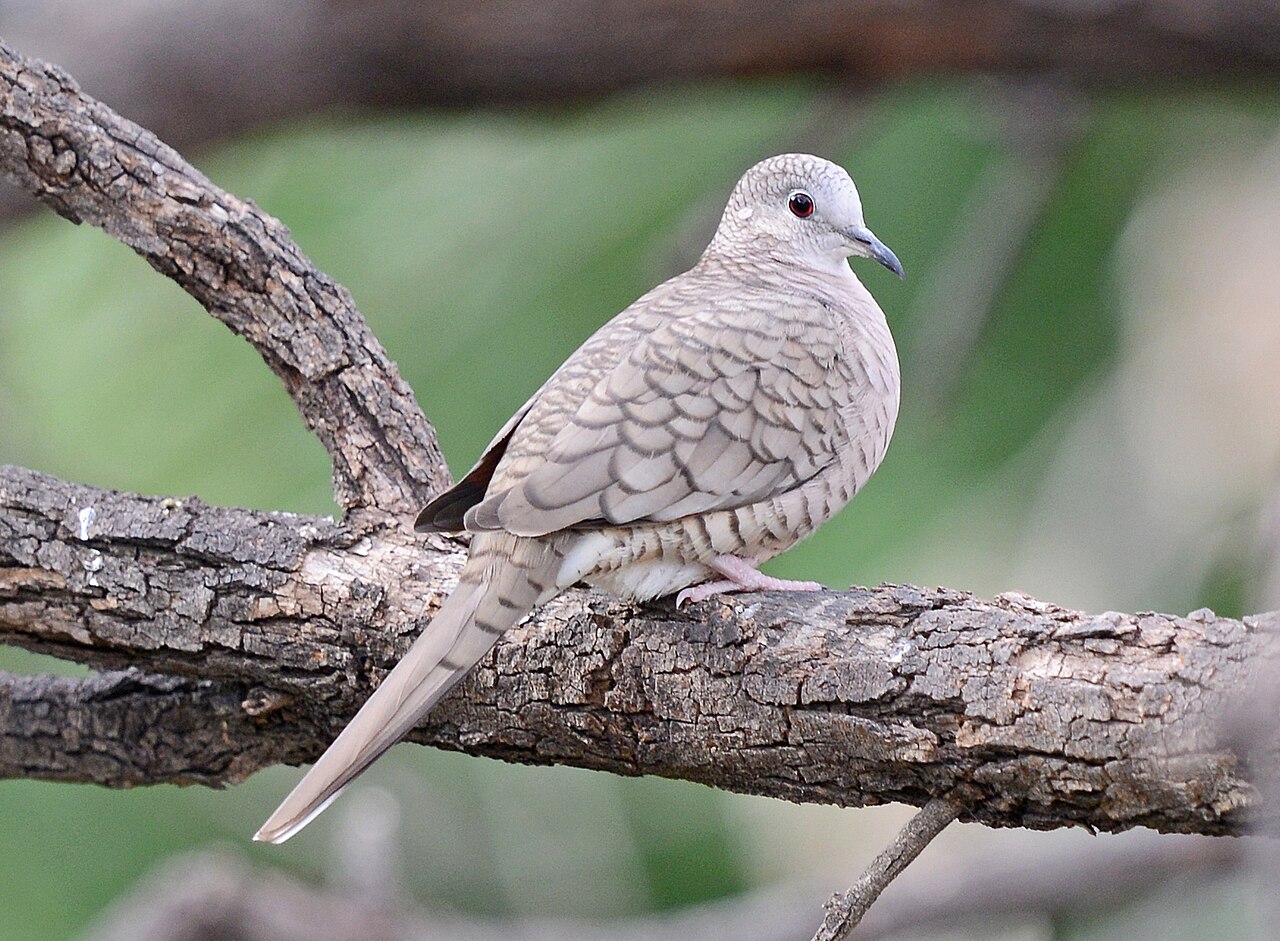
Inca Dove is one of the smallest doves in North America, barely larger than a starling, with a long straight tail and a plumage in which every feather carries a dark edge. It belongs to the arid Southwest but lives there mainly on what people leave behind: watered lawns, spilled seed and the shade of planted trees. On cold nights up to a dozen birds press together on a single branch, stacked two or three layers deep.
Voice
The call is a two-syllable hollow cooing repeated for minutes on end without a change of pace: coo-COOP, rendered in field guides as no-hope. It calls from a wire, a roof edge or a bare branch, all year round and even in the middle of a hot day, when most other birds fall silent. Both sexes call, but the male does so by far the most, especially in early morning and late afternoon. On take-off the wings make a short dry rattle, a sound that often gives the bird away before its cooing does.
Recording: Manuel Grosselet — CC BY-NC-SA 4.0 · Mancha, Actopan, Veracruz, Mexico · xeno-canto
Identification
A small, slender dove with a proportionately long, straight tail edged white on both sides. The whole plumage is sandy grey-brown and every feather carries a dark rim, so that head, back, breast and flanks all look scaled from top to bottom. In flight a rufous panel opens in the hand, sharply bordered with black along the rear edge. Male and female are almost alike; the male shows a slightly warmer pink wash on crown and breast. Juveniles are duller with a vaguer scaled pattern.
Confusion species
Common Ground Dove is clearly smaller and has a short, blunt tail without white; its scaling is confined to head, neck and breast, and the back is plain. Ruddy Ground Dove is equally small but has a plain breast, a dark bill and, in the male, a warm cinnamon back. Mourning Dove is nearly twice as large, with a tapering tail, black spots on the wing and a plain sandy-brown back. At distance the long white-edged tail together with the scaling over the whole body is the safest combination.
Habitat
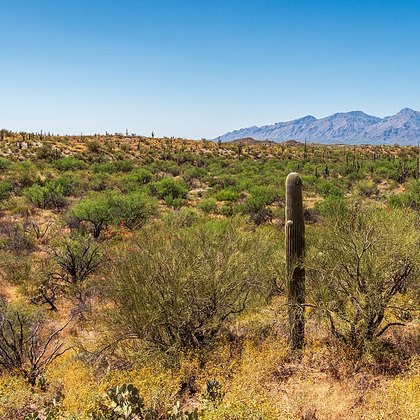
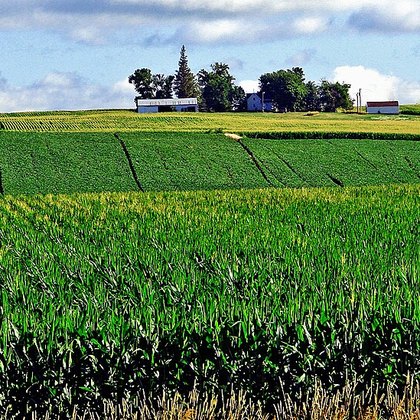
It wants bare or short-cropped ground to walk on with shrubs and low trees beside it, and finds that combination mostly around people: gardens, parks, schoolyards, farmyards, field edges and village streets. Water decides where it sits in the dry Southwest; where there is irrigation it is present, and where that stops it stops. Away from settlement it occurs in mesquite (thorny legume shrub of the southwest, forming dense thickets) thorn scrub and along dry watercourses with scattered trees. It avoids closed forest and tall dense grass entirely.
Where the bird is most often found, arranged by the USNVC — the vegetation classification of the United States and Canada — and CMECS for sea and coast.



Range and movements
Resident from the southwestern United States through nearly all of Mexico into Guatemala, El Salvador, Honduras and Nicaragua, and on into northwestern Costa Rica. It is absent from the Yucatán Peninsula and from the humid lowlands along the Gulf of Mexico. North of Mexico it was still scarce in the nineteenth century; with towns, gardens and irrigation it moved north into Nevada, Oklahoma, Arkansas and Louisiana, and in recent years it has been seen as far north as Colorado. It does not migrate, but young birds wander well outside the breeding range in late summer and autumn.
- Resident
- Breeding (summer)
- Winter
- Passage
- dark = core range, pale = thinly spread
Where and when to look
Look for it walking on a close-mown lawn or under a feeder, among House Sparrows and Common Ground Doves: it moves in small steps with a bobbing head and lets people approach within a few metres. In a residential district of Tucson, Phoenix or San Antonio listen for the monotonous two-syllable cooing, which is there all year and at any hour of the day. On take-off watch for the rufous wing panel and the white tail sides.
Conservation
The species is listed as Least Concern (LC); the world population is estimated at about three million birds, over half of them in Mexico and roughly a third in the United States. The Breeding Bird Survey recorded an increase of more than one and a half per cent a year between 1966 and 2015. It benefits from settlement and irrigation and is under no pressure as a species; in the dry part of its range, however, its presence depends on open water, which is in most cases brought there by people.
Scientific name
Columbina inca | (Lesson, 1847)
Lesson described the species in 1847 as Chamaepelia inca; because it was later placed in the genus Columbina, author and year stand in parentheses. Columbina is a Latin diminutive of columba, 'dove', and so means something like 'little dove'. The species name inca refers to the empire of the Incas, although the bird occurs in none of the lands that belonged to it. Lesson gave the type locality simply as Mexico; the description appeared on page 211 of his Description de mammifères et d'oiseaux récemment découverts.