All species › Passerines › Finches, euphonias and allies › ʻIʻiwi
ʻIʻiwi | Drepanis coccinea
ʻIʻiwi | ʻIʻiwi
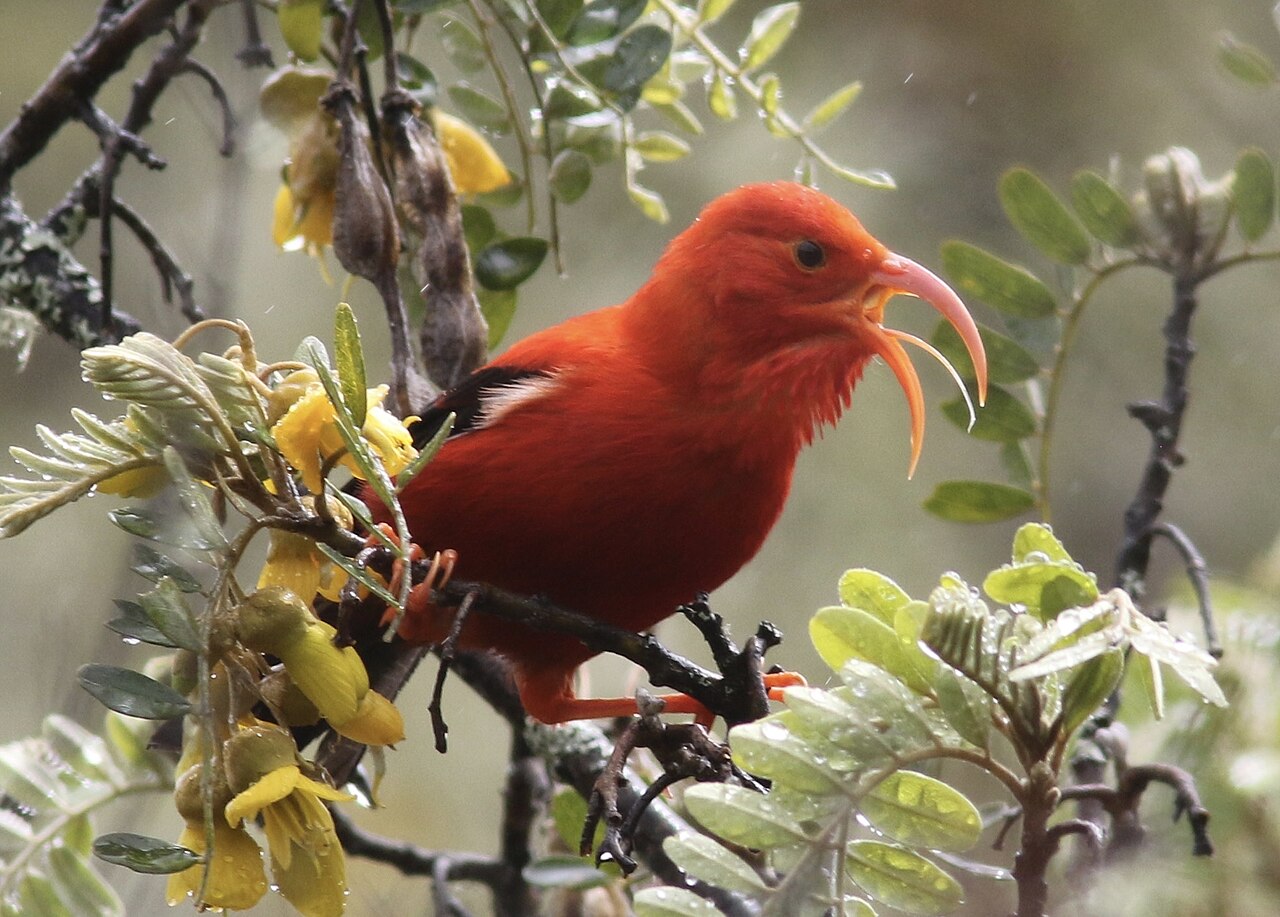
The ʻIʻiwi is the scarlet honeycreeper of Hawaii: black wings and tail and a long salmon-pink sickle of a bill for reaching into the flowers of the ʻohiʻa lehua. It is the living emblem of the Hawaiian mountain forest, and at the same time the bird that shows most plainly what an introduced mosquito does to an island fauna: it now holds on only above the height at which it is too cool for malaria.
Voice
An ʻIʻiwi sounds like a rusty hinge: a run of creaking, squeaking and gurgling notes without melody, delivered unhurriedly with seconds of silence between them. The calls include a metallic eek or coo-eek, a long rising nasal note, and a short beep-beep. Both sexes sing, all year and most of all from October to December, and both mimic other birds. Most distinctive is the sound of the wings: a loud whirring flutter with which it drives rivals out of a flowering tree, and which often betrays it before its voice does.
Recording: Patrick Blake — CC BY-NC-SA 4.0 · Alaka'i Wilderness Preserve, Halepa'akai Stream, Kauai, Hawaii, United States · xeno-canto
Identification
A small, blazing bird: the whole body vermilion, the wings and tail black, with a white patch on the wing that can flash in flight. The bill is long, thin and strongly decurved, salmon-pink to orange against the red, and almost as long as the head. The sexes look alike; the male is a little larger and longer-billed. Juveniles are entirely different: mottled yellow-green washed with orange and spotted dark, with a dull yellow bill, and they only take on adult colour during their first year. In a flowering crown it often hangs upside down to reach the base of the flower.
Confusion species
ʻApapane (Himatione sanguinea) is the only real confusion species: also red and in the same forest, but smaller, deeper crimson rather than vermilion, with a short, barely curved black bill and white under belly and tail. Young ʻIʻiwi, green-yellow and spotted, are taken for ʻamakihi, which have a far shorter and far less curved bill. Beyond that there is little in the Hawaiian mountain forest that looks like an ʻIʻiwi.
Habitat
Native montane rainforest of ʻohiʻa lehua and koa (Acacia koa, a native Hawaiian tree), and on the dry slopes of Mauna Kea the mamane woodland. It follows the flowering: outside the breeding season it wanders widely and drops to lower forest as soon as something blooms there, rising again when the high forest comes into flower. Today it is found almost only between 1,300 and 1,900 metres — not because that suits it best, but because it is warmer lower down and there are mosquitoes there. It makes little use of introduced woodland or cleared land.
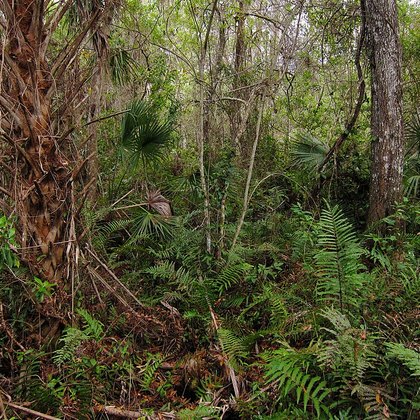
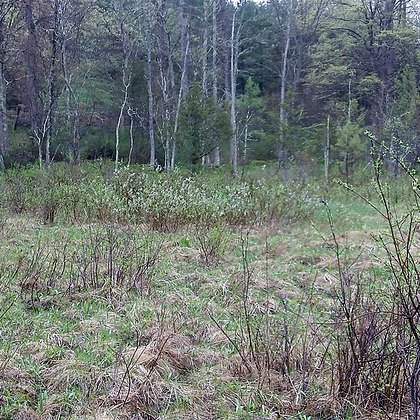
Where the bird is most often found, arranged by the USNVC — the vegetation classification of the United States and Canada — and CMECS for sea and coast.
Range and movements
Endemic to the Hawaiian Islands. By far the most birds live in the mountain forests of the island of Hawaii; a small population hangs on in east Maui, only a few hundred remain on Kauaʻi, and on Oʻahu, Molokaʻi and Lanaʻi it has gone or nearly so. It once occurred on all the main islands down into the lowlands, and its feathers were worked by the thousand into the cloaks and helmets of the Hawaiian chiefs. The collapse of the low-lying populations coincided with the establishment of the introduced southern house mosquito after 1826.
- Resident
Where and when to look
The surest places are high on the island of Hawaii: the Hakalau refuge on the eastern flank of Mauna Kea and the forest road above Volcanoes National Park, and on Maui the trail at Hosmer Grove in Haleakala, all early in the morning. Find an ʻohiʻa lehua in full flower and stay with it: every nectar bird in the forest comes past, and the ʻIʻiwi announces itself with the whirr of its wings. It sings most from October to December.
Conservation
Vulnerable (VU). The IUCN puts the population at 250,000 to 500,000 mature birds, nearly all on the island of Hawaii, and expects thirty to fifty per cent of them to be gone by 2030. The cause is avian malaria, carried by the southern house mosquito (Culex quinquefasciatus), which came ashore from a ship on Maui in 1826: about 94 per cent of infected ʻIʻiwi die, more than in any other honeycreeper. As long as it was too cool for the mosquito above a thousand metres a safe belt of forest remained, but with warming the mosquito line creeps higher year by year, and on Kauaʻi the top of the forest has already been reached. Since 2023, therefore, male mosquitoes carrying a bacterium that leaves them unable to father young have been released by drone on Maui and Kauaʻi to push the mosquito numbers down; alongside that, native forest is fenced against pigs and replanted.
Scientific name
Drepanis coccinea | (Forster, 1780)
Georg Forster described the species in 1780 as Certhia coccinea, among the treecreepers, from a specimen of Cook's third voyage; because it was later placed in Drepanis, author and year stand in parentheses. The genus Drepanis was introduced by Temminck in 1820, from Greek drepane, 'sickle', after the curved bill. coccinea is Latin for 'scarlet'. The type locality is given as the Hawaiian Islands; Stresemann suggested in 1950 that it was probably Kauaʻi. In Hawaiian the bird is ʻiʻiwi, and Dutch, English and Spanish all take the name over unchanged.