All species › Passerines › Finches, euphonias and allies › Maui Parrotbill
Maui Parrotbill | Pseudonestor xanthophrys
Mauipapegaaiensnavel | Pinzón Loro de Maui
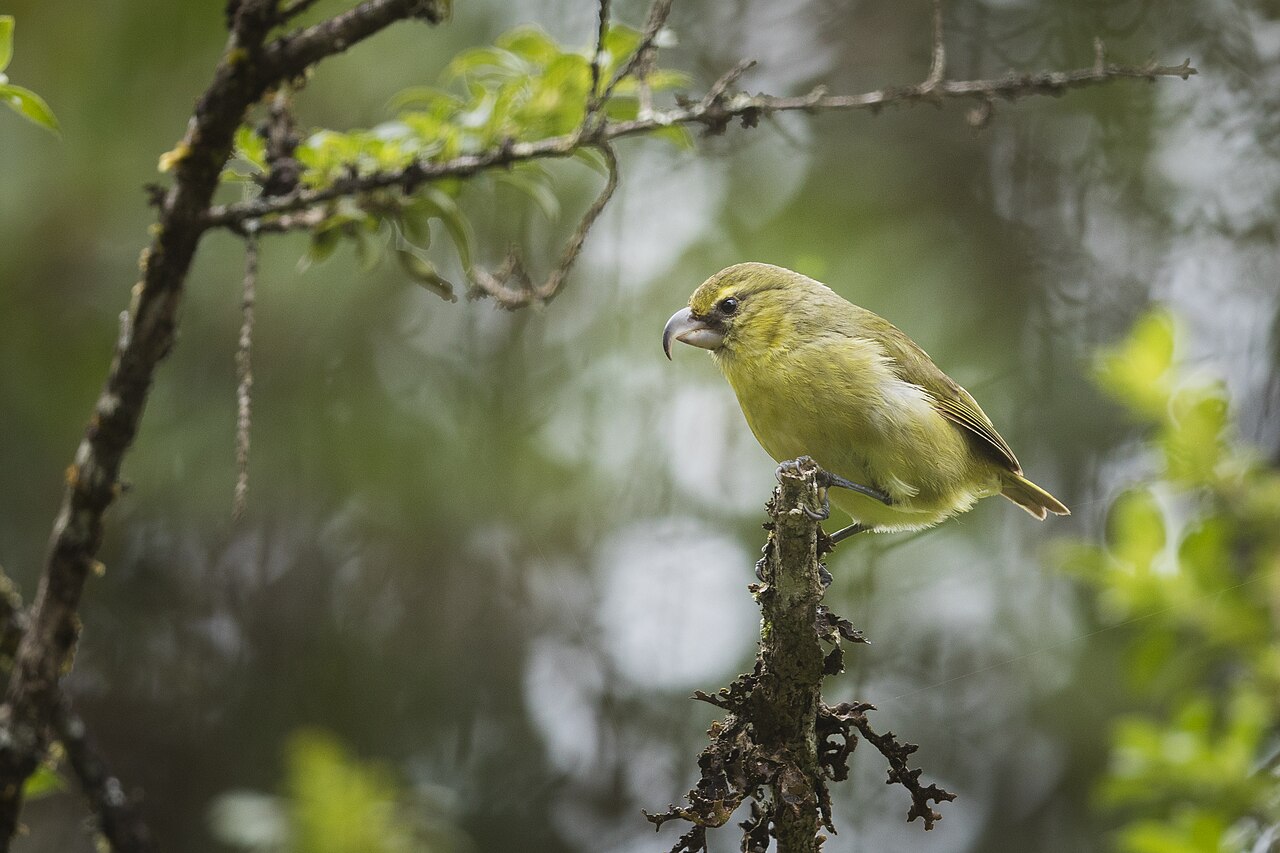
The Maui Parrotbill, or Kiwikiu, is a green-and-yellow honeycreeper with a heavy hooked bill with which it prises open branches and twigs to reach larvae. It survives only in a band of wet forest on the windward side of Haleakala on Maui and, with fewer than two hundred birds, is among the rarest songbirds in North America.
Voice
The call is a short chip, repeated every few seconds as the bird works through the branches. The song is a series of slow, full cheer notes, lower and richer than those of the other Maui honeycreepers, and a shorter variant sounding like cheer-wee. Often the sound of wood is noticed first: an audible cracking and splitting of twigs.
Recording: Brooks Rownd — CC BY-NC-SA 3.0 · TNC Waikamoi Preserve, Maui County, Hawaii, United States · xeno-canto
Identification
A stocky honeycreeper, olive-green above and yellow on cheeks, breast and belly, with a bright yellow eyebrow stripe above a dark lore. The bill is the feature: the upper mandible is dark grey, deep and strongly hooked, the lower pale ivory, straight and chisel-like, so that the two halves are plainly unequal. Males are larger and longer-winged than females; females and young birds are a duller yellow.
Confusion species
Hawaiʻi ʻAmakihi shares the forest and is also yellow-green, but smaller, with a thin curved bill of equal halves and no yellow eyebrow. The ʻAkiapolaʻau on Hawaii Island has a comparable build with unequal mandibles, but a long, strongly curved upper bill and an orange-yellow head; the two never occur on the same island. The introduced Warbling White-eye has a white eye-ring and a fine straight bill.
Habitat
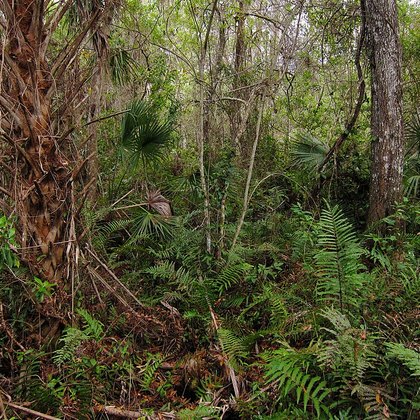
Wet and mesic montane forest of ohia lehua and koa (Acacia koa, a native Hawaiian tree) with a dense understorey of olapa and kanawao, on the windward slope of Haleakala between roughly 1200 and 2150 metres. It forages in wood: beetle larvae and caterpillars from dead branches, twigs and koa seed pods. Historically the species also occupied dry lowland forest down to two or three hundred metres and occurred on Molokaʻi.
Where the bird is most often found, arranged by the USNVC — the vegetation classification of the United States and Canada — and CMECS for sea and coast.
Range and movements
The whole range now amounts to some fifty square kilometres of forest on the northeastern slope of Haleakala, chiefly in the Hanawi Natural Area Reserve, the Waikamoi Preserve and adjoining Haleakala National Park. Subfossils and nineteenth-century records show the species once lived across Maui and on Molokaʻi, including dry leeward forest. The present range is thus less than a tenth of the original.
- Resident
Where and when to look
The species can be seen only on guided trips into the managed reserves; there is almost no freely accessible ground. Listen for the cracking of twigs in the understorey and then find the bird, working slowly and methodically along a dead branch, more like a tit than a nectar feeder. The yellow eyebrow and the heavy hooked bill are what settle it at close range.
Conservation
The species is listed as Critically Endangered (CR) and has been federally protected since 1967; recent estimates give fewer than 150 mature birds, with a steep decline since 2001. Avian malaria carried by introduced mosquitoes, which reach ever higher as the climate warms, is the main cause; damage to the forest by pigs and predation by rats and cats add to it. A captive breeding programme produced young, and in 2019 birds were released into the restored Nakula Natural Area Reserve on the leeward side, where nearly all the released birds died of malaria. Management has since concentrated on mosquito suppression using the Wolbachia method and on a reserve population in zoos.
Scientific name
Pseudonestor xanthophrys | Rothschild, 1893
Walter Rothschild described the species in 1893 as Pseudonestor xanthophrys, the name it still bears; author and year therefore stand without parentheses. The genus Pseudonestor is from Greek pseudos 'false' and Nestor, the genus of the New Zealand Kea and Kaka, after the parrot-like bill. The species name xanthophrys is Greek for 'yellow-browed'. The Hawaiian name kiwikiu was coined in 2010 from kiwi 'curved', for the bill, and kiu 'retiring', a word that also denotes a cold wind. The specimen described came from Maui.