All species › Passerines › Snowfinches and Old World sparrows › House Sparrow
House Sparrow | Passer domesticus
Huismus | Gorrión común
The House Sparrow is the bird of the pavement, the terrace and the filling station: a stocky brown bird hopping among table legs after crumbs and seldom more than a few metres from a building. It does not belong here naturally — birds from England were released in Brooklyn in 1851 and 1852 — and within a century it ran from Canada to Central America. Since 1966, by contrast, its numbers in North America have fallen steeply.
Voice
The sound of this species is an endlessly repeated cheerp or philip, differing a little in pitch from bird to bird, delivered for months on end from the same gutter or branch beside the nest hole. In a group it runs together into a busy, even chattering with no beginning and no end — the sound of a full hedge in the middle of the day. In flight and in excitement there is a rolling chur-r-r, and at a cat or a hawk a sharp, rapidly repeated chek chek chek at which the whole group dives into cover. Young birds beg with a hoarse, insistent wheezing that comes from under the eaves all summer.
Recording: Philippe Grange — CC0 · Arrondissement de la Roche-sur-Yon (near La Roche-sur-Yon), Vendée, Pays de la Loire, France · xeno-canto
Identification
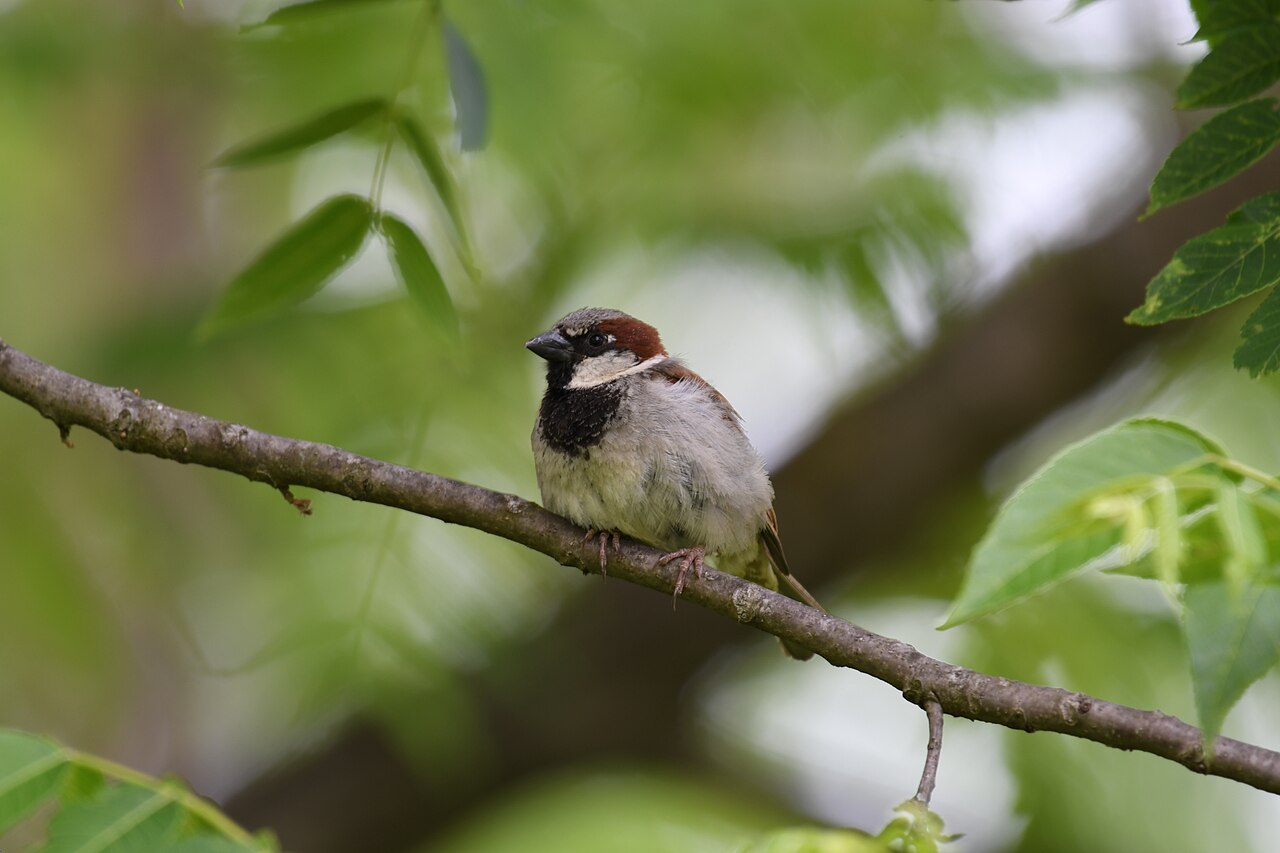
The male has a grey crown with a chestnut band running from behind the eye to the nape, a white cheek patch, and a black bib spreading from the chin over the breast; in fresh winter feathers that bib is still veiled by pale fringes, and in spring it is at its largest. The female is plain greyish brown, with a dull broad stripe behind the eye, an unmarked breast and a pale bill. Juveniles resemble the female but are a warmer yellow-brown and show a yellow gape. The back in both sexes is warm brown with black streaks, and the wing carries a single narrow white bar. The build is compact, with a short tail, a thick head and a heavy conical bill, black in summer and horn-coloured in winter.
Confusion species
Eurasian Tree Sparrow (Passer montanus), released in this region only around Saint Louis and still confined there, has an entirely chestnut crown in both sexes and a black spot in the middle of the white cheek. Native sparrows such as Song Sparrow are slimmer, longer-tailed and finer-billed, with a streaked breast and a dark central spot, and they keep to rough vegetation rather than the street. Females and young House Sparrows are the ones most often mistaken: look for the plain breast without a trace of streaking and for the short, heavy bill.
Habitat
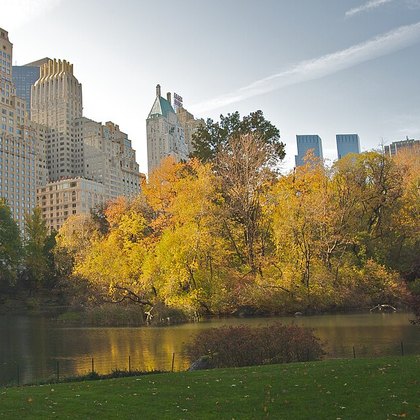
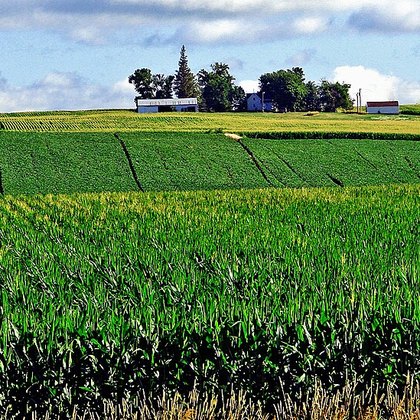
Towns, villages, farmyards, stockyards, harbours, industrial estates, gardens and parks — anywhere with grain, crumbs or cattle feed and a cavity to nest in. It stays away from closed forest, unbroken grassland, true desert and the far north; it follows people, and where the buildings stop the sparrow stops too. In summer it feeds on arable land; in winter the flock shifts to farmyards and barns. It is one of the few birds at home inside sheds, station halls and shopping centres.
Where the bird is most often found, arranged by the USNVC — the vegetation classification of the United States and Canada — and CMECS for sea and coast.



Range and movements
The North American population goes back to birds released in Brooklyn in 1851 and 1852, meant to control caterpillars in the city trees; dozens of separate introductions followed, from Portland to San Francisco. By about 1870 it ran from South Carolina to Texas and Montreal, in the 1870s it reached the west coast, and later Alaska and Central America. It now breeds from the settled part of Canada to Panama, with established populations in Hawaii, Bermuda, the Bahamas, Cuba, Jamaica and Puerto Rico. Only the far north and the uninhabited desert have stayed empty.
- Resident
- Breeding (summer)
- Winter
- Passage
- dark = core range, pale = thinly spread
Where and when to look
Watch a male in March or April calling beside a hole under a roof edge: he holds that spot all day and is back there next morning. At a winter feeder this is the species that arrives in parties and stays, while native sparrows work the ground beneath — the best chance there is to see the females of both side by side. Note the bill as you do: horn-coloured in winter, black in the breeding season.
Conservation
Some seven hundred and forty million House Sparrows are estimated to breed worldwide and the species is listed as Least Concern (LC). In North America numbers have fallen by about three per cent a year since 1966 — nearly eighty per cent in all — and the decline in Europe is severe as well. The causes are sought in the industrialisation of farming, which removes spilled grain and cattle feed, and in sealed modern building, which leaves no cavity to nest in. As a hole-nester it also takes over nest boxes from native birds, and for that reason it is not covered by the Migratory Bird Treaty Act.
Scientific name
Passer domesticus | (Linnaeus, 1758)
Linnaeus described the species in 1758 as Fringilla domestica, among the finches; because it was later moved to another genus, author and year stand in parentheses. The genus Passer was introduced by Brisson in 1760 and is no more than the ordinary Latin word for sparrow. domesticus means 'of the house', which is exactly where the bird is. The type locality is in Sweden: as with a few other introduced species in this guide, it was described from a European specimen, for in 1758 it did not yet occur in North America.