All species › Passerines › Snowfinches and Old World sparrows › Eurasian Tree Sparrow
Eurasian Tree Sparrow | Passer montanus
Ringmus | Gorrión molinero
The Eurasian Tree Sparrow owes its North American existence to a single introduction: twelve pairs released at St. Louis in April 1870. More than a century and a half later the entire North American population is still confined to a small area around that city, which makes it one of the most localized introduced birds on the continent.
Voice
The voice is a series of hard, clear tschip notes, higher and drier than House Sparrow and without its rolling quality. Unpaired males string those notes into a fast, excited series that serves as a song. In flight it gives a sharp, two-syllabled tek-tek that betrays the species in a mixed sparrow flock.
Recording: Walter Wallner — CC BY-NC-SA 4.0 · Deutsch Schützen-Eisenberg (near Edlitz im Burgenland), Oberwart, Burgenland, Austria · xeno-canto
Identification
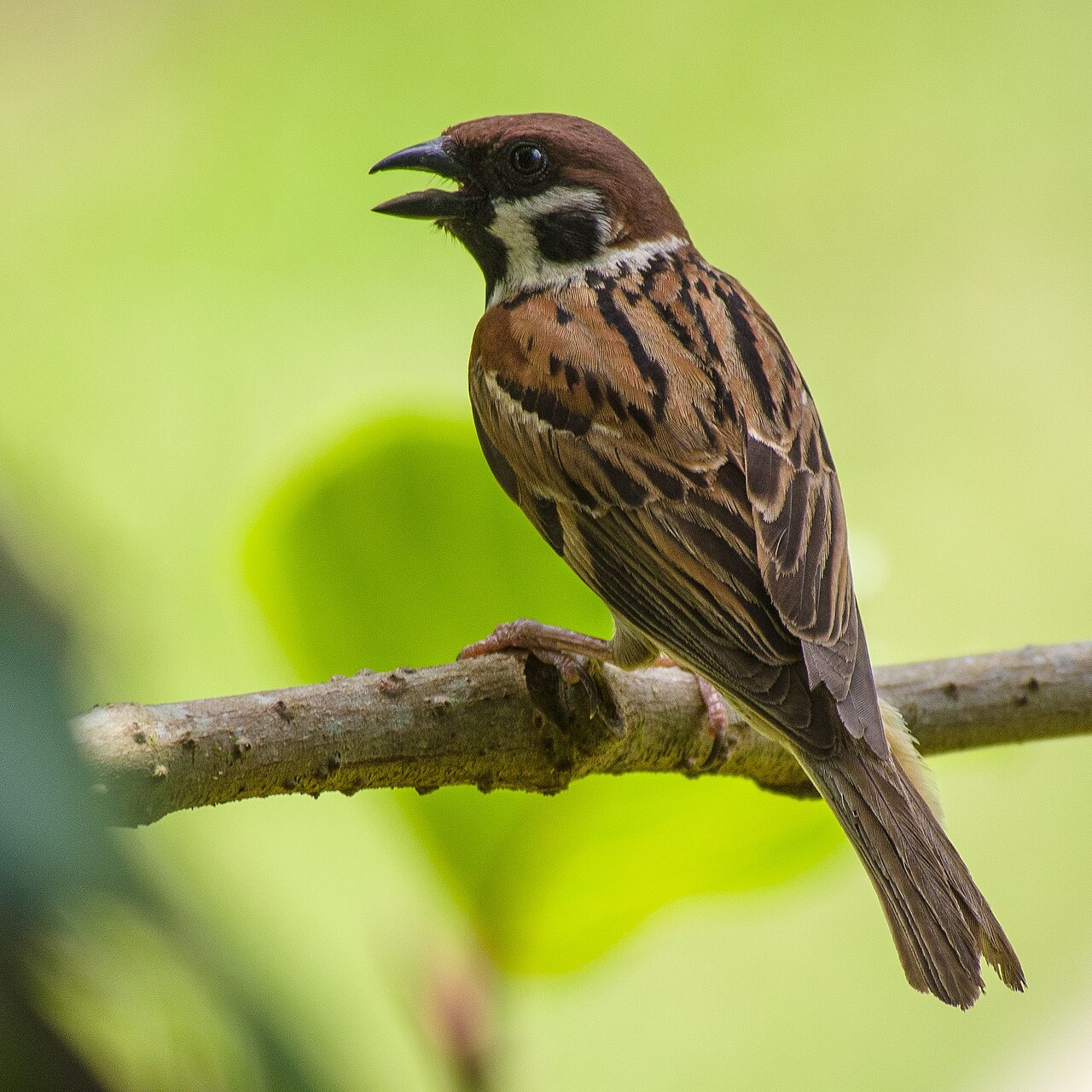
A small, compact sparrow, about a tenth smaller than House Sparrow, with the crown and nape wholly chestnut. The cheeks are white with a sharply defined black spot in the centre, and a narrow white collar runs round the neck; the throat patch is small and black. The back is warm brown streaked with black and the wing shows two white bars. Male and female are identically marked, which is unusual within this genus.
Confusion species
A male House Sparrow has a grey crown, a grey cheek without a black spot and a far larger black bib; the female is dull grey-brown with a pale supercilium and no chestnut at all. The black cheek spot on white is present in every plumage and at every age in Eurasian Tree Sparrow and is the quickest mark. Where the two feed together on the ground in Missouri and Illinois, the Eurasian Tree Sparrow also stands out by its smaller size and rounder head.
Habitat
In North America farmyards, hedgerows, village edges, parks and groves along the Mississippi and Missouri, usually where old trees or buildings provide cavities. Unlike House Sparrow it avoids the built-up city centre and prefers semi-open, lightly wooded farmland. It nests in tree holes, nest boxes, hollow posts and gaps in barns, and feeds on the ground on seed and spilt grain, with insects in summer.
Where the bird is most often found, arranged by the USNVC — the vegetation classification of the United States and Canada — and CMECS for sea and coast.






Range and movements
The natural range covers nearly all of Europe and Asia, from Portugal to Japan and Java. The North American population descends from the birds released at St. Louis in April 1870, part of a shipment of European birds meant for German immigrants. From there it spread slowly into northeastern Missouri, west-central Illinois and southeastern Iowa, together some 15,000 birds. Outside that area there are only stray records; the occurrence in Alaska involves Asian birds and is unconnected with the Midwestern population.
- Resident
- Breeding (summer)
- Winter
- Passage
- dark = core range, pale = thinly spread
Where and when to look
Look on farmyards and in villages north of St. Louis, along the Mississippi in Missouri and Illinois, and at feeders in winter. Scan mixed sparrow flocks for the black cheek spot and use size: a sparrow clearly smaller and rounder than the rest is usually this species.
Conservation
Worldwide the species is listed as Least Concern (LC), though numbers in western Europe fell sharply during the twentieth century with changes in farming. The North American population is small but stable and stays within a few hundred kilometres; its expansion is probably held back by the far commoner House Sparrow, which takes the better nest cavities. Because every bird descends from a handful of founders, this population differs in size, genetics and song from its German ancestors.
Scientific name
Passer montanus | (Linnaeus, 1758)
Linnaeus described the species in 1758 as Fringilla montana; because it was later moved to another genus, author and year stand in parentheses. The genus name Passer is Latin for 'sparrow'. The species name montanus means 'of the mountains', which does not match the habits of a bird found almost everywhere in the lowlands. The Dutch name refers to the white collar; the English 'tree sparrow' and the Spanish gorrión molinero point to the tree cavities and to the mills and farms where the species nests. The type locality 'in Europe' was later fixed on Bagnacavallo near Ravenna in Italy.