All species › Cranes, rails and allies › Rails, gallinules and coots › Hawaiian Coot
Hawaiian Coot | Fulica alai
Hawaiimeerkoet | Focha hawaiana
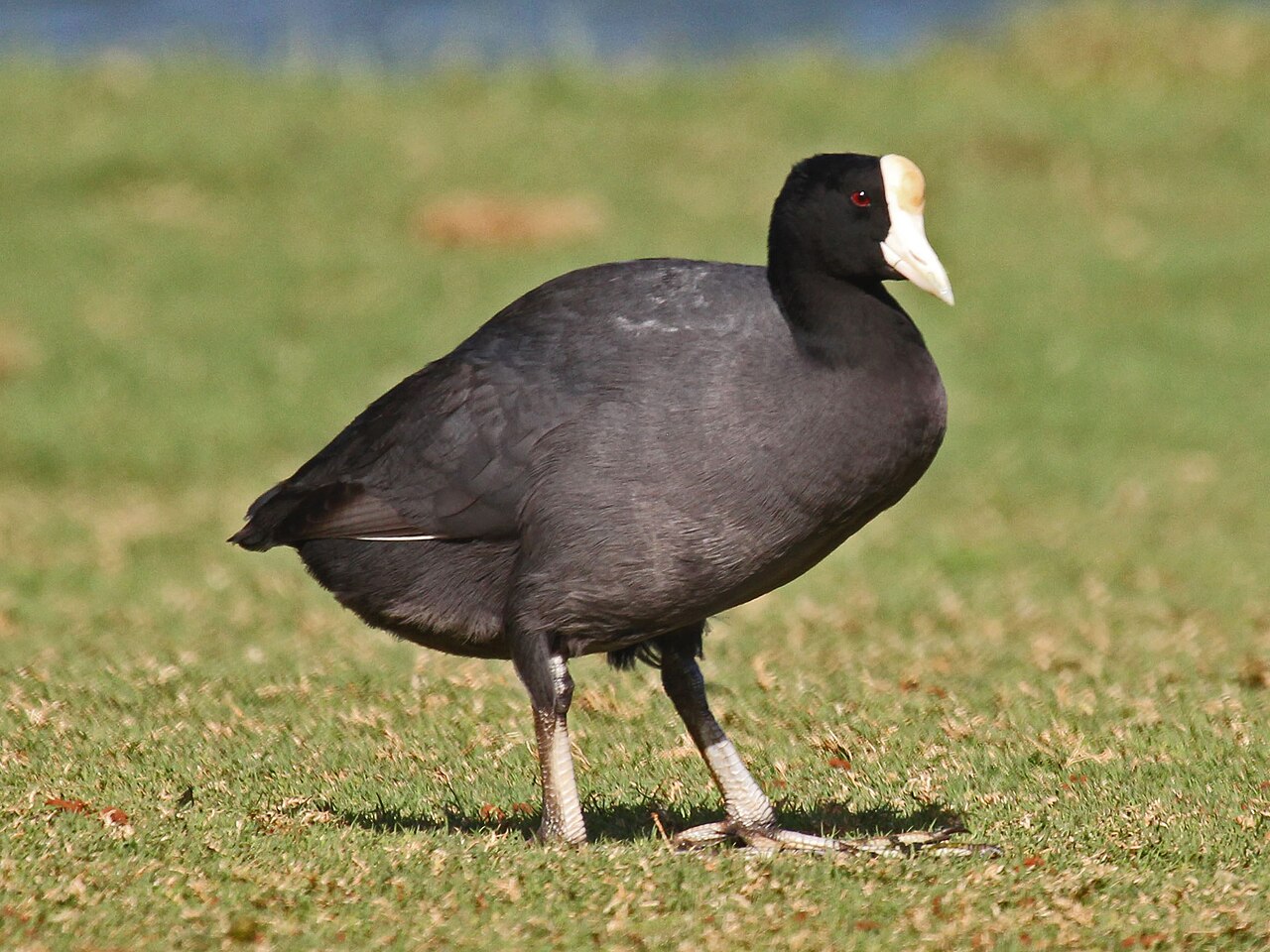
The Hawaiian Coot is the coot of the Hawaiian Islands: slate grey, with a large white frontal shield that covers half the forehead. It is the only coot in the world confined to a single archipelago, and it holds on in a handful of marshes, taro fields and ponds. Its Hawaiian name, ʻalae keʻokeʻo, means 'white alae'.
Voice
A sharp single-noted keek, usually from dense cover at the water's edge and often the first sign that the bird is there. Beyond that, drawn-out sequences of harsh croaking and cackling much like American Coot. In disputes — and there are many — a loud barking screech carries across the water. It calls all year, most of all in the breeding season and at dusk.
Recording: Jim Holmes — CC BY-NC-SA 4.0 · Kealia NWR, Kihei, Maui County, Hawaii, United States · xeno-canto
Identification
A squat, blackish-grey waterbird with a chicken-like white bill and a bulging white frontal shield far larger than that of any other coot. Head and neck are black, the body slate grey, with white feathering under the tail that flashes now and then as it swims. The eye is red, the legs greenish yellow, and the toes carry broad lobes instead of webs. A small minority of birds have a deep red shield rather than a white one; that is nothing but a colour variant. Juveniles are greyer, with a white throat, a dull bill and hardly any shield.
Confusion species
There is no other coot on the islands, but American Coot (Fulica americana) turns up now and then as a vagrant and looks similar. It is slightly larger and has a much smaller white shield with a reddish-brown spot at the top, and usually a dark band just behind the bill tip. Common Gallinule (Gallinula galeata), which lives in the same marshes, has a red shield, a red bill with a yellow tip and a white line along the flank.
Habitat
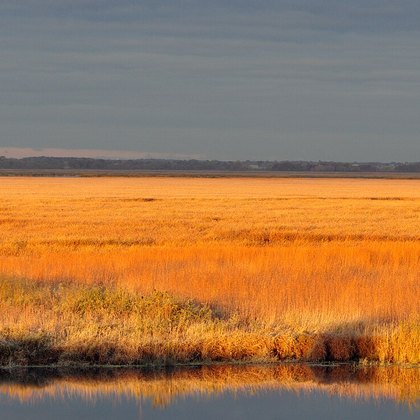
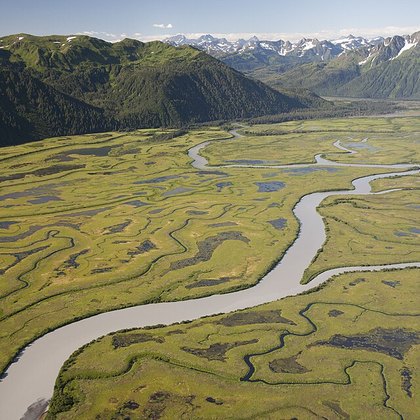
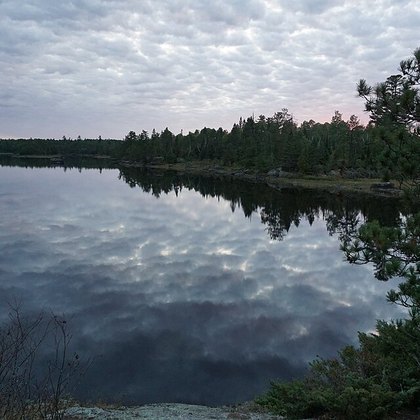
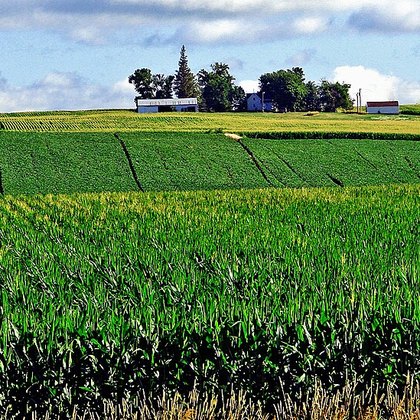
Shallow freshwater marshes with reeds and sedges, silted ponds, taro fields, old rice land, small reservoirs and sewage lagoons, mostly below three hundred metres. Also brackish coastal ponds and the old Hawaiian fishponds, where it shares the open water with stilts. It needs open water to dive in and a dense fringe to anchor the floating nest; heavily overgrown and wholly bare waters it avoids. Outside the breeding season it gathers on the largest sheets of water.
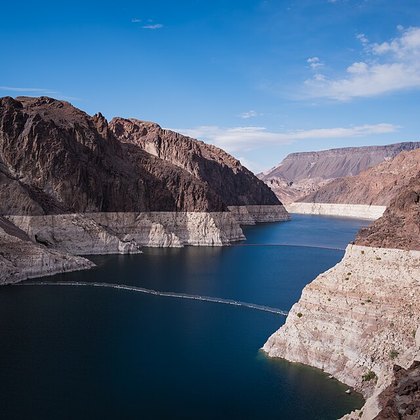
Where the bird is most often found, arranged by the USNVC — the vegetation classification of the United States and Canada — and CMECS for sea and coast.
Range and movements
Endemic to the Hawaiian Islands, breeding on Niʻihau, Kauaʻi, Oʻahu, Molokaʻi, Maui and Hawaii; most birds are on Oʻahu, Kauaʻi and Maui. It does not migrate, but flies regularly from island to island, following the water: when a marsh dries out the whole flock leaves. Wanderers reach the far islands of the northwestern chain. Filling and draining of the coastal marshes shrank its range badly during the twentieth century; with wetland restoration since the 1980s numbers have risen again.
- Resident
Where and when to look
The managed marshes of the coastal refuges give the surest chance all year round: Hanalei and Huleʻia on Kauaʻi, Kanaha and Kealia Pond on Maui, James Campbell and Kawainui on Oʻahu. On the water, look at the shield: in this species it is so large that even at distance the head looks broad and top-heavy. A bird with a red shield is not another species but a variant of the same one.
Conservation
The whole world population is about 1,250 to 1,750 mature birds, spread over a few dozen wetlands. The IUCN rates the species Near Threatened (NT); the United States lists it as endangered. Numbers swing widely with rainfall and with water levels in the managed marshes. The threats are the classic island ones: loss of lowland marsh to building and farming, introduced rats, cats and mongooses taking eggs and young, alien water plants closing over the open water, and outbreaks of botulism. Management consists mainly of controlling water levels, trapping predators and mowing the margins.
Scientific name
Fulica alai | Peale, 1849
Titian Peale described the species in 1849 as Fulica alai, from specimens of the Wilkes exploring expedition; it still stands in the same genus, so author and year carry no parentheses. Fulica is the ordinary Latin word for a coot. alai is the Hawaiian ʻalae, the name for the marsh hens of the islands; this one is ʻalae keʻokeʻo, 'white alae', against the red-shielded gallinule. The type locality is given no more precisely than 'the Hawaiian Islands'.