All species › Passerines › Finches, euphonias and allies › Hawaiʻi Creeper
Hawaiʻi Creeper | Loxops mana
Hawaiikruiper | Trepador de Hawái
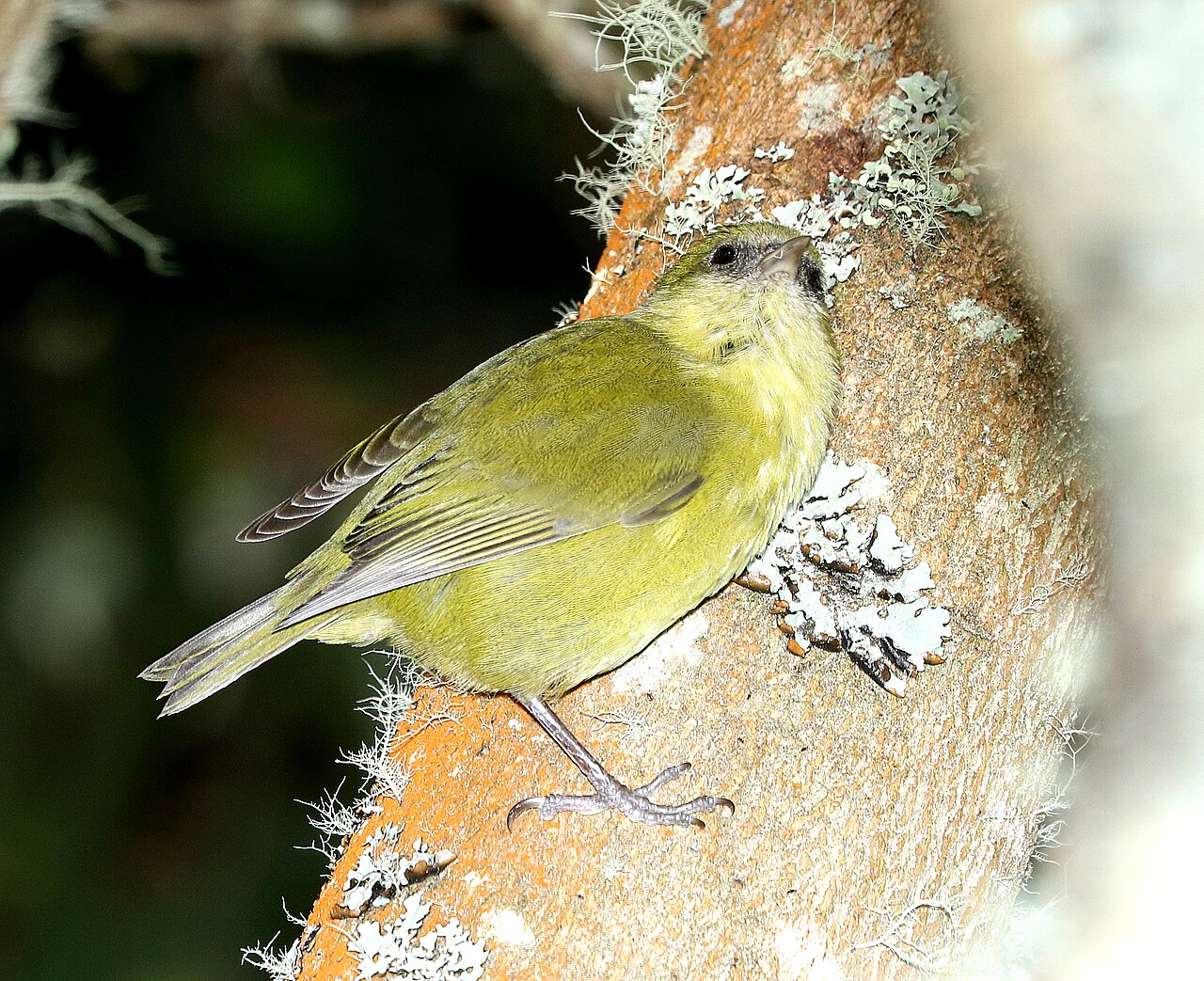
The Hawaiʻi Creeper, in Hawaiian ʻalawi, is a green and yellow honeycreeper found only on the island of Hawaii. It takes its name from the way it feeds: it works up and down trunks and heavy limbs, picking insects out of bark, moss and lichen.
Voice
The male's song is a descending trill of about a second, usually repeated several times in succession and weaker in volume than the song of the Hawaiʻi ʻAmakihi. The call is a soft, short chip or tseet, sounding almost continuously within mixed flocks. Outside the breeding season the voice is the most reliable clue, since the bird stays in the canopy and moves without drawing attention.
Recording: Brooks Rownd — CC BY-NC-SA 3.0 · Station 11-27, below Nauhi Experiment Station, Honohina Tract, Hakalau Forest NWR, Hawaii County, Hawaii, United States · xeno-canto
Identification
Eleven to thirteen centimetres, slightly larger than the Hawaiʻi ʻAkepa. Green above, yellowish below, with a grey head and throat and a black mask running from the base of the bill across the eye and ending in a point behind it; the mask is broader on the male. The bill is short and tapered, slightly curved — straighter than an ʻamakihi's, but clearly longer than an ʻakepa's. The bird climbs along the trunk and often hangs beneath a branch.
Confusion species
The Hawaiʻi ʻAmakihi has a narrower, less sharply edged mask, a longer and more strongly curved bill, and feeds among leaves and flowers rather than on bark. The Hawaiʻi ʻAkepa is smaller, with a minute bill and a longer notched tail, and the male is orange. The Warbling White-eye has a white eye-ring and lacks the black mask. Trunk-climbing is the quickest separation from all three.
Habitat
Old, closed montane forest of koa (Acacia koa, a native Hawaiian tree) and ohia, mainly between roughly one thousand and two thousand metres and most numerous above fifteen hundred. The species needs trees with rough bark carrying moss and lichen; young or open forest yields far less food. Outside the breeding season, from late summer into winter, it joins mixed flocks with ʻamakihi and ʻakepa. Insects and spiders are the main food, with nectar from koa and ohia in addition.
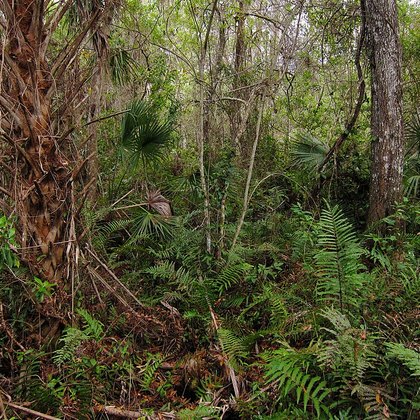
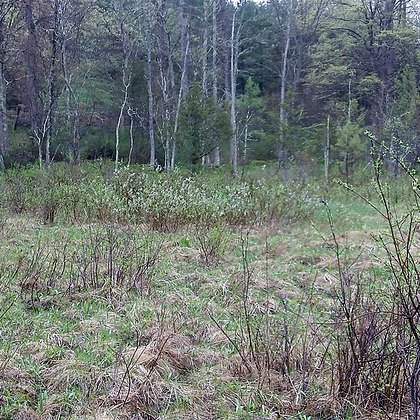
Where the bird is most often found, arranged by the USNVC — the vegetation classification of the United States and Canada — and CMECS for sea and coast.
Range and movements
Confined to the island of Hawaii, in three separate core areas: the Hamakua slopes with Hakalau Forest National Wildlife Refuge, the high forests of Kaʻu, and the north slope of Hualalai, where the species may now be gone. The total population has been put at about twelve thousand birds. At Hakalau numbers over 1987–2024 were on the whole stable to increasing, while they fell in the densest forest stratum.
- Resident
Where and when to look
Hakalau Forest Refuge offers the best chance, but the public section is reached only by a rough mountain road; day trips with a permitted guide also go there. Look in the morning, before the cloud closes in, and put your binoculars on trunks and heavy limbs rather than on flowering crowns — that is where the difference from the ʻamakihi lies.
Conservation
The species is listed as Endangered (EN) and has held federal protection since 1975. Avian malaria and avian pox are the main pressure, with rat predation and damage to the forest by cattle and pigs alongside. At Hakalau, fencing, removal of hoofed animals and koa replanting have held numbers up, which sets this species apart from the ʻakepa in the same refuge. The upward shift of the mosquito season is the longer-term problem.
Scientific name
Loxops mana | (Wilson, 1891)
Scott Barchard Wilson described the species in 1891 as Himatione mana; because it was later moved to another genus, author and year stand in parentheses. The genus Loxops was introduced in 1847 by Jean Cabanis, from Greek loxos 'slanting' and ops 'face', after the sideways-crossed bill tips of the group. The species name mana is a Hawaiian word that Wilson took over. The English name refers to the climbing along trunks; since 2017 the Hawaiian name ʻalawi has also been in use.