All species › Passerines › Finches, euphonias and allies › ʻAkekeʻe
ʻAkekeʻe | Loxops caeruleirostris
ʻAkekeʻe | ʻAkepa de Kauaʻi
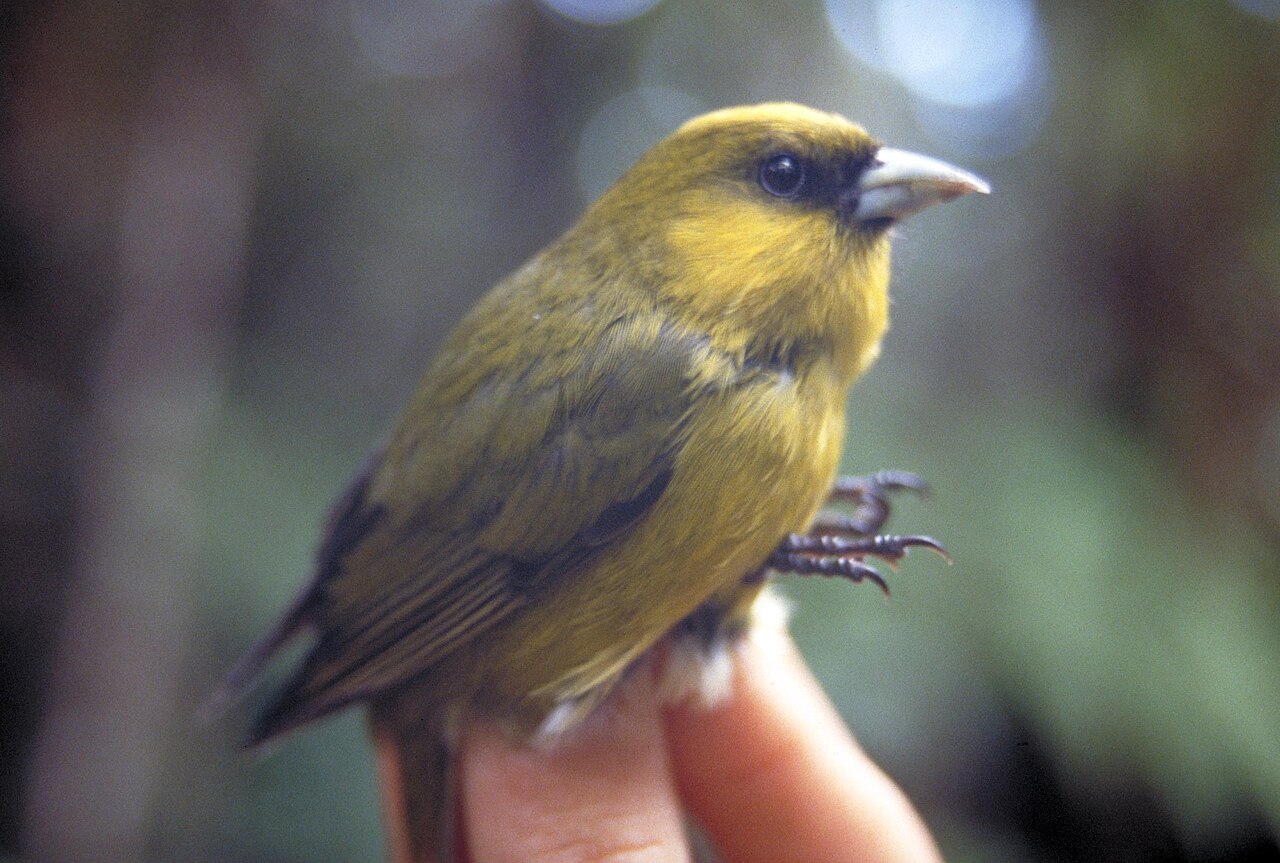
The ʻAkekeʻe is a small green and yellow honeycreeper of the wet montane forest of Kauaʻi, with a blue-grey bill whose tips slide past each other sideways. Of all the birds in this guide it has one of the smallest surviving populations: numbers have fallen by more than ninety per cent in two decades.
Voice
The song is a wavering trill of one or two seconds that changes in speed and pitch — first accelerating and rising, then falling away again. The call is a soft, upslurred su-weet, given at intervals while feeding. In the wet forest of the Alakai the sound carries poorly, and in mist or wind the species is seldom detected.
Recording: Ross Gallardy — CC BY-NC-SA 4.0 · Alaka'i Swamp trail, Kaua'i, Hawaii , United States · xeno-canto
Identification
Ten to eleven centimetres. Green-yellow, with a yellow crown and throat and a black mask around the eye, sharpest on the male; the female is greener and duller. The bill is short and conical, blue-grey, with the tip of the lower mandible bent to one side — a feature visible only at close range. The tail is long for the size, forked and notched at the tip.
Confusion species
The Kauaʻi ʻAmakihi, which lives in the same forest, has a long, pale, strongly curved bill, no yellow crown and a square tail, and works along trunks and thick branches; the ʻAkekeʻe stays out at the outermost leaf clusters of the ohia. The ʻAnianiau is smaller, plain bright yellow without a black mask, and has a short, slightly curved bill. The crossed bill tips are the definitive mark, but are seldom visible in the field.
Habitat
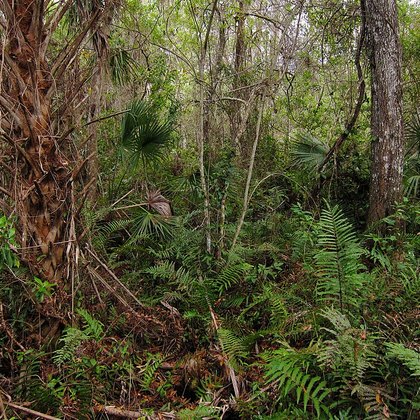
Wet native montane forest dominated by ohia, above six hundred metres and densest above eleven hundred, where mosquito pressure is lowest. The bird forages almost entirely at the ends of branches: it prises open ohia leaf buds and flower buds with its bill and takes spiders, psyllids and caterpillars from them. That food requires an undisturbed native canopy; plantations and secondary forest do not supply it.
Where the bird is most often found, arranged by the USNVC — the vegetation classification of the United States and Canada — and CMECS for sea and coast.
Range and movements
Confined to Kauaʻi, and there now restricted to the Alakai Wilderness, Kokee State Park and Waimea Canyon State Park. Estimates ran from fewer than five thousand birds in 2012 to fewer than a thousand in 2016 and fewer than six hundred and forty in 2021; more recent counts put the wild population at fewer than a hundred birds. The decline runs at about twenty-one per cent a year, leaving the remaining nuclei small and fragmented.
- Resident
Where and when to look
The chance of a sighting is slim; the Pihea Trail and the Alakai Swamp Trail at Kokee are the only places where it still happens. Go in dry, clear weather early in the morning and listen for the wavering trill, because at any distance the bird is hardly separable from the Kauaʻi ʻAmakihi. Watch where it feeds: outer leaf clusters point to this species, a trunk to the ʻamakihi.
Conservation
The species is listed as Critically Endangered (CR) and is protected federally and by the state. Avian malaria carried by the introduced southern house mosquito is the decisive factor: as the climate warms, mosquitoes reach ever higher into the Alakai, and the bird has no higher, disease-free forest left above it. Rat predation, damage to the forest by pigs and goats, and invasive plants add to this. In 2025 the release of sterile male mosquitoes began on Kauaʻi to break transmission, and birds have been taken into captivity to build a reserve population.
Scientific name
Loxops caeruleirostris | (Wilson, 1890)
Scott Barchard Wilson described the species in 1890 as Chrysomitridops caeruleirostris; because it was later moved to another genus, author and year stand in parentheses. The species name is Latin: caeruleus 'blue' and rostrum 'bill', thus 'blue-billed', the mark that separates it from the ʻakepa of the other islands. The genus Loxops was introduced in 1847 by Jean Cabanis, from Greek loxos 'slanting' and ops 'face'. ʻAkekeʻe is the bird's Hawaiian name.