All species › Passerines › Crows, jays and magpies › Green Jay
Green Jay | Cyanocorax yncas
Incagaai | Chara verde
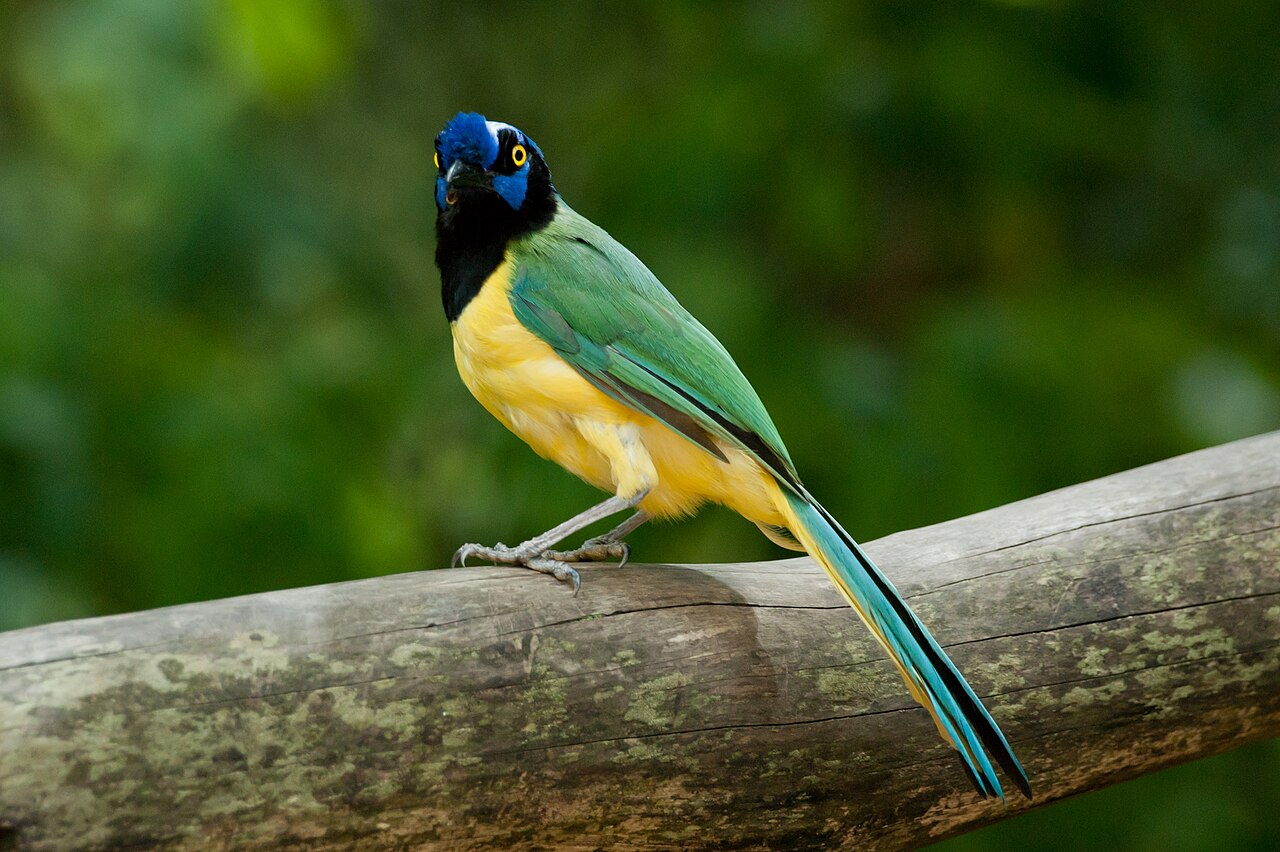
The Green Jay is the only green jay of North America: green on back and wings, with a blue head and a black mask. At the northern end of its range it reaches no further than the southern tip of Texas, where it stays year round in the brushland along the Rio Grande.
Voice
The repertoire is wide and consists mostly of short, hard series. The commonest sound is a rasping, rattling chek-chek-chek-chek, often from several birds at once. There is also a clear, metallic ticking that recalls an electric bell, and a soft rolling chatter within the group. The species imitates the calls of other birds, including raptors; that imitation is used to drive other birds away from a food source. A song in the sense of a fixed phrase is absent.
Recording: Juan Freile — CC BY-NC-SA 4.0 · Zamora-Chinchipe: Copalinga, Ecuador · xeno-canto
Identification
Back, wings and tail are grass green, the belly is yellow-green to yellow, and the outer tail feathers are yellow. The head carries a black bib and a black mask, with a blue or whitish-blue crown and blue patches above the eye and on the cheek. The short crown feathers can be raised into a low crest. The bill is black and heavy, as in all jays. Birds from Texas and northeastern Mexico have a pale green belly and a dark brown eye; southward the belly becomes deeper yellow and the eye yellow. Young birds are duller and the mask is less sharply defined.
Confusion species
Within its range there is no other green songbird of this size. Woodhouse's Scrub-Jay lives in west Texas but not in this range; Blue Jay overlaps at the northern edge, but is blue and white with no green. What is confusing is the limits of the species itself: the birds from Texas to Honduras and those of the Andes from Colombia to Bolivia are separated by some 1500 kilometres and differ in size, in belly and eye colour and in voice. Some lists therefore split them into two species (Cyanocorax luxuosus in the north, C. yncas in the Andes); here they are treated as one. In south Texas a few hybrids with Blue Jay have been recorded; those birds are green-blue with a mixed head pattern.
Habitat
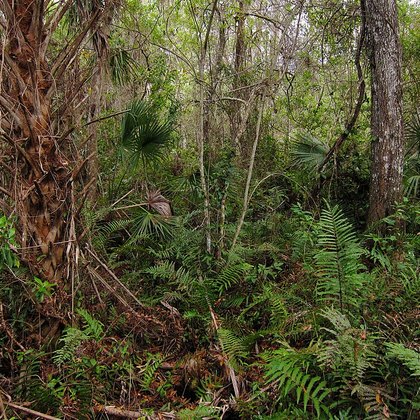
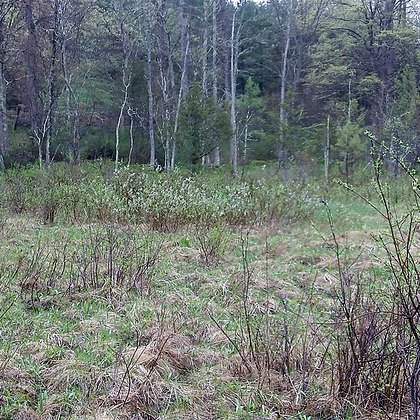
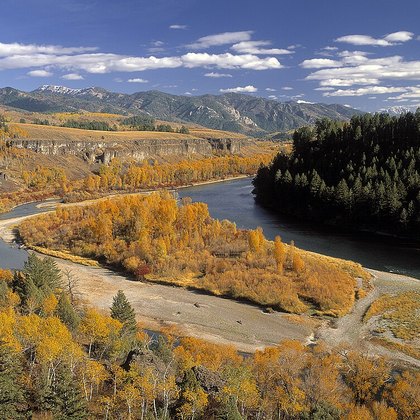
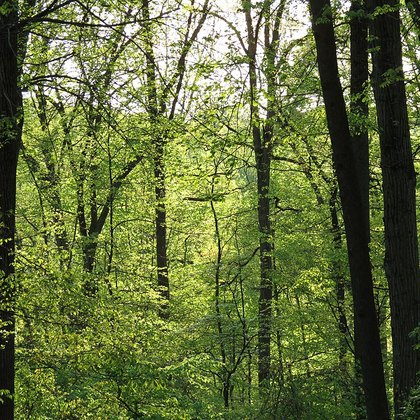
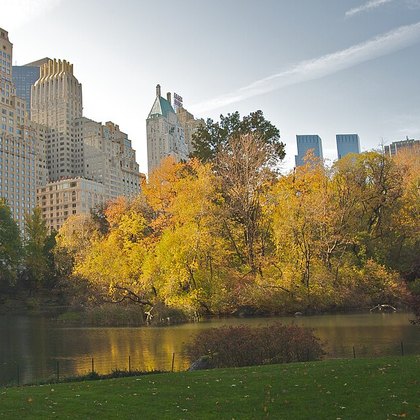
Dense thorn scrub and low woodland, usually near water: in Texas the Tamaulipan thornscrub and the remaining woods of mesquite (thorny legume shrub of the southwest, forming dense thickets), ebony and hackberry along the Rio Grande. Further south it is tropical deciduous forest, cloud forest and forest edge up to about 2000 metres. It avoids open ground and forages in the lower and middle levels. In settled country it visits gardens, parks and the feeding stations of the refuges.
Where the bird is most often found, arranged by the USNVC — the vegetation classification of the United States and Canada — and CMECS for sea and coast.
Range and movements
From south Texas across eastern Mexico, Belize and Guatemala to Honduras, and separately in the Andes from Colombia and Venezuela south to Bolivia. The birds do not migrate. In Texas the centre lies in the Lower Rio Grande Valley; during the twentieth century the northern limit moved from the immediate riverbank to Live Oak, Bee and Maverick counties, with breeding records as far as Alice and Kingsville. The species stays within its breeding range; outside the season groups wander over short distances.
- Resident
- Winter
- Passage
- dark = core range, pale = thinly spread
Where and when to look
At Santa Ana and Bentsen-Rio Grande Valley State Park it walks about on the feeding tables, including in the middle of the day. If you hear the rattling chek-chek from dense brush, stand still: the group usually works its way through the bushes towards you within a few minutes. From April to June it is quieter than in winter, because breeding pairs then behave inconspicuously.
Conservation
The IUCN places the species in the Least Concern (LC) category and considers numbers to be increasing. In Texas the range expanded northward during the twentieth century, despite the loss of most of the original riparian woodland in the Lower Rio Grande Valley; restoration of that woodland in the refuges along the river adds new habitat. The oldest ringed bird was at least eleven years and seven months old.
Scientific name
Cyanocorax yncas | (Boddaert, 1783)
Boddaert described the species in 1783 as Corvus yncas, from a plate of a bird from Peru; because it was later moved to another genus, author and year stand in parentheses. The type locality was restricted by Zimmer in 1953 to Chilpes in the department of Junín. The species name yncas refers to the Incas, and so to the Peruvian origin of the specimen described. The genus Cyanocorax is from Greek kyanos 'dark blue' and korax 'raven'.