All species › Falcons › Falcons and caracaras › Crested Caracara
Crested Caracara | Caracara plancus
Kuifcaracara | Caracara Carancho
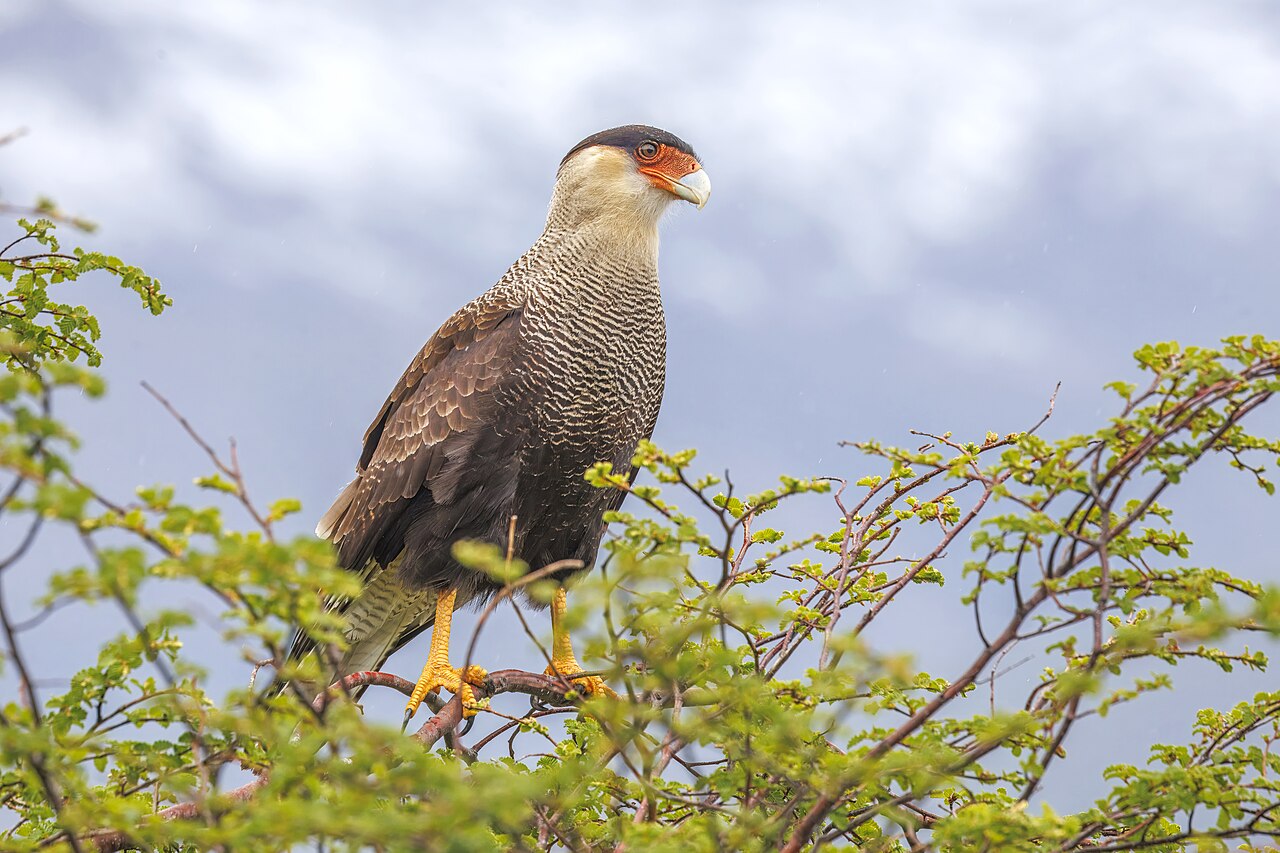
The Crested Caracara departs sharply from the true falcons in build and behaviour: a bare, orange-red face, long legs and a preference for walking over flying make it more of a scavenger than a hunter. In the southern United States it reaches only the edge of its range, which otherwise runs through all of Middle and South America.
Voice
Its name imitates the call: a harsh, rattling cara-cara-cara, given with the head thrown back against the shoulders. Nest defence and disputes over food produce a series of shorter, cracking notes. Outside these situations the species is largely silent.
Recording: JAYRSON ARAUJO DE OLIVEIRA — CC BY-NC-SA 4.0 · Reserva do Setor Sítio de Recreio Caraíbas-Goiânia, Goiás, Brazil · xeno-canto
Identification
A large, long-legged raptor with a black cap and crest above a bare, orange-red face and a blue-grey bill. The neck and upper breast are white with fine barring, the rest of the body blackish-brown. In flight the white wingtips and white tail base stand out against the otherwise dark plumage, carried on nearly straight wings with slow, powerful beats.
Confusion species
At a distance the Crested Caracara's black colouring recalls the Black Vulture, but that species lacks white wingtips and soars with its wings held in a shallow V, while the caracara flies on flat wings with steady beats. The bare orange-red head and long yellow legs settle any ground sighting at once.
Habitat
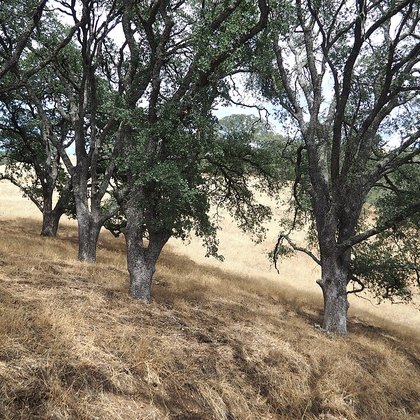
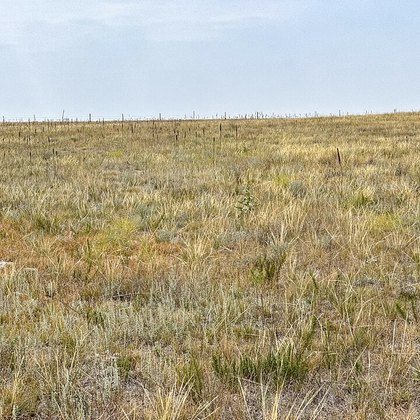
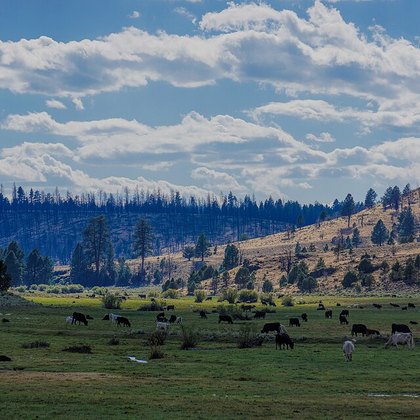
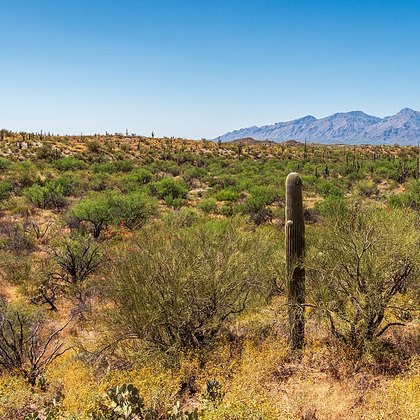
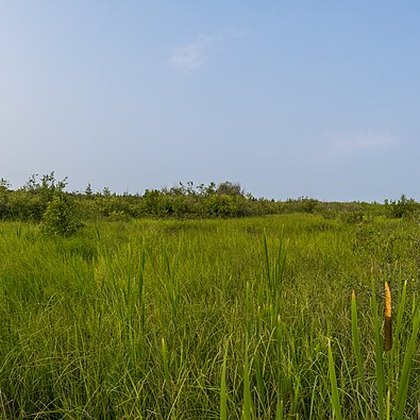
Open, damp prairie, pasture and farmland with scattered trees, poles or fences for perching make up the habitat in Florida and Texas. Farther south it also occupies savanna and semi-desert with short grass, always in open terrain where it can walk in search of carrion and small prey.
Where the bird is most often found, arranged by the USNVC — the vegetation classification of the United States and Canada — and CMECS for sea and coast.
Range and movements
The breeding range runs from southern Texas, the extreme south of Arizona and central Florida south through all of Mexico and Middle America deep into South America. Within this range the Crested Caracara is a year-round resident: adults stay near their territory throughout the year, while young birds may wander several tens of kilometres after fledging in search of a place of their own.
- Resident
- Breeding (summer)
- Winter
- Passage
- dark = core range, pale = thinly spread
Where and when to look
Drive the back roads of southern Texas in spring and scan poles, dead trees and fence lines along open pasture: Crested Caracaras often gather there with Black Vultures at a roadside carcass, their orange-red heads setting them apart at once. In Florida the best areas are the open pastures and prairies north and west of Lake Okeechobee.
Conservation
Globally the species is listed as Least Concern (LC), given its large and continuous range through Middle and South America. The isolated population in central Florida is small and receives federal protection, since the damp prairie it depends on has been reduced by farming and housing development.
Scientific name
Caracara plancus | (Miller, 1777)
Miller described the species in 1777 as Falco Plancus, with Tierra del Fuego as the type locality. It has since been placed in several genera, including Polyborus for a long period; only after Banks and Dove established in 1992 that Caracara, introduced by Merrem in 1826, is the valid generic name did it settle for good in that genus, hence the parentheses around author and year: Caracara plancus (Miller, 1777). Caracara derives from the Guaraní word for the bird, itself an imitation of its call; plancus is Latin for 'flat-footed', after its broad feet, but also a variant of plangus, the Latin name for a kind of eagle; which meaning Miller intended is uncertain.