All species › Woodpeckers and allies › Woodpeckers › Arizona Woodpecker
Arizona Woodpecker | Leuconotopicus arizonae
Arizonaspecht | Carpintero de Arizona
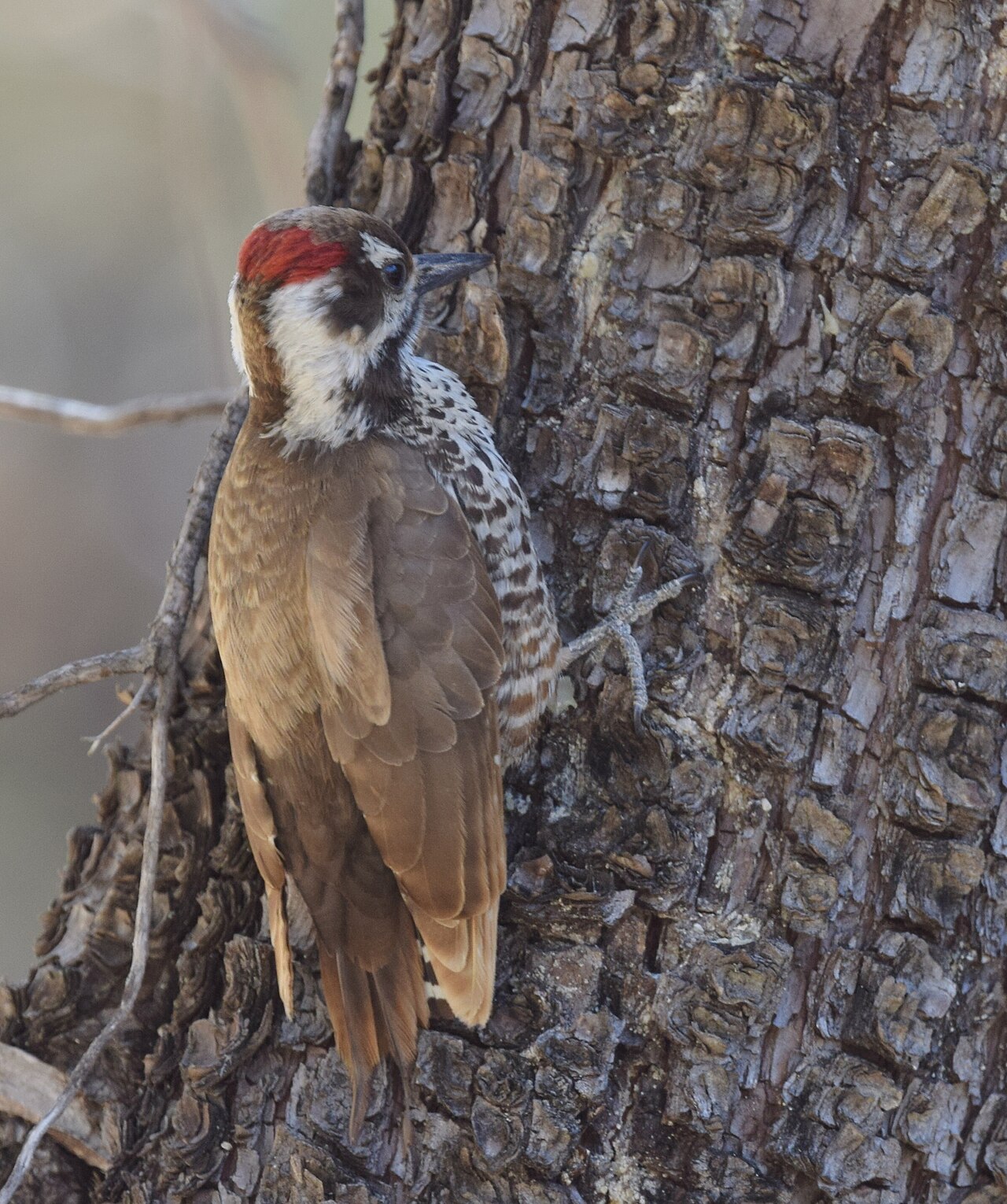
The Arizona Woodpecker is the only woodpecker in the United States with a plain brown back. It lives in the oak and pine-oak woodland of the mountains of south-eastern Arizona and south-western New Mexico, the so-called sky islands, and further south along the western flank of the Sierra Madre Occidental in Mexico. It is a quiet, unobtrusive bird that works its way up trunks and branches in short hitches along a spiral.
Voice
The usual call is a sharp, somewhat hoarse keech, reminiscent of the call of Hairy Woodpecker but rougher. It also gives a rattle of descending, grating notes, often during encounters between birds. In spring the males advertise with calls and a short, even drum on dead wood. Outside the breeding season it is largely silent, so the breeding season from March to May is the time to find it by sound.
Recording: Barry Edmonston — CC BY-NC-SA 4.0 · Acarichi, Guachochi, Chihuahua, Mexico · xeno-canto
Identification
A small to medium-sized woodpecker with a plain chocolate-brown back and brown wings with fine white spots. The white underparts are densely marked with brown spots and, on the flanks, with brown bars. The head is brown with a broad brown ear patch, framed by a white stripe above and a white stripe below the eye, which together with a white neck patch form a clear face pattern. The outer tail feathers are white with brown bars. The male has a red patch on the nape, which the female lacks. Males have a noticeably longer bill than females.
Confusion species
Within its US range confusion is hardly possible, since all the other woodpeckers there are black and white. Ladder-backed Woodpecker, found in lower, drier country, has a black-and-white barred back and a black-and-white head. Hairy Woodpecker has a black head with white stripes and a clean white back stripe. In Mexico, Strickland's Woodpecker (Leuconotopicus stricklandi) of the volcanoes of central Mexico looks similar, but it has a white-barred back and a breast that is streaked rather than spotted; their ranges do not meet.
Habitat
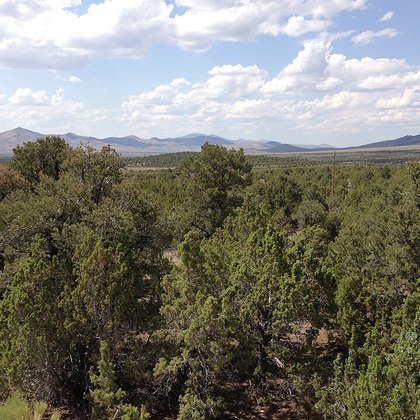
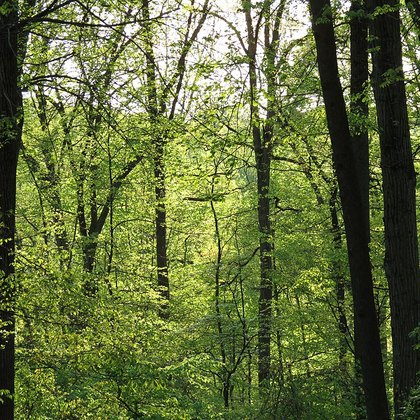
Dry pine-oak and oak woodland on mountain slopes and in canyons, mostly between about 1,200 and 2,300 metres, locally a little lower in sheltered ravines. Also important are the sycamore and walnut woods along streams in the canyons, where it likes to nest. It usually excavates its nest cavity in dead wood, often in a dead limb of an oak, sycamore or walnut. It feeds mainly on beetle larvae, supplemented with berries and acorns.
Where the bird is most often found, arranged by the USNVC — the vegetation classification of the United States and Canada — and CMECS for sea and coast.
Range and movements
In the United States confined to the mountain ranges of south-eastern Arizona, including the Huachuca, Santa Rita and Chiricahua Mountains, and the extreme south-west of New Mexico. From there the range runs south through Sonora and Chihuahua along the Sierra Madre Occidental into Jalisco and Michoacán. Two subspecies are recognised: arizonae from Arizona to north-western Mexico and fraterculus from southern Sinaloa to Michoacán. It is resident.
- Resident
- Breeding (summer)
- Winter
- Passage
- dark = core range, pale = thinly spread
Where and when to look
Look for it in the canyons of the Huachuca or Santa Rita Mountains, where pine-oak woodland gives way to sycamores along the creek. Watch for a brown bird that starts at the base of a tree and works rapidly upwards in a spiral, then flies to the base of the next tree. Females flake off bark more often, males excavate more; with a pair foraging together that difference is sometimes obvious at once.
Conservation
The IUCN rates the species as Least Concern (LC). Partners in Flight puts the global breeding population at about 200,000 birds, only a small share of which live in the United States, and places the species on its Yellow Watch List. Reliable trend data are lacking. Threats include large wildfires after years of drought and fire suppression, climate change affecting oak woodland and streamside forest, grazing that hampers the regeneration of sycamores, and in Mexico logging in pine-oak forest.
Scientific name
Leuconotopicus arizonae | (Hargitt, 1886)
Edward Hargitt described the species in 1886 as Picus arizonae, from birds from the Santa Rita Mountains in Arizona; because it has since been moved to another genus, author and year stand in parentheses. It was long treated as a subspecies of Strickland's Woodpecker, until the American Ornithologists' Union recognised it as a separate species in 2000. Leuconotopicus, introduced by Malherbe in 1845, means 'white-backed woodpecker', from Greek leukos 'white' and nōton 'back' — hardly a fitting name for this brown-backed species. The American Ornithological Society places it in Dryobates. arizonae means 'of Arizona'.