All species › Passerines › New World sparrows › California Towhee
California Towhee | Melozone crissalis
Californische towie | Rascador californiano
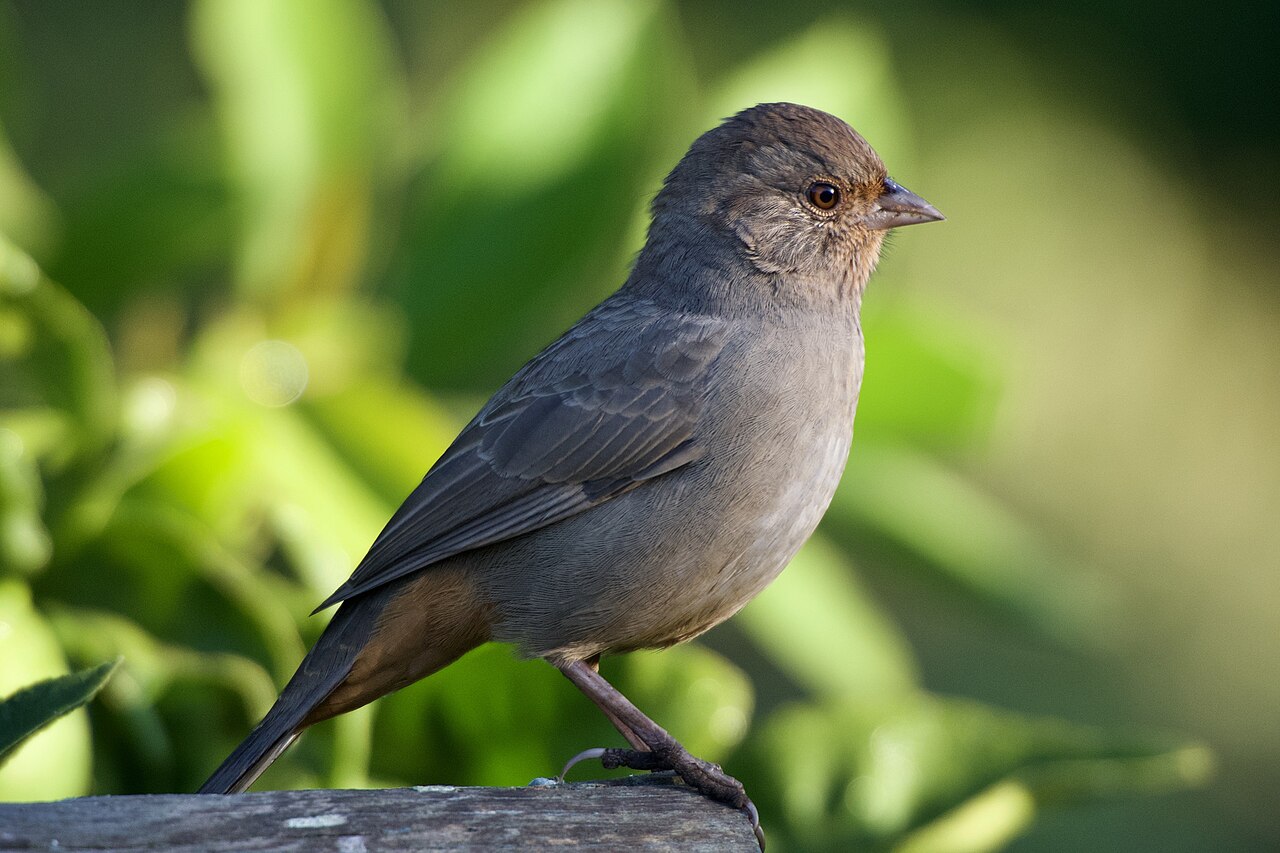
The California Towhee is the large, plain brown ground bird of chaparral (dense evergreen shrubland of dry hillsides), gardens and city parks in California. It stays in one territory all year and, in the settled part of its range, is one of the commonest birds under the shrubs.
Voice
The call is a clear, metallic chip recalling a Northern Cardinal; the bird gives it singly or in strings every couple of seconds, and trebles the rate when threatened. The male's song consists of repetitions of that same note: a few well-spaced ticks that accelerate rapidly into a trill and then stop abruptly, one to two seconds in all. A pair also performs a duet, the birds facing each other in a rapid series of squeals and squeaks.
Recording: Ed Pandolfino — CC BY-NC-SA 4.0 · Greilach Rd, Amador County, California, United States · xeno-canto
Identification
A large, long-tailed sparrow in dull grey-brown, without streaking on back or breast, with rusty undertail coverts. The throat is pale buff and bordered by a line of fine dark streaks; the breast sometimes carries a faint spot. The bill is thick and conical, the wings short and rounded, the tail long at eight to twelve centimetres. Male and female look alike. It forages by hopping on the ground, scratching backwards with both feet at once.
Confusion species
Canyon Towhee, which begins only east of California, has a distinctly rufous crown, a more sharply marked throat necklace and a single dark breast spot. Abert's Towhee has a black patch around bill and chin and keeps to riparian scrub of the low desert; the overlap is small. Spotted Towhee is black with white spots and rufous flanks, and has red eyes. Juvenile California Towhees are lightly streaked on the breast — that is age, not another species.
Habitat
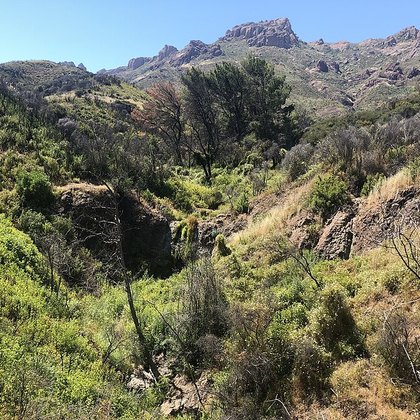
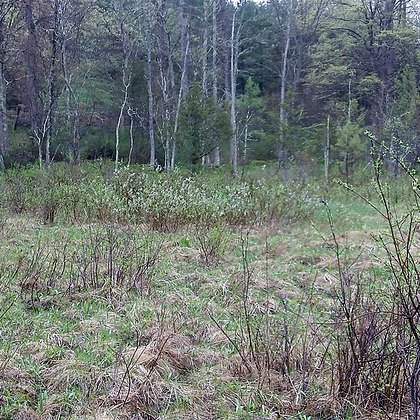
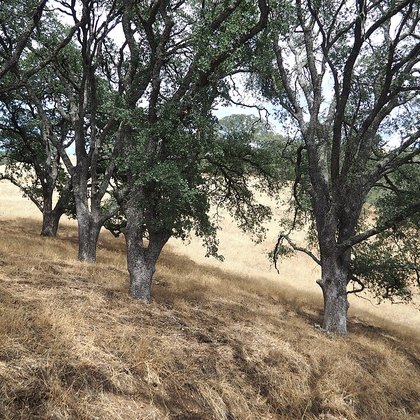
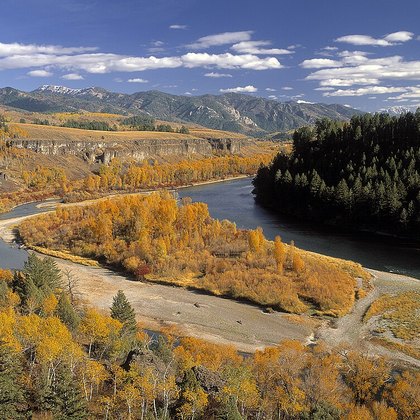
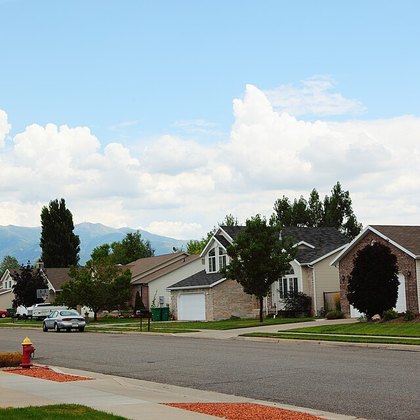
Dense chaparral on coastal slopes and in the foothills, plus streamsides and canyon bottoms on the desert edge, with manzanita, buckthorn, madrone, foothill pines and oaks. In settled parts of California it occupies shrubby residential areas, gardens and city parks, picking up seed on the ground under feeders. It wants shrub-height cover with open bare ground beside it.
Where the bird is most often found, arranged by the USNVC — the vegetation classification of the United States and Canada — and CMECS for sea and coast.

Range and movements
Resident in a narrow coastal belt from southwestern Oregon through California to the south of Baja California Sur; eastwards it reaches the western edge of the Sierra Nevada and the canyons of the Mojave region. Migration is absent altogether: ringed birds often spend their whole lives within a few hundred metres. An isolated population in the Inyo Mountains of eastern California stands apart from the continuous range.
- Resident
- Winter
- Passage
- dark = core range, pale = thinly spread
Where and when to look
In any Californian garden with shrubs this is often the first bird to answer pishing. Go by the metallic chip; if the bird is silent, check the combination of plain grey-brown plumage, buff throat with a streaked border and rusty undertail. A pair's duet is the clearest sign that two birds belong together.
Conservation
Partners in Flight puts the breeding population at 7.5 million birds and scores the species 11 out of 20 on the Continental Concern Score. The Breeding Bird Survey showed a stable trend between 1966 and 2019. The Inyo Mountains subspecies, M. c. eremophilus, is the exception: it fell to about 175 breeding birds in the early 1980s and is listed as federally threatened. Numbers rose again after Bureau of Land Management measures in 2001; degradation of the riparian patches by grazing and invasive plants remains the pressure there.
Scientific name
Melozone crissalis | (Vigors, 1839)
Nicholas Aylward Vigors described the species in 1839 as Fringilla crissalis; because it later moved to Melozone, author and year stand in parentheses. The genus Melozone is from Greek mēlon 'cheek' and zōnē 'girdle, band'. The species name crissalis derives from New Latin crissum, the area under the tail, after the rusty undertail coverts. The type material came from Monterey, California. Until 1989 this bird and the Canyon Towhee formed a single species, the Brown Towhee.