All species › Pelicans, herons and ibises › Herons, egrets and bitterns › Black-crowned Night-Heron
Black-crowned Night-Heron | Nycticorax nycticorax
Kwak | Martinete común
The Black-crowned Night-Heron is the most widespread heron in the world, and in North America a common breeder on almost every marsh, lake and riverbank with enough cover. Its Dutch name kwak, like similar names in dozens of other languages, imitates its call. By day it sits hidden and motionless in dense cover; only at dusk does it become active.
Voice
The Black-crowned Night-Heron is a quiet hunter but a noisy colony bird: at nightfall and when leaving the roost it gives a short, hard quok or woc, usually in flight and audible from far away. In breeding colonies that call sounds constantly from every direction, mixed with hoarse hissing and bill-clattering during nest disputes. Hunting alone, which is how it usually feeds, it stays quiet.
Recording: Xavier Riera — CC BY-NC-SA 4.0 · Montsià (near El Poble Nou del Delta), Tarragona, Catalonia, Spain · xeno-canto
Identification
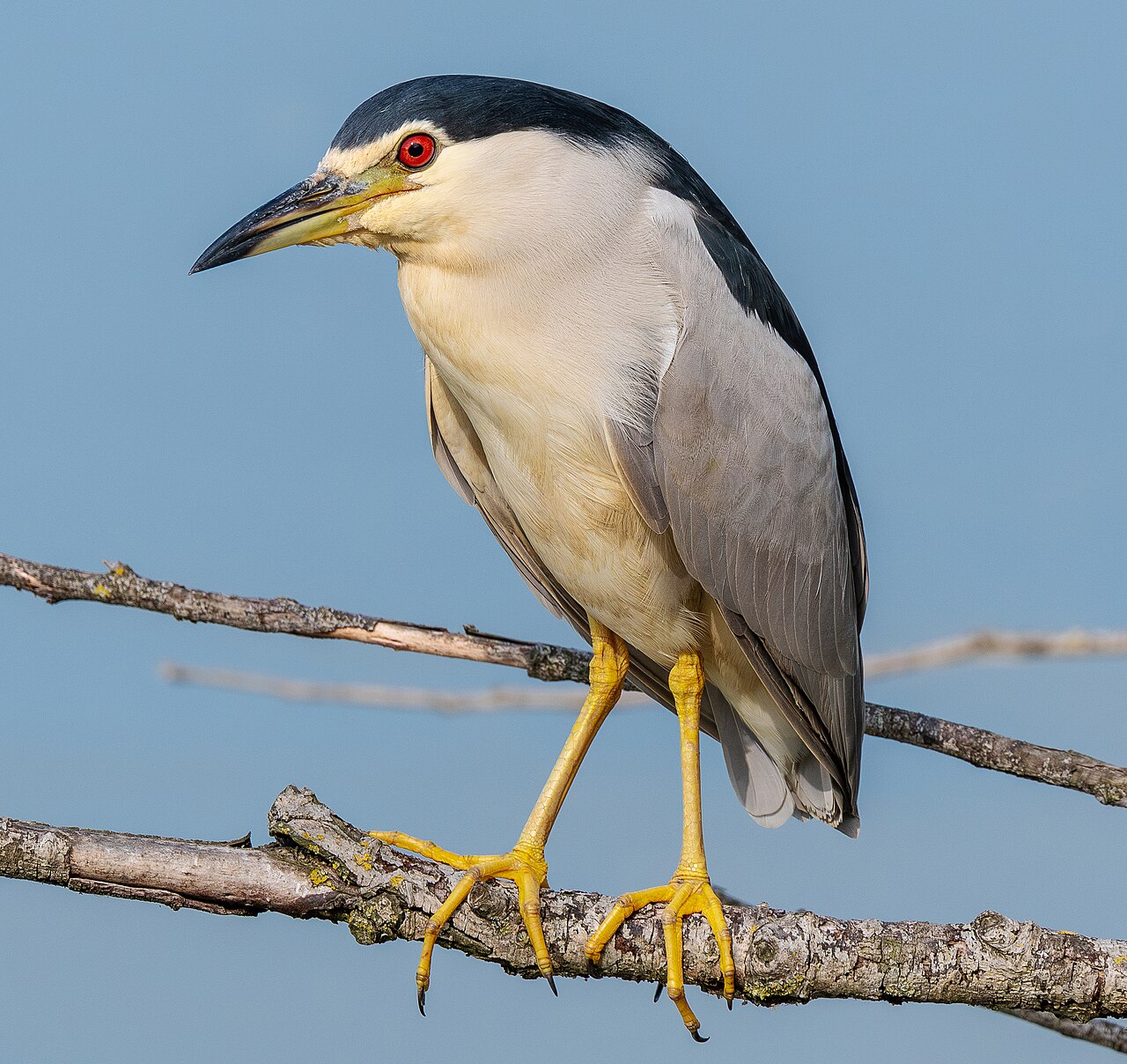
The adult Black-crowned Night-Heron is a stocky, short-legged heron with a black crown and back, pale grey wings and underparts, and red eyes that stand out at dusk. When excited, two or three long white plumes rise from the nape. In flight the short legs barely extend past the tail, giving the bird a hunched silhouette different from the long-legged herons around it. Young birds are brown with large, irregular white spots on the wings and a coarsely streaked breast, with a yellow-and-black bill instead of the adult's uniformly black one.
Confusion species
Young birds are confused with young Yellow-crowned Night-Herons (Nyctanassa violacea): those stand straighter on longer legs, have a heavier bill and show finer, more sharply defined spotting than the coarser markings of a young Black-crowned. American Bittern (Botaurus lentiginosus) is considerably larger, with streaked rather than spotted plumage and a more pointed bill. Green Heron (Butorides virescens) is much smaller, with a chestnut neck and yellow rather than red eyes.
Habitat
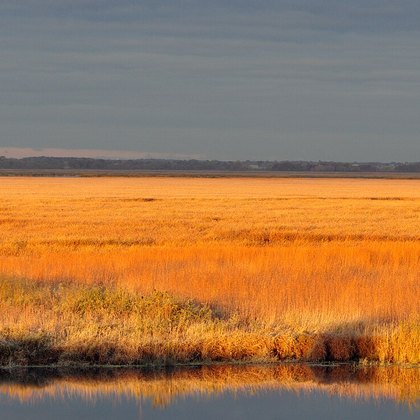
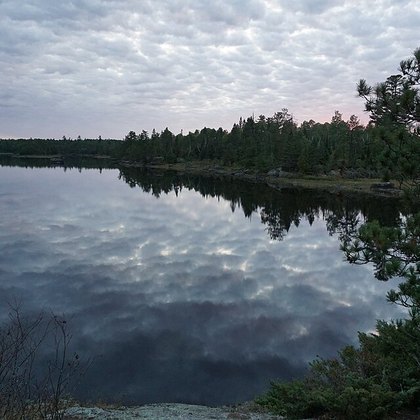
The Black-crowned Night-Heron uses almost every type of wetland: freshwater marsh, salt marsh, brackish estuaries, lakes, riverbanks and artificial waters such as reservoirs and ponds. By day it hides in dense trees or shrubs directly above or beside the water, preferably on islands or in swamp forest that keep out ground predators. Colonies also settle in city parks and zoos, wherever water and enough cover are nearby. Open water without any bank vegetation offers it little.
Where the bird is most often found, arranged by the USNVC — the vegetation classification of the United States and Canada — and CMECS for sea and coast.



Range and movements
The Black-crowned Night-Heron breeds across almost the entire North American continent, from southern Canada to Central America and the Caribbean, wherever suitable marsh with cover is available. In the south — Florida, the Gulf Coast, California and Mexico — it is present year-round; birds breeding further north and inland move south in autumn to Mexico, Central America and the Caribbean. Beyond this area the species breeds on through South America. Of the herons in this guide, none has as large and continuous a breeding range.
- Resident
- Breeding (summer)
- Winter
- Passage
- dark = core range, pale = thinly spread
Where and when to look
Look for the Black-crowned Night-Heron not by day in the open marsh but at dusk, when groups leave the roost and fly overhead to their hunting grounds with a hard quok. Many cities have a long-standing colony at a park or zoo pond, often on the same site for generations — ask a local bird club about such a spot for a near-guaranteed sighting.
Conservation
Worldwide the IUCN rates the Black-crowned Night-Heron as Least Concern (LC), and its adaptation to artificial waters — from sewage lagoons to park ponds — has helped it persist where natural marsh disappeared. In the mid-twentieth century the species, like many fish-eating birds, suffered from pesticides such as DDT, with thinner eggshells and reduced breeding success; after the ban it recovered. Pollution of the waters it hunts in remains a point of concern.
Scientific name
Nycticorax nycticorax | (Linnaeus, 1758)
Linnaeus described the species as early as 1758 as Ardea Nycticorax, from southern European specimens; it has since been moved to another genus, hence the parentheses around author and year. The English naturalist Thomas Forster introduced the genus Nycticorax in 1817 — in the same work in which he also introduced Egretta. The name combines the Greek nyx, 'night', and korax, 'raven', after the bird's nocturnal habits and harsh, crow-like call. The type locality lies in southern Europe, well outside the North American range this guide covers.