All species › Cranes, rails and allies › Rails, gallinules and coots › Tasmanian Nativehen
Tasmanian Nativehen | Tribonyx mortierii
Tasmaans waterhoen | Gallineta de Tasmania
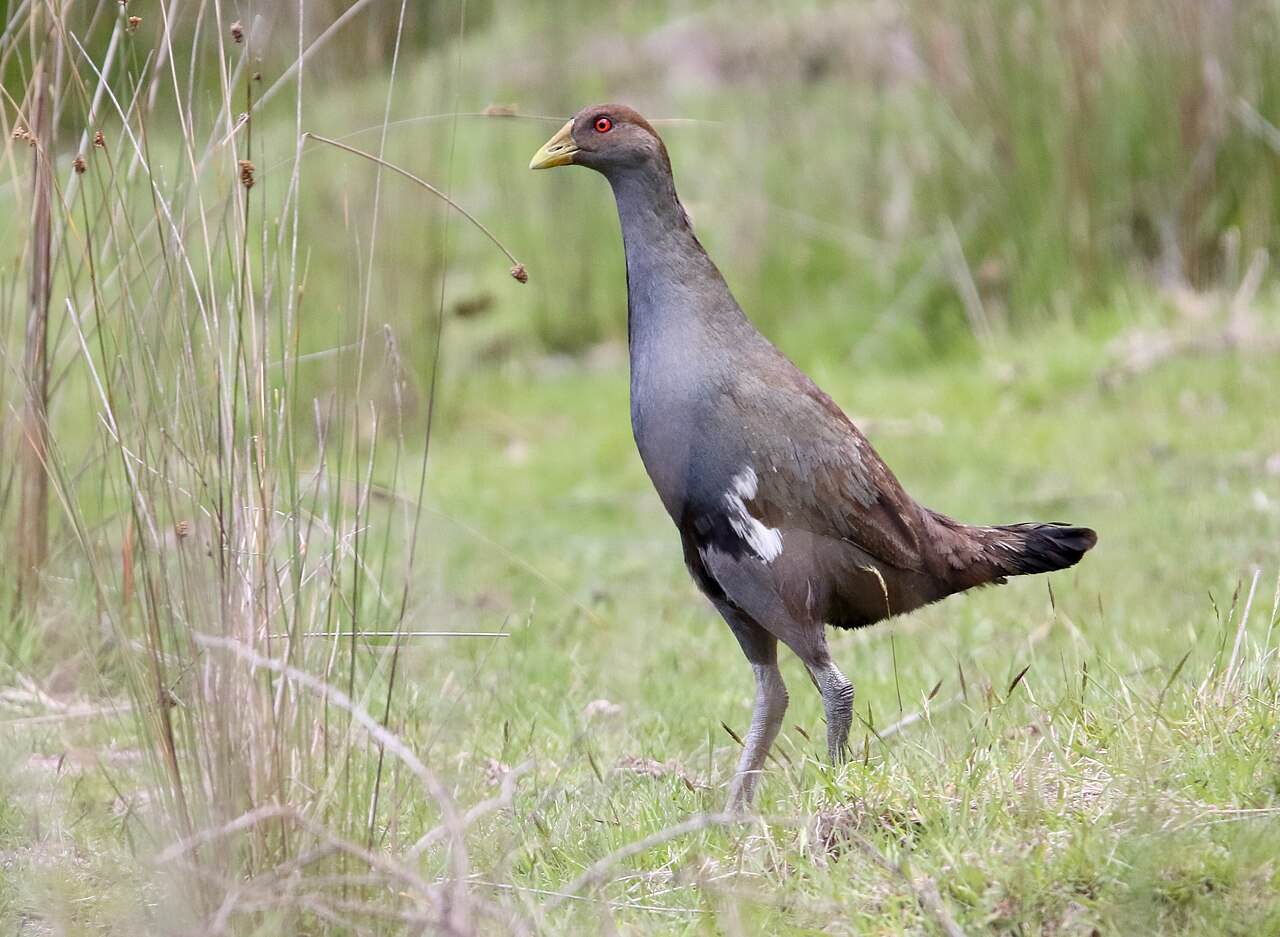
The Tasmanian Nativehen is a heavy, flightless rail found only in Tasmania, where it stands out in the open everywhere: on pasture, along drains and on roadsides. Olive-brown above, dark blue-grey below, with a bold white flank patch, a short black tail often held upright, and stout grey legs. It does not fly, but runs at up to thirty-five kilometres an hour.
Voice
The species has fourteen distinct calls. The best known is a loud, rasping see-saw given in duet by a pair or a whole group, speeding up and rising until it ends in a screech — a sound that carries across a valley and is heard at night as well. With it go low grunting contact notes and a high, sharp alarm call.
Recording: Ramit Singal — CC BY-NC-SA 4.0 · Don, Devonport City Council, Tasmania, Australia · xeno-canto
Identification
A heavily built rail of forty-three to fifty-one centimetres, averaging forty-eight. The upperparts are olive-brown, the underparts dark slate-blue, and a single clean white patch or stripe marks the flank. The tail is short, black and often cocked. The bill is short and thick and yellow-green, with a small yellow-green frontal shield; the iris is bright red; the legs are thick and grey with coarse scaling. The wings are small and never used for flight, at most for balance while running. Young birds are duller.
Confusion species
Black-tailed Nativehen (Tribonyx ventralis) of the mainland is close in shape and colour, but is smaller and slimmer, has bright orange-red legs instead of grey, carries white spots on the flank instead of one stripe, and can fly. More to the point, the two do not meet in the field, because the Tasmanian Nativehen occurs only in Tasmania and on Maria Island. Dusky Moorhen (Gallinula tenebrosa) swims, is darker, and has a red frontal shield and red bill base. Purple Swamphen (Porphyrio porphyrio) is blue and purple with long red legs and is not a confusion at all.
Habitat
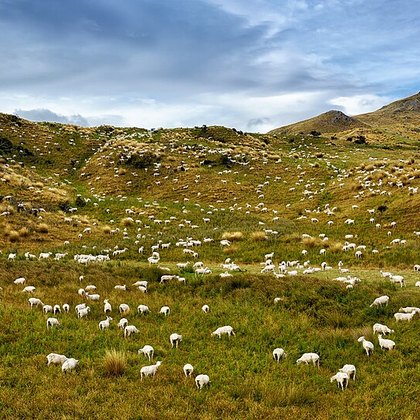
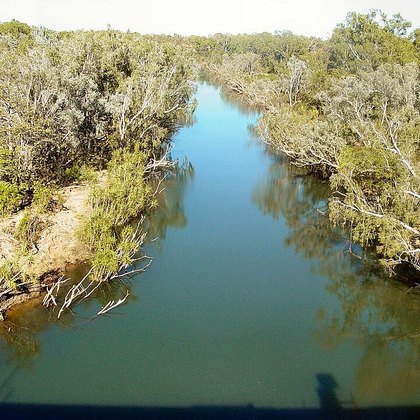
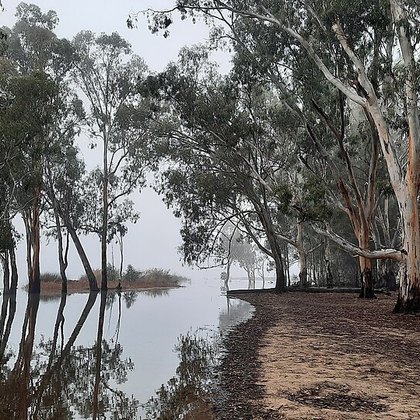
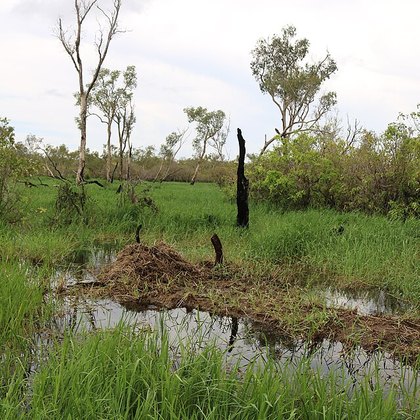
Open grassland, pasture and other cleared, closely grazed ground near fresh water: small swamps, stock dams, drains and river banks, with scrub, reed or tall grass nearby for cover. It also walks on lawns, golf courses, campsites and road verges, and feeds by day on the ground on seeds, leaves and grass.
Where the bird is most often found, arranged by main group and formation.
Range and movements
Endemic to Tasmania and widespread through the north, east and centre of the island; it is absent from the wet west and south-west. It does not occur on King or Flinders Island in Bass Strait. On Maria Island it has been introduced and is established. On the Australian mainland the species survived until roughly four and a half to five thousand years ago — the fossils show that — and disappeared there, possibly through the arrival of the dingo, through hunting, or through prolonged drought. Pairs and small groups hold the same territory all year.
- Resident
- dark = core range, pale = thinly spread
Where and when to look
Drive early morning or towards dusk past pasture beside water in the Midlands, around Launceston or in the Derwent Valley: the groups stand out in the open grass and would rather run than hide. The check is simple — black tail cocked and thick grey legs means this species, orange-red legs means the mainland relative, which is not here.
Conservation
Least Concern (LC). The species is doing well and has gained from the clearing of forest for pasture; it is numerous enough that farmers complain of grazing damage, after which it was given legal protection in August 2007. The main concern is not the present numbers but what happens if the red fox establishes in Tasmania: little is expected of a flightless, ground-nesting bird of open pasture in that case. Beyond that, vehicle strikes and predation by cats and loose dogs count.
Scientific name
Tribonyx mortierii | Du Bus de Gisignies, 1840
Du Bus de Gisignies described the species in 1840 as Tribonyx mortierii; he introduced the genus Tribonyx himself, so author and year carry no parentheses. Tribonyx is built from Greek tribo, 'to wear down or rub', and onux, 'claw', for the heavy, worn claws of a bird that spends its life walking. mortierii honours the Belgian botanist Barthélemy Dumortier. The type locality is Tasmania; in palawa kani, the revived language of the Tasmanian Aboriginals, the bird is called piyura.