All species › Kingfishers, bee-eaters and rollers › Kingfishers › Sacred Kingfisher
Sacred Kingfisher | Todiramphus sanctus
Heilige ijsvogel | Alción sagrado
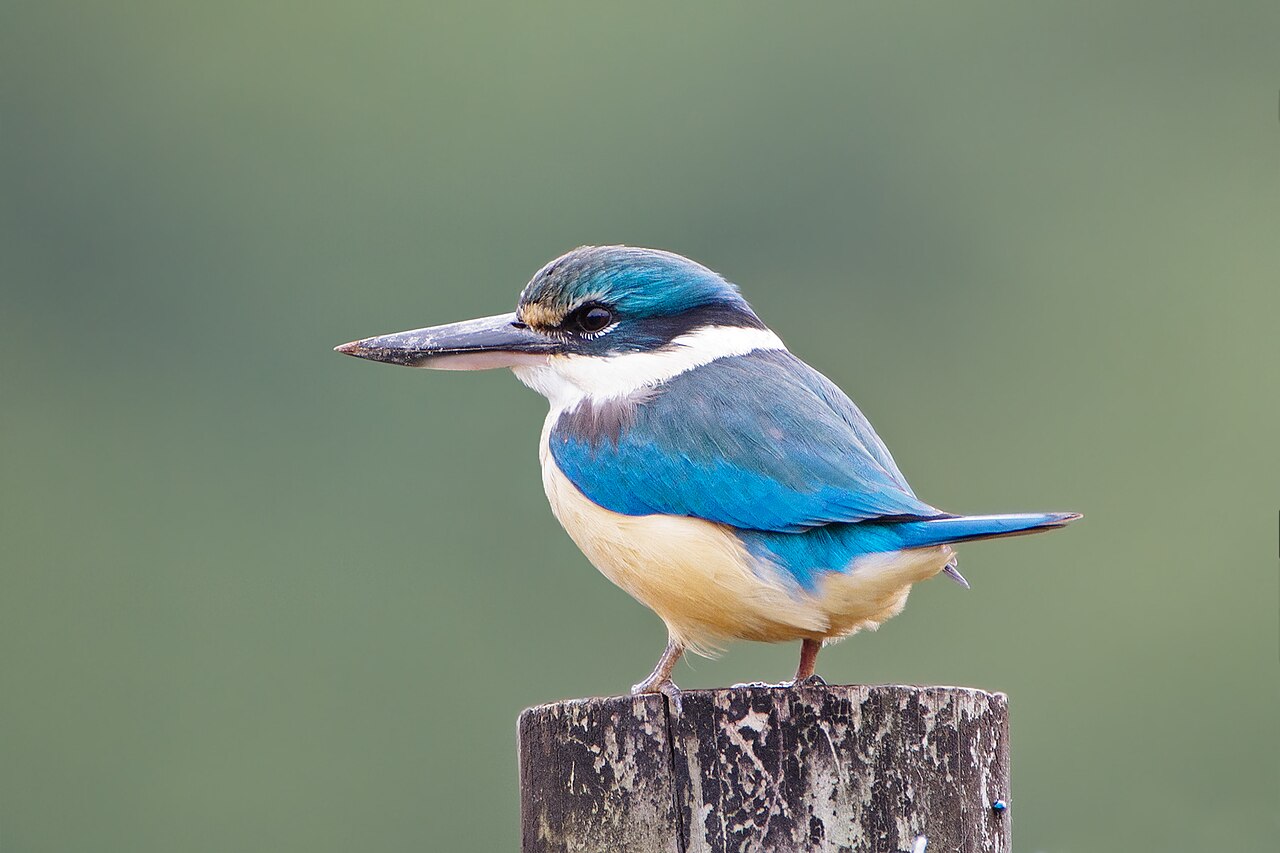
The Sacred Kingfisher is the kingfisher you meet most often in Australia and New Zealand, and it is usually nowhere near water: a turquoise-green bird with cream-white underparts, a broad cream collar and a black mask, hunting the ground from a low bare branch. In southern Australia it is a summer bird that returns at the end of August; in New Zealand it is present year-round and is called kotare.
Voice
Right through the breeding season comes a loud, evenly repeated series of four or five short notes: ek-ek-ek-ek, all on one pitch and at a fixed spacing, and it usually places the bird before you see it. In excitement the series runs faster and higher into kee-kee-kee; at an intruder near the nest there is a harsh, chattering scold. Pairs answer one another across hundreds of metres.
Recording: Étienne Leroy — CC BY-NC-SA 4.0 · Tidbinbilla sanctuary, Australian Capital Territory, Australia · xeno-canto
Identification
A small, compact kingfisher of a good twenty centimetres, turquoise-green above with a bluer rump and tail and cream-white below. A broad black stripe runs from the bill through the eye to the nape, and below it lies a broad cream collar that carries right round the neck; a small pale spot sits before the eye. The bill is long and dagger-shaped, black with a pale base to the lower mandible. The female is duller and greener above, and young birds show rusty edges on the wing coverts and breast. In flight it is short-tailed and fast, with a shallow beat low over open ground.
Confusion species
Forest Kingfisher (Todiramphus macleayii) has pure white underparts with no cream tone at all, a deep blue crown and a conspicuous white wing patch that flashes in flight; Sacred lacks that patch. Torresian Kingfisher (Todiramphus sordidus) is clearly larger and heavier-billed, darker green above, and stays tied to mangrove and tidal flat. Red-backed Kingfisher (Todiramphus pyrrhopygius) gives itself away by a chestnut rump and a finely streaked pale crown and belongs to the dry interior. On a bird facing you, the cream wash across breast and collar and the plain dark green crown settle it.
Habitat
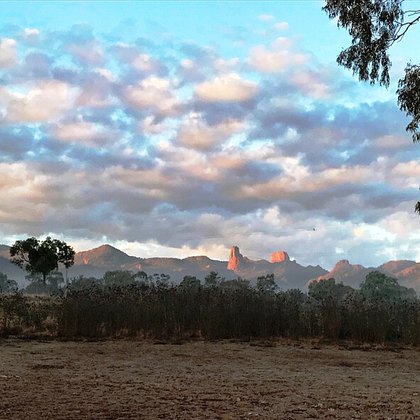
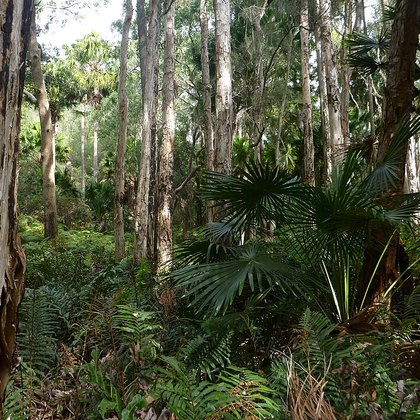
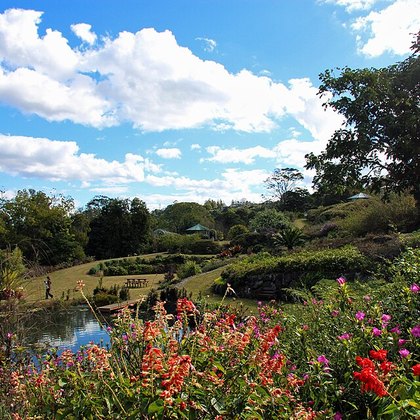
Open eucalypt forest and woodland with a thin understorey make the main picture, with melaleuca swamp forest, mangrove, the wooded margins of creeks and rivers, and in settled country gardens, parks and orchards. It hunts the ground from a low lookout, taking insects, lizards and crabs; fish are the exception in this species. It nests in a tree hollow, in an earth bank, or in a chamber dug out of an arboreal termite nest.
Where the bird is most often found, arranged by main group and formation.

Range and movements
Nearly all of coastal and subcoastal Australia, from the southwest around Perth through the Top End and Queensland into Victoria; in Tasmania it is scarcer and present only in summer. Birds from the southern two thirds of the mainland move north after breeding to New Guinea, the Solomon Islands and Indonesia, returning in August and September. In New Zealand it breeds on both main islands and shifts from higher ground to the coast after breeding; Norfolk Island has a subspecies of its own that stays all year.
- Resident
- Breeding (summer)
- dark = core range, pale = thinly spread
Where and when to look
In the south, walk a forest edge or a creek bank from late August and listen for the even ek-ek-ek series — it places the bird before you see it. Then scan low bare branches and wires over open ground, because it chooses a lookout with a clear view of the soil and sits there motionless for long spells. Check every bird that flies off for the absence of a white wing patch.
Conservation
Least Concern (LC): the species is widespread, common, takes well to planted and settled country, and holds an enormous range from Australia out into the Pacific. Where old hollow-bearing trees go out of the landscape the supply of nest sites falls and the bird has to fall back on earth banks and termite nests; locally, competition for hollows with starlings and other hole-nesters costs it nests.
Scientific name
Todiramphus sanctus | (Vigors & Horsfield, 1827)
Vigors and Horsfield described the species in 1827 as Halcyon sanctus; since it now sits in Todiramphus, authors and year take parentheses. Todiramphus combines the genus Todus, a small West Indian bird, with Greek rhamphos, 'bill'. sanctus means 'sacred': Latham already used that name in 1782 because Pacific islanders treated the bird with veneration — it was often seen at marae and burial grounds — and it was later credited with power over the waves. The type locality is New Holland, narrowed to New South Wales; in Maori it is kotare.