All species › Tubenoses › Petrels, shearwaters and diving petrels › Pycroft's Petrel
Pycroft's Petrel | Pterodroma pycrofti
Pycroft-stormvogel | Petrel de Pycroft
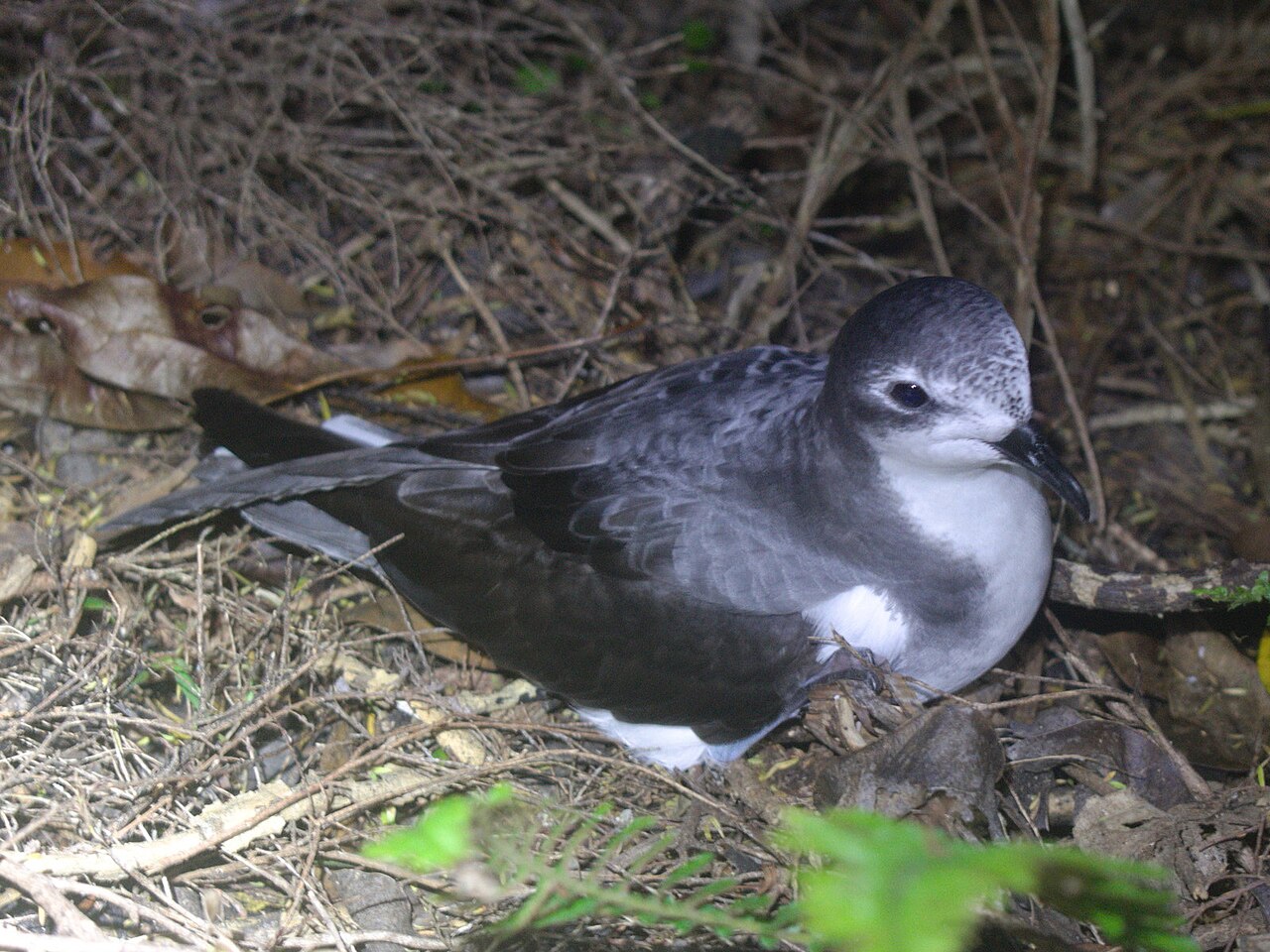
Pycroft's Petrel is the smallest of the New Zealand gadfly petrels: a bird of twenty-eight centimetres with narrow wings, a pointed tail and an almost wholly white underwing, breeding only on a handful of predator-free islets off the north-east coast of the North Island. It forms a trio that is difficult to separate with Cook's Petrel and Gould's Petrel.
Voice
At sea it is silent. Over the colony at night come shrill whistles, ti-ti-ti or zip-zip-zip, and from the ground and the burrow lower notes: a drawn-out boor and a yapping yap-yap. The chorus is there only in the summer breeding months and only after dark; walk such an islet by day and there is nothing to hear.
No recording with a suitable Creative Commons licence has been found for this species yet; what to listen for is described below.
Identification
A small gadfly petrel of twenty-eight centimetres and about a hundred and fifty grams, grey above with a broad dark brown-black M running across the wings and rump. The head is dark grey with a white-and-dark speckled forehead and a dark eye patch. The underwing is mostly white, with only a thin dark line along the leading edge of the outer wing — that is the feature everything turns on. The bill is black and hooked, twenty-three to twenty-six millimetres long and nine to eleven deep, so noticeably fine. Wings narrow, tail pointed; the flight is fast, light and springy, with high arcs in wind.
Confusion species
This is the hardest identification in the guide. Cook's Petrel (Pterodroma cookii) is slightly larger, paler grey above and has a more heavily speckled, hence paler, crown and a more open, whiter face; Pycroft's therefore looks darker-headed, with a more obvious eye patch. At sea and at range that difference is often simply not safe to call, and many observers deliberately leave such birds as "Cook's/Pycroft's" — only good photographs of head and tail settle it. Gould's Petrel (Pterodroma leucoptera) is easier: it has a dark cap running below the eye and onto the nape, and a far broader black leading edge on the underwing. Black-winged Petrel (Pterodroma nigripennis) is the best comparison: besides the black leading edge it has a broad black diagonal bar right across the inner underwing, where Pycroft's has only that thin line. Chatham Islands Petrel (Pterodroma axillaris) has the same diagonal bar and, on top of that, black axillaries.
Habitat
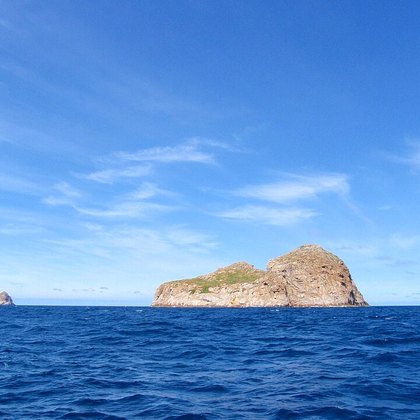
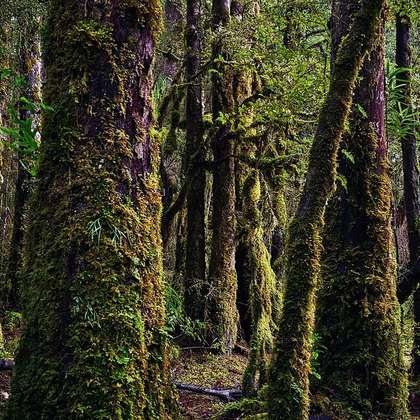
At sea, warmer water north of the subtropical convergence, nearly always over deep water beyond the continental shelf. Ashore it is restricted to small predator-free islands, where it digs its burrow in loose forest soil under coastal forest and scrub, mostly on slopes under pohutukawa and dense undergrowth.
Where the bird is most often found, arranged by main group and formation.
Range and movements
Within the map window New Zealand only, and there only the islets off the north-east coast of the North Island: the Mercury group, the Hen and Chickens, the Poor Knights and Ririwha, plus Cuvier Island, where chicks were transferred in 2001–03. Red Mercury Island alone holds about three quarters of the world population. It formerly bred on Norfolk Island but has gone from there. After breeding it migrates to the tropical central Pacific; in Australian waters it is all but unknown.
- Breeding (summer)
- dark = core range, pale = thinly spread
Where and when to look
Take a pelagic in the outer Hauraki Gulf or off the Mercury Islands in November, December or January, late in the afternoon, when birds are heading in to the colony. Photograph every small gadfly petrel that passes, because this is above all a species you identify at home on the screen rather than in the field. Watch for the thin leading-edge line on an otherwise white underwing and the dark head with a clear eye patch.
Conservation
Vulnerable (VU), though in New Zealand it is rated "Recovering" and that is deserved. The heavy damage came from the Pacific rat, the kiore, which took eggs and chicks; between 1991 and 2011 it was removed from the breeding islands by aerial poisoning, after which fledging success rose above eighty per cent. The stock is put at five to ten thousand pairs on Red Mercury Island and hundreds to thousands on Stanley, Double and Lady Alice; the remaining islets hold fewer than a hundred pairs between them. The main risks left are fire in a dry late summer and the return of a rat to an island.
Scientific name
Pterodroma pycrofti | Falla, 1933
Falla described the species in 1933 directly in Pterodroma, so author and year carry no parentheses. The epithet pycrofti honours Arthur John Pycroft, an Auckland naturalist and island specialist who did much for the knowledge of these islets. The type locality is Taranga, that is Hen Island in the Hen and Chickens group. The genus Pterodroma was introduced by Bonaparte in 1856, from Greek pteron (wing) and dromos (runner).