All species › Waders, gulls and terns › Coursers and pratincoles › Oriental Pratincole
Oriental Pratincole | Glareola maldivarum
Oosterse vorkstaartplevier | Canastera oriental
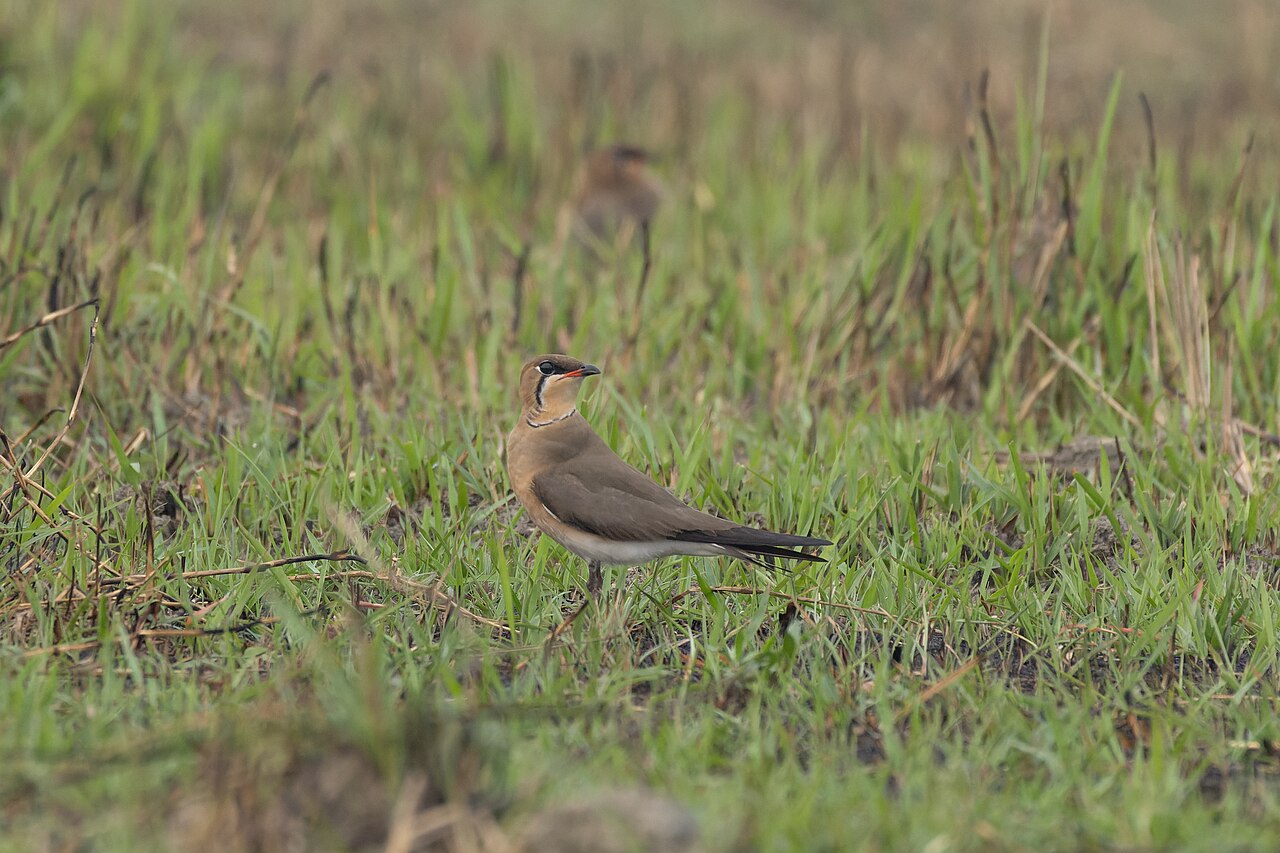
The Oriental Pratincole is a wader that lives like a swallow: short legs, long pointed wings, a forked tail and a wide gape with which it takes insects out of the air. It breeds in Asia and winters in northern Australia, where it stands in flocks on bare plains through the wet season. In 2004 it turned out that those flocks can be of an unimagined size.
Voice
A sharp, tern-like kee-kik or chik-chik-chik, given in flight and, from a large flock, swelling into a sustained rattling chatter that carries far across a plain. On the ground it is usually silent. At any alarm the whole flock lifts at once, calling loudly, and circles a few times before settling again.
Recording: 王自堃 — CC BY-NC-SA 4.0 · Tianjin, Tian Jin Shi, China · xeno-canto
Identification
A compact bird of twenty-three to twenty-four centimetres, sandy to olive-brown above and white on the belly, with a short black bill red at the base. In breeding plumage it carries a creamy throat patch framed by a thin black line — the best mark for the species. The legs are short and dark, so it stands low and squat on the ground. In flight it is tern-like: long pointed wings with black primaries, a white rump, a short forked tail, and chestnut underwing coverts that show only in good light and from below. Outside the breeding season the black throat frame is missing and the bill base is dull; young birds are scaly through pale feather fringes and dark subterminal bands.
Confusion species
Australian Pratincole (Glareola isabella) is the only real confusion and stands on the same fields in the north: it is clearly taller on the legs, paler and more cinnamon, lacks the creamy black-framed throat, carries a dark chestnut-and-black patch in the centre of the belly in breeding plumage, and has an almost uniformly black underwing rather than chestnut coverts. In flight the species strongly suggests a tern, and over a plain at dusk a nightjar as well; the white rump with the black tailband rules out both. On the ground it is overlooked among small plovers until the whole flock lifts at once.
Habitat
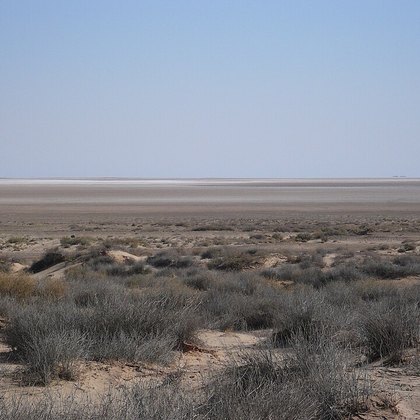
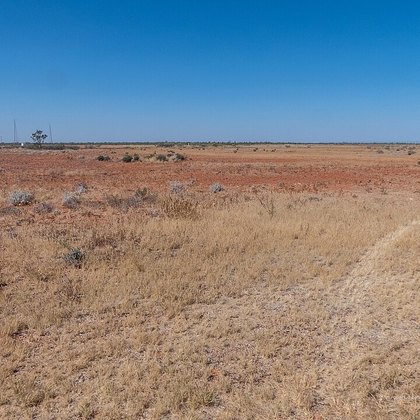
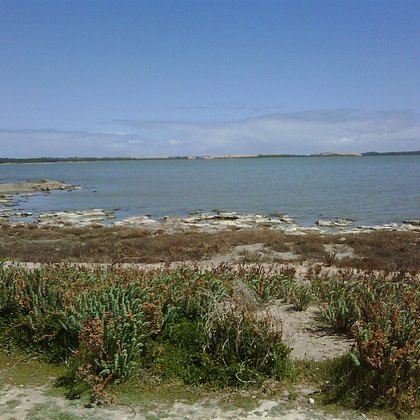
Bare, flat, open ground with short grass or none: drying claypans (shallow clay basin that holds water for a time after rain) and ephemeral lakes, black-soil plains with Mitchell grass, saltmarsh and the drier edge of tidal flat and estuary, overgrazed pasture, airfields and burnt patches of savanna. It needs room to land and take off and wants a clear view; it feeds in the air over those same plains and over water, mostly at dusk, and often in dense swarms around a grass fire or a termite flight.
Where the bird is most often found, arranged by main group and formation.

Range and movements
Within the map window of this guide a non-breeding visitor from Asia. Birds arrive from October and November and leave in March and April. The centre of gravity is tropical northern Australia: the Kimberley, the Northern Territory, the Gulf of Carpentaria and Cape York Peninsula, with the coastal strip of Eighty Mile Beach in the north-west as the best known gathering place. In wet years flocks push far south, into inland New South Wales and South Australia. In New Zealand it is a vagrant with about a dozen records, the first at Westport in 1898, and it has been seen a few times on Norfolk Island.
- Resident
- dark = core range, pale = thinly spread
Where and when to look
Drive a bare plain or a drying claypan in the north during the wet and watch for a low dark band on the ground that suddenly dissolves into the air as a whole — that is how the species gives itself away. Then look up and find the short forked tail and the white rump. To see the chestnut underwing, wait until a bird passes low and in sunlight; against the light that underwing simply looks black.
Conservation
Least Concern (LC), and the species is besides a textbook case of how uncertain such estimates can be. Until 2004 the world population was put at some seventy-five thousand birds. On 7 February of that year, counters along Eighty Mile Beach in north-western Australia met a single concentration of over two and a half million — after which the world estimate was revised to about 2.88 million. The wintering range thus turns out to be concentrated on a few coastal plains, and that is at the same time the risk: loss or disturbance of a handful of sites would hit a disproportionate share of the species. Beyond that, the draining of the Asian breeding grounds and the use of insecticides, which removes the aerial food, both play a part.
Scientific name
Glareola maldivarum | Forster, 1795
Forster described the species in 1795 as Glareola maldivarum, and it has stayed in that genus, so author and year carry no parentheses. The genus Glareola was introduced by Brisson in 1769, from Latin glarea, 'gravel', for the bare, pebbly ground these birds live on. maldivarum means 'of the Maldives', and there lies the joke: the type material came from a flock that settled on a ship at sea near the Maldives, while the species is in fact only an irregular visitor there — a name that points to a chance meeting rather than to a range.