All species › Waders, gulls and terns › Jaegers and skuas › Brown Skua
Brown Skua | Stercorarius antarcticus
Bruine jager | Escúa antártica
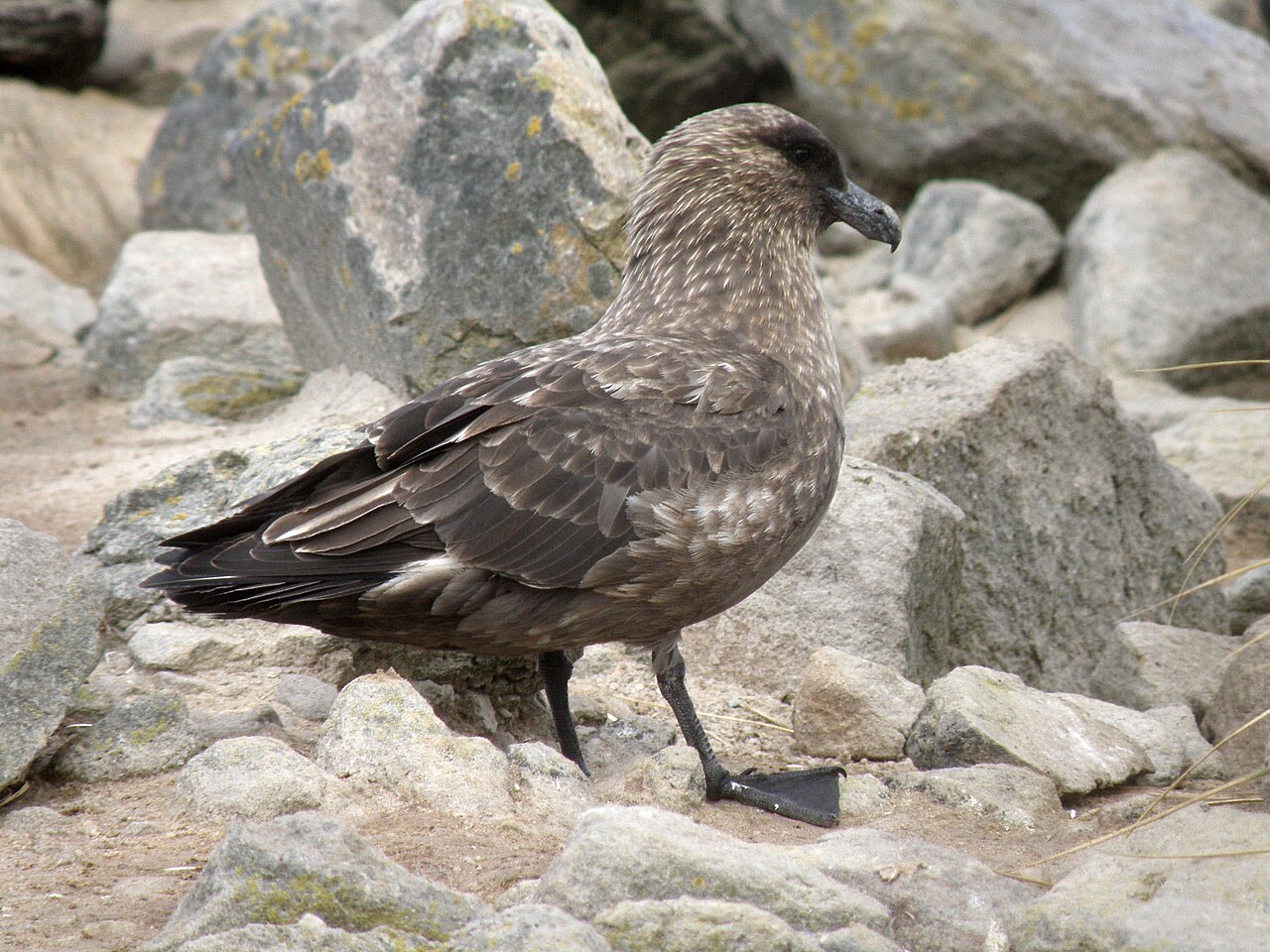
The Brown Skua is the heaviest predator in the air over the subantarctic islands: a bulky, barrel-chested brown bird the size of a Kelp Gull, with a heavy black hooked bill and a large white patch in each wing that flares with every beat. It lives on what other seabirds yield it — eggs, chicks, adult petrels coming out of their burrows at night, carrion at the seal beaches — and defends its territory by stooping at anything that comes too close, visitors included. Females are noticeably larger than males.
Voice
At the nest it is loud. The territorial long-call is a raw, descending ah-ah-ah delivered with both wings held straight up, a posture known on the islands as the Viking helmet and visible from a long way off. On the ground, anxiety produces a quacking, duck-like note. Anyone who comes too near a nest gets an ear-splitting scream during the stoop. At sea and in ordinary flight it is almost always silent.
Recording: Kevin Guille — CC BY-NC-SA 4.0 · Mayes island, France · xeno-canto
Identification
A large, heavily built brown seabird of a little over sixty centimetres, with a wingspan of about one and a half metres and a weight of one and a half to well over two kilos — at the top end double that of a Pomarine Jaeger. The bill is short, black and strongly hooked, the legs and eyes are black, and the broad pointed wings carry a large white primary patch above and below that is the steadiest mark the species has. The tail is short and wedge-shaped. Plumage runs from uniform dark sooty brown to paler and mottled, with golden streaking on the nape, but do not steer by that: size, the weight of the bill and the broad barrel-chested body are what count. Females are clearly bigger than males but otherwise alike. Flight is slow and gull-like, until an attack, when the bird shifts to a speed you do not expect.
Confusion species
South Polar Skua (Stercorarius maccormicki) is the real problem: smaller and slimmer, with a shorter, blunter bill and usually a strong contrast between a pale honey-coloured head and body and dark wings. Dark South Polar Skuas lack that contrast and can then be separated only on size and bill weight; on the Antarctic Peninsula, where the two meet, they also hybridise. Pomarine Jaeger (S. pomarinus) and Parasitic Jaeger (S. parasiticus) are far lighter, with narrower wings, a smaller head and an agile falcon-like flight instead of a barrel body; Long-tailed Jaeger (S. longicaudus) is lighter still and flies like a tern. A young Kelp Gull (Larus dominicanus) is also brown and mottled and much the same size, but lacks the white wing patch entirely, has a slimmer bill and flies with far less power.
Habitat
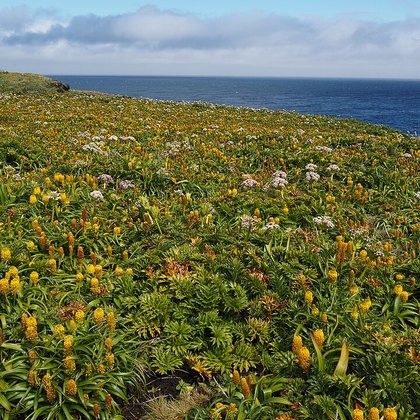
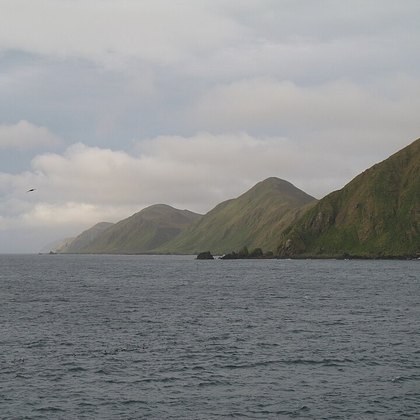
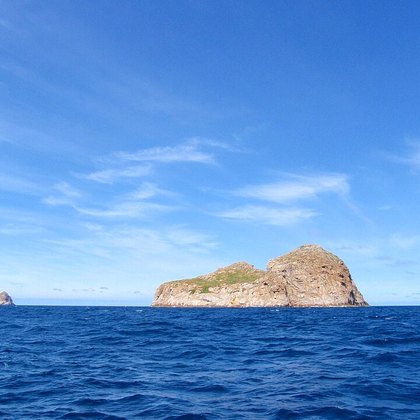
To breed it takes open ground with low vegetation on the subantarctic islands: coastal terraces, tussock grassland, bare rock knolls and the margins of peat flats, by preference within walking distance of a penguin colony, a field of petrel burrows or a seal beach that supplies carrion and afterbirth. Some pairs nest in loose groups, others entirely alone on a headland of their own. Outside the breeding season it lives wholly at sea, over the continental shelf and in subantarctic water, following fishing vessels and floating carrion.
Where the bird is most often found, arranged by main group and formation.
Range and movements
Within the map window it breeds on all the New Zealand subantarctic groups — Snares, Antipodes, Auckland Islands and Campbell — and besides these on the Chathams, on the islets around Stewart Island and on the Solanders, with the odd pair in southern Fiordland. On the Australian side it breeds on Macquarie, and outside the map window also on Heard and McDonald. Outside the breeding season the birds spread north: across the Tasman Sea, along both New Zealand main islands and along the southeastern Australian coast, where they are seen on pelagic trips all year but mainly in winter, out into subtropical water. On Norfolk it is all but absent.
- Resident
- dark = core range, pale = thinly spread
Where and when to look
On a subantarctic cruise you need do nothing: it comes to the boat as soon as anything edible goes over the side, and then hangs beside the rail for minutes on end. Ashore on the islands you certainly do not look for it — come near a nest and it comes to you, and the stoop arrives from behind; a raised hand or walking pole is enough to make the bird veer off. Along the ordinary coast of New Zealand and southeastern Australia a pelagic trip out to the shelf break is what pays, and there check every large dark bird for the white wing patch: it gives the species away further off than any plumage character.
Conservation
Least Concern (LC) globally, but on the New Zealand national list it stands as Nationally Vulnerable — the breeding population is small and concentrated on a handful of island groups, and rises and falls with the seabird colonies it lives off. Introduced cats, rats and pigs on the Auckland Islands have hit both its nests and its prey, and longline bycatch takes a toll elsewhere in the subantarctic. On Macquarie rabbits long made up a large part of the diet; since their removal from the island in 2014 the food base of the skuas there has changed fundamentally, and the consequences are still being followed.
Scientific name
Stercorarius antarcticus | (Lesson, 1831)
Lesson described the species in 1831 as Lestris antarcticus; because it later moved to another genus, author and year stand in parentheses. The genus Stercorarius was introduced by Brisson in 1760, after Latin stercus, 'dung', from the old sailors' belief that skuas ate the droppings of their victims when in reality it was disgorged fish. antarcticus simply means 'of the Antarctic'. Lesson gave both the Falkland Islands and New Zealand as its origin; Mathews restricted the type locality to the Falklands in 1912. The birds of this region belong to the subspecies lonnbergi, which Mathews named in the same year after the Swedish zoologist Einar Lönnberg. In Maori the bird is hakoakoa.