All species › Tubenoses › Petrels, shearwaters and diving petrels › Little Shearwater
Little Shearwater | Puffinus assimilis
Kleine pijlstormvogel | Pardela chica
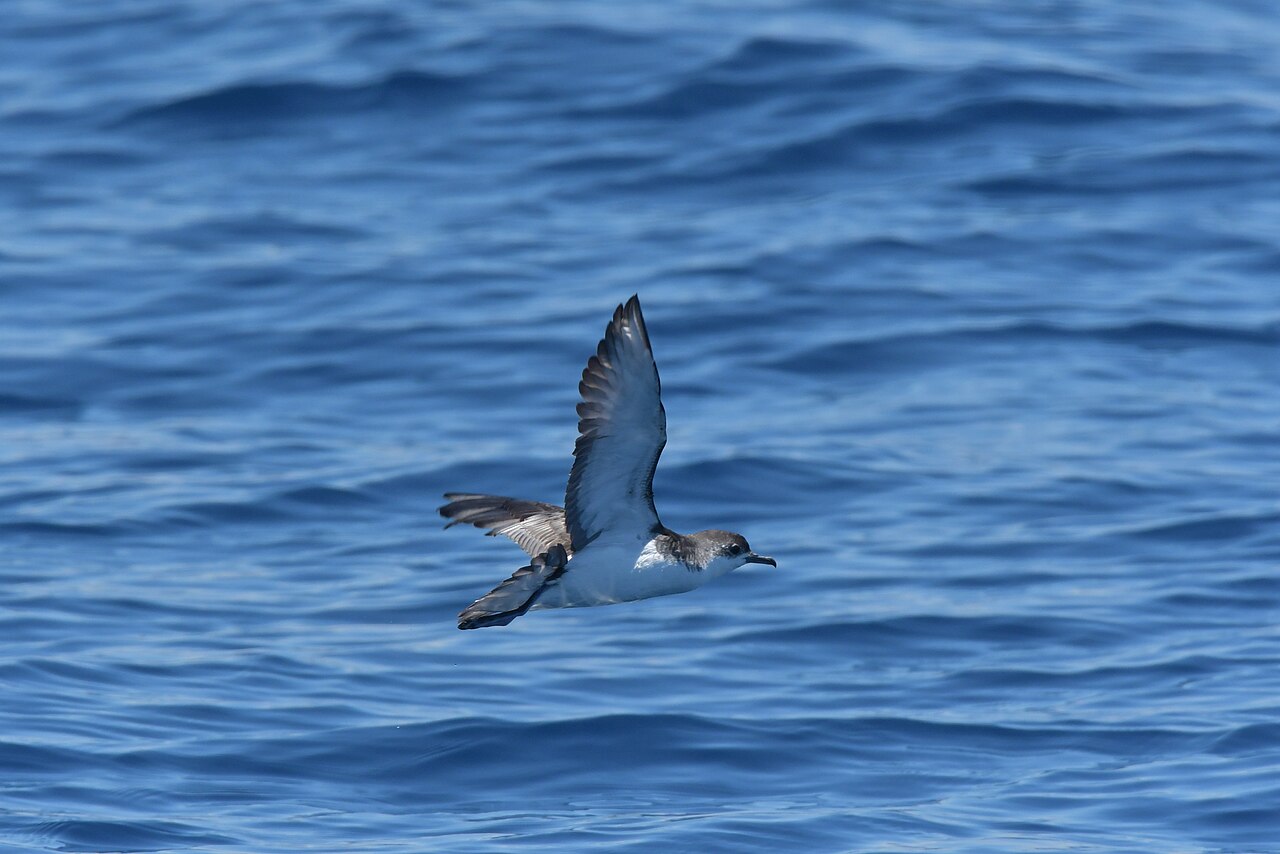
The Little Shearwater is the smallest black-and-white tubenose of this region: barely bigger than a pigeon, short-billed, with a clean white underwing and blue legs. It flies unlike any other shearwater here — fast whirring beats just above the water, broken by short glides — so that at range it suggests an auk rather than a shearwater.
Voice
At sea it is silent. At night the colony is noisy: a loud, harsh, rapidly repeated kakakakakak-urrr, the last syllable sounding as if the bird were drawing breath in mid-call. The sound comes both from the burrows and from birds circling over the scrub, and is easiest to hear on a still winter night.
Recording: David Boyle — CC BY-NC-SA 4.0 · Lady Alice Island, Whangarei District, Northland, New Zealand · xeno-canto
Identification
Twenty-eight centimetres and about two hundred and forty grams. Black above and white below, with a sharp dividing line passing over or through the eye, so that white remains above the eye and the dark eye sits in a white face. The underwing is white with a narrow black margin, clean and contrasting. Small white tabs show on the flanks behind the wing base. The bill is fine, grey with a dark tip, and short; the legs are blue with pinkish webs. With short broad wings and a short tail it looks like a small cross in flight, and it travels low and fast on whirring beats.
Confusion species
Fluttering Shearwater (Puffinus gavia) and Hutton's Shearwater (Puffinus huttoni) are both distinctly larger (31–37 and 36 cm), brown-black rather than jet-black, with a much longer and thinner bill, pink legs and a dark cap reaching below the eye instead of stopping above it; their underwing is dingy and dark-bordered where the Little Shearwater's is clean white. The flight differs too: the two larger species beat in stiff series and then glide on at length, while the Little Shearwater whirrs almost continuously. Subantarctic Shearwater (Puffinus elegans), recently split from this species and given its own page in this guide, is the hardest case: it is barely larger (30 against 28 cm) and the only usable field mark lies in the face — in elegans the dark border runs below the eye, so that the eye sits in the black, whereas this species has a whiter face with the border running through or above the eye. From a moving boat this can rarely be seen with certainty; in practice area and season help more. Elegans breeds on the southern outlying islands — the Antipodes and the Chathams — and lays from late August to early October, whereas this species breeds around northern New Zealand and lays in midwinter. An identification outside its own range calls for photos. Common Diving-Petrel (Pelecanoides urinatrix) is smaller and dumpier still, with a buzzing, straight-line flight without glides, and dives straight into the water when disturbed instead of banking away.
Habitat
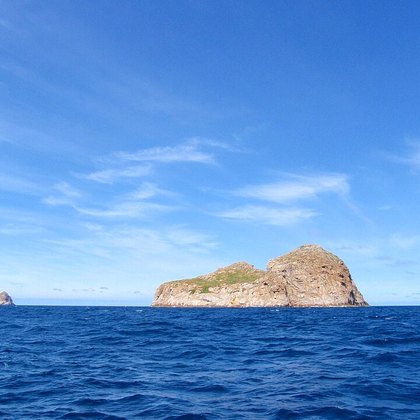
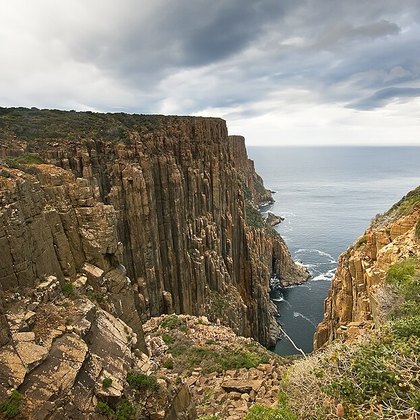
Warm and temperate water over and beyond the continental shelf, where it feeds alone or in small parties and dives deeper than its size suggests. It breeds on predator-free islets and steep coastal slopes, in short burrows and rock crevices under scrub and coastal forest, often close to the cliff edge.
Where the bird is most often found, arranged by main group and formation.
Range and movements
Within this map window it breeds on three fronts. In Australian territory the nominate birds hold Norfolk and Lord Howe — Norfolk is the species' type locality — and a form of its own breeds on islets off south-western Western Australia. In New Zealand the North Island form breeds on the islands off the north-east coast: the Aldermen Islands with about four thousand pairs, Red Mercury with about a thousand, and beyond those the Hen and Chickens, the Mokohinau and the Mercury Islands. By far the largest numbers are on the Kermadec Islands, where Curtis Island alone holds some hundred thousand pairs. At sea it keeps mainly to the pelagic waters around the Kermadecs and along the northern North Island coasts, and on the west side south to Wellington.
- Breeding (summer)
- dark = core range, pale = thinly spread
Where and when to look
A pelagic trip out of Whitianga, Tutukaka or Sydney in the cooler months is the usual way; look for a small, compact black-and-white bird whirring past low and fast that rarely lingers at the boat. The best mark at range is not the colour but the rhythm of the wingbeat. To be sure, go to an island with a colony at night: the call is unmistakable and places the birds in the dark. Note that it breeds through the southern winter, when most other shearwaters are gone.
Conservation
Least Concern (LC), but that applies to the species as a whole; the individual island populations are vulnerable. Introduced predators are the main cause: Pacific rats depress breeding success, while Norway rats, ship rats, feral cats and stoats prevent breeding altogether. On the Kermadecs volcanic activity is a threat of its own. The burrows are shallow and fragile, so trampling by people, sea lions or goats also does damage. On several New Zealand islands numbers are clearly improving after rat removal, and the species counts there as recovering.
Scientific name
Puffinus assimilis | Gould, 1838
Gould described the species in 1838 as Puffinus assimilis, and it has stayed in that genus, so author and year carry no parentheses. assimilis is Latin for 'similar', after the confusing likeness to other small shearwaters — a name still apt after nearly two centuries, since the group has been split repeatedly. Puffinus is a Latinised form of the English 'puffin', originally the cured young of shearwaters. The type locality was first recorded as 'New South Wales' but was later fixed on Norfolk Island. The Maori name is totorore.