All species › Passerines › Bowerbirds › Golden Bowerbird
Golden Bowerbird | Prionodura newtoniana
Meiboombouwer | Pergolero dorado
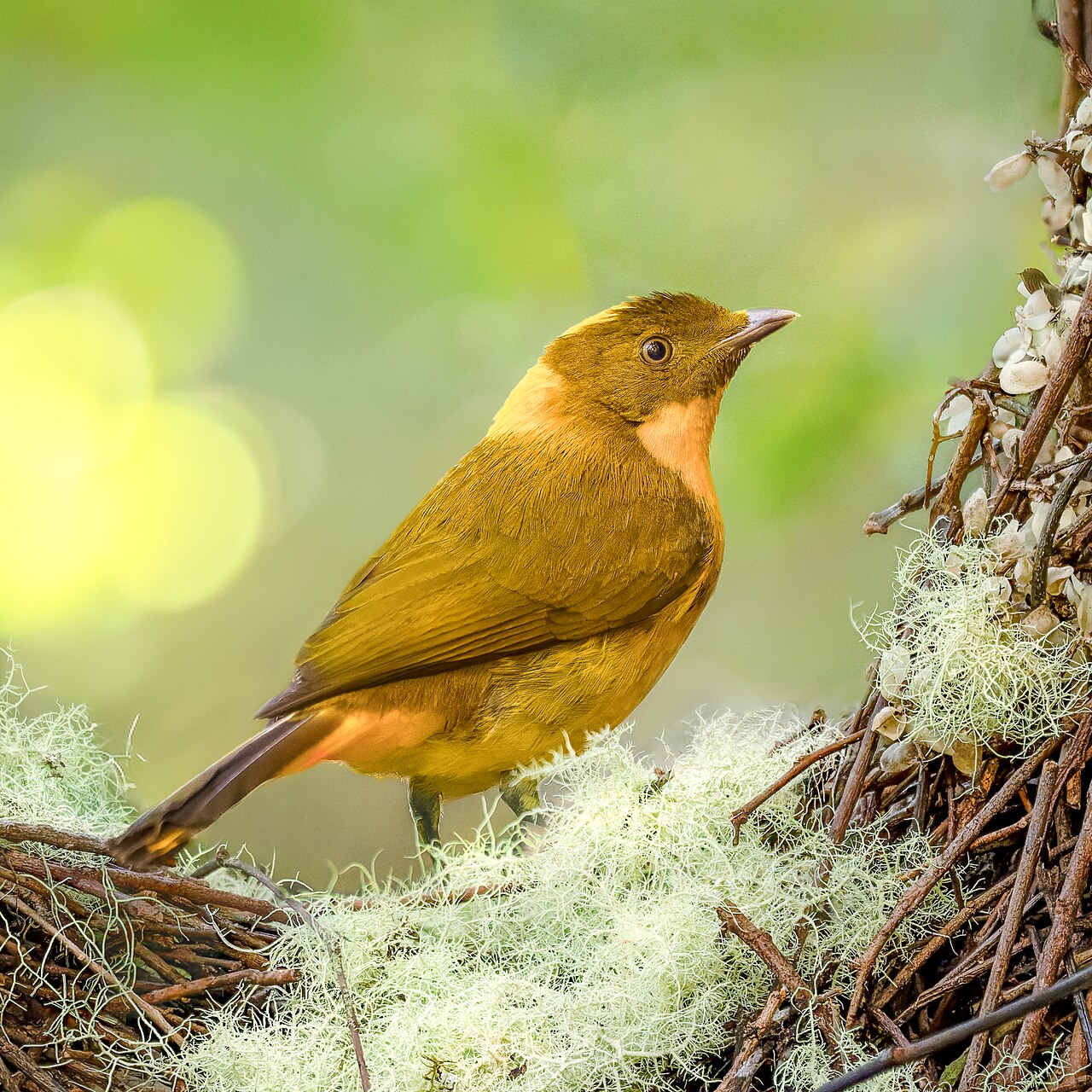
The Golden Bowerbird, the smallest bowerbird in the world, makes the largest structure. A male of barely twenty-five centimetres piles two towers of sticks around two slender saplings, sometimes higher than a person, and links them with a horizontal song perch. Such a maypole is added to year after year, and it stands only in the mountain rainforest of the Wet Tropics of north-eastern Queensland.
Voice
The characteristic sound at the maypole is a pulsating rattle of one to two seconds, repeated several times, with the tone of a wound-up mechanism. Between the rattles come squealing calls, rasping scolds and clear whistles, and the male weaves mimicry of other rainforest birds through his display. Calling peaks from September to December, early in the morning.
Recording: Henk Krajenbrink — CC BY-NC-SA 3.0 · Mt Lewis, Queensland, Australia · xeno-canto
Identification
The adult male is olive-brown on head, back and wings, with a golden-yellow crown, nape, tail and underparts; in a sunfleck on the forest floor that gold lights up sharply. The female is olive-brown above and ash-grey below, with no gold at all, and young birds resemble her. The build is small and compact, with a short bill and short rounded wings. The structure itself gives the species away fastest: not a two-walled avenue as in the Spotted, Great and Fawn-breasted Bowerbirds of the genus Chlamydera, but a tower form — two columns of interlocked sticks built up around two closely set saplings, joined by a horizontal stick on which the male sings. The decoration hangs on the towers rather than lying in front of them: pale beard lichens, white flowers and greenish fruits, always placed at eye level of the song perch.
Confusion species
A female or young bird is an inconspicuous olive-brown bird and is taken in the rainforest for the Tooth-billed Bowerbird (Scenopoeetes dentirostris); that species is however much larger, heavier billed and closely dark-streaked below, while the Golden Bowerbird is plain ash-grey below. The catbirds of the genus Ailuroedus are bright grass-green above and much larger. A female Victoria's Riflebird (Ptiloris victoriae), which lives in the same forest, has a long decurved bill and dark arrowhead markings below. A golden male can be confused with nothing in this area.
Habitat
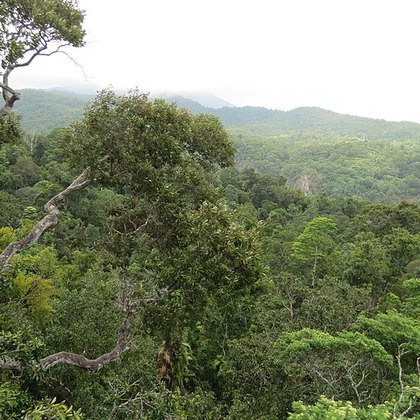
Tropical mountain rainforest with a closed canopy, almost always above three hundred and fifty metres and most numerous above nine hundred, where the cloud bank keeps the forest cool and wet. The maypoles stand on gentle slopes, on ridges just below the crest and where the ground levels off beneath a steep face; canopy cover over such a spot is usually more than seventy per cent. The bird is tied to that cool elevation and is absent from the warm lowlands.
Where the bird is most often found, arranged by main group and formation.
Range and movements
Endemic to the Wet Tropics of north-eastern Queensland, in a series of separate mountain blocks between the hinterland of Cooktown in the north and the Paluma area in the south, with the Atherton Tableland as its core. Within that the distribution is patchy: what is high and cool enough is occupied, and the valleys between are empty. Resident, staying at the same maypole all year; young males build simpler towers at the edge of an occupied area.
- Resident
- dark = core range, pale = thinly spread
Where and when to look
Look not for the bird but for the maypole. Walk the mountain rainforest with your eyes at knee height along the floor and watch for two closely set saplings with a conspicuously tidy pile of sticks around them and a pale patch of lichen at eye level. Come in the southern spring, between September and December, early in the morning, sit down ten metres away and wait for the rattle; the male usually returns to the cross stick within half an hour.
Conservation
Near Threatened (NT). The species is trapped in a cool upland band above which there is nothing left: as the climate warms, the suitable zone slides off the mountain top. Counts point to a decline in the order of twenty to thirty per cent, attributed to cyclone damage to the canopy and to the warming of the mountain climate. The range lies almost entirely within the Wet Tropics World Heritage Area, so logging and clearing no longer play a part; the climate itself cannot be fenced off.
Scientific name
Prionodura newtoniana | De Vis, 1883
De Vis described the species in 1883 and placed it at once in a genus of its own, so author and year stand without parentheses. Prionodura is formed from Greek prion (saw) and oura (tail); what exactly that saw refers to cannot be made out from the original description. The specific name newtoniana honours the British ornithologist Alfred Newton. The Dutch name meiboombouwer translates the English maypole type: the structure resembles a maypole, a post with decoration around it.