All species › Passerines › Thornbills, scrubwrens, gerygones and allies › Fernwren
Fernwren | Oreoscopus gutturalis
Zwartkeelstruiksluiper | Acantiza de helechal
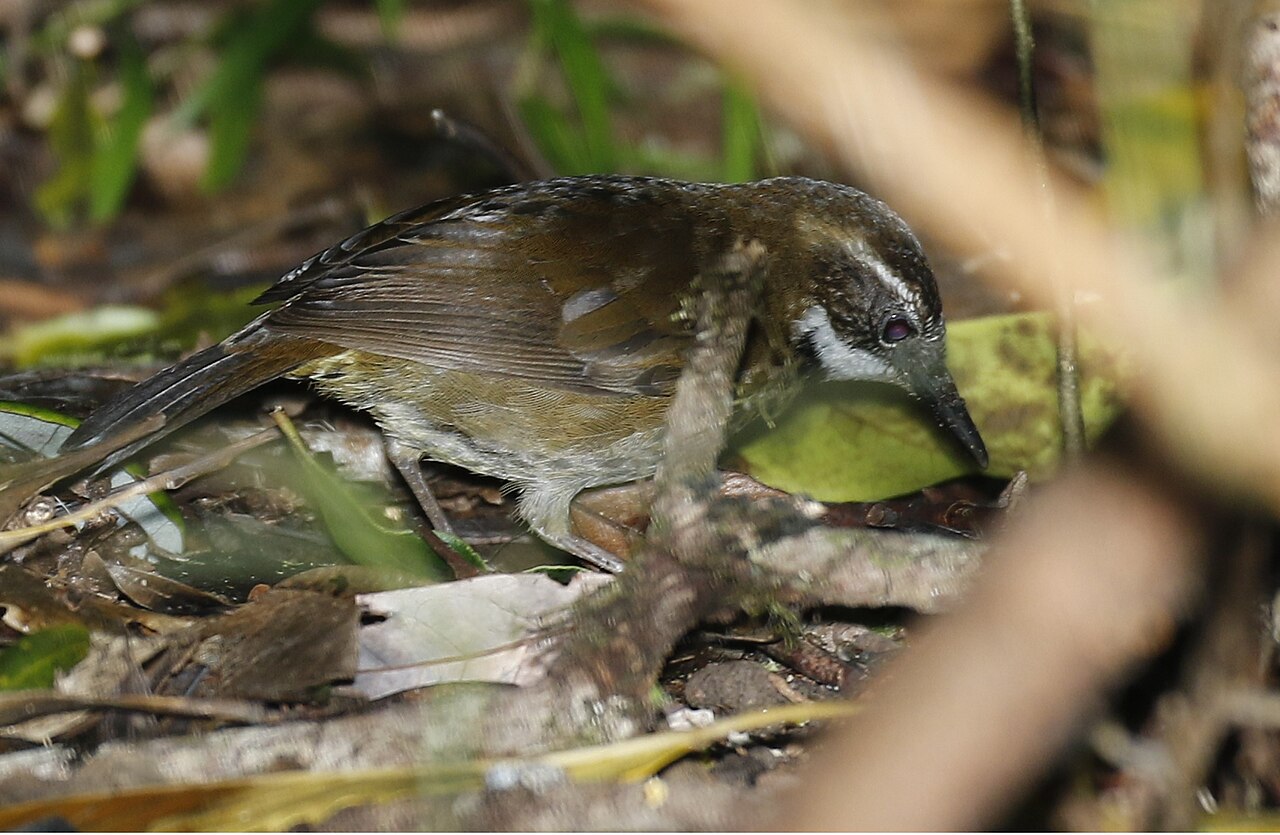
The Fernwren is the litter bird of the upland rainforest of the Wet Tropics: dark olive-brown, with a white eyebrow and a white throat set like a mask around a dark face, and a black bib below them. It is the only species in its genus and occurs nowhere but north-eastern Queensland. Of all the birds of that rainforest it is the most tied to the ground.
Voice
A high, thin series of clear whistles that slowly falls in pitch and carries far through closed forest; at a distance it sounds faint and slight. There is also a soft, fast chatter between two birds keeping together in the litter, and in alarm a buzzing, grating scold. Song comes mostly in the first hour after sunrise, from the ground or a low fern frond. Both sexes are heard.
Recording: J.V. Moore — CC BY-NC-SA 4.0 · Queensland: Cape York Peninsula: Daintree NP, Australia · xeno-canto
Identification
Twelve to fourteen centimetres: a compact bird with a short tail, long strong legs and a long, slender, slightly decurved bill. The upperparts are dark olive-brown, the underparts a duller grey-brown. The face is dark brown and enclosed above and below by pure white: a broad eyebrow and a white throat, with a black bib beneath them on the upper breast. The sexes are closely alike; young birds lack the white on the face and so look evenly dark. It walks and hops over the ground and rarely flies higher than a metre.
Confusion species
The scrubwrens of the genus Sericornis that share this forest are duller, lack the black bib and do not have the combination of white eyebrow and white throat; they also work the shrub layer more than the floor. Mountain Thornbill (Acanthiza katherina), of the same mountains, is smaller, olive-green and keeps to the canopy. Chowchilla (Orthonyx spaldingii) does forage in the litter, but is twice the size, far noisier, and has a white or orange throat without a black bib. A small dark bird flicking leaves aside on the floor and wearing a white mask is, in this forest, this species.
Habitat
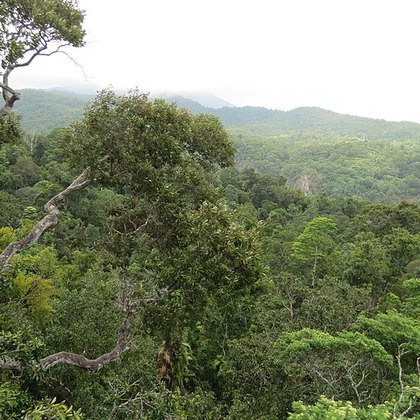
The floor of closed mountain rainforest, in shaded gullies with ferns, moss and a thick, damp layer of litter. It occurs between three hundred and fifteen hundred metres, but the weight of the population lies above six hundred and fifty; in the lowlands it is all but absent. Forest edges, plantations and clearings are avoided: it needs a closed canopy and a litter layer that does not dry out. Where feral pigs have turned the ground over, it disappears.
Where the bird is most often found, arranged by main group and formation.
Range and movements
Only in the Wet Tropics of north-eastern Queensland, from the Paluma Range near Townsville north to Cape Tribulation, across a series of mountain blocks separated by lowland. It is sedentary and does not migrate; each block has its own birds and exchange is slight. The occupied area is therefore small and fragmented, and it is also a narrow band: with the warm lowlands below and nothing but the summits above. Since logging in the Wet Tropics stopped and the area became World Heritage, little rainforest has been added or lost.
- Resident
- dark = core range, pale = thinly spread
Where and when to look
Walk slowly and watch the ground. The best places are the rainforest tracks above seven hundred metres — Mount Lewis, Mount Hypipamee, the Paluma Range — early in the morning, while the light in the gullies is still low. Look for movement in the leaves: the bird throws litter aside with its bill and gives itself away by that rustle sooner than by its thin whistle. Stand still the moment you hear something; whoever keeps walking will not see it.
Conservation
Endangered (EN). The rainforest itself is protected and no longer logged, but the range is small, lies almost wholly above six hundred metres and is divided over separate mountain blocks. The warming of the Wet Tropics pushes that altitudinal band upward, and above the summits it ends: that, and not logging, is why the species has moved up the Red List. Cyclones that open the canopy and feral pigs that turn over the litter do the rest.
Scientific name
Oreoscopus gutturalis | (De Vis, 1889)
De Vis described the bird in 1889 as Sericornis gutturalis, among the scrubwrens; because the species was later placed in a genus of its own, author and year stand in parentheses. The genus name Oreoscopus is formed from Greek oros (mountain) and skopos (watcher): the bird that keeps watch over the mountains. gutturalis is Latin for 'of the throat', after the black bib. The type locality is Herberton in northern Queensland.