All species › Passerines › Thornbills, scrubwrens, gerygones and allies › Yellow-throated Scrubwren
Yellow-throated Scrubwren | Neosericornis citreogularis
Geelkeelstruiksluiper | Sedosito gorjigualdo
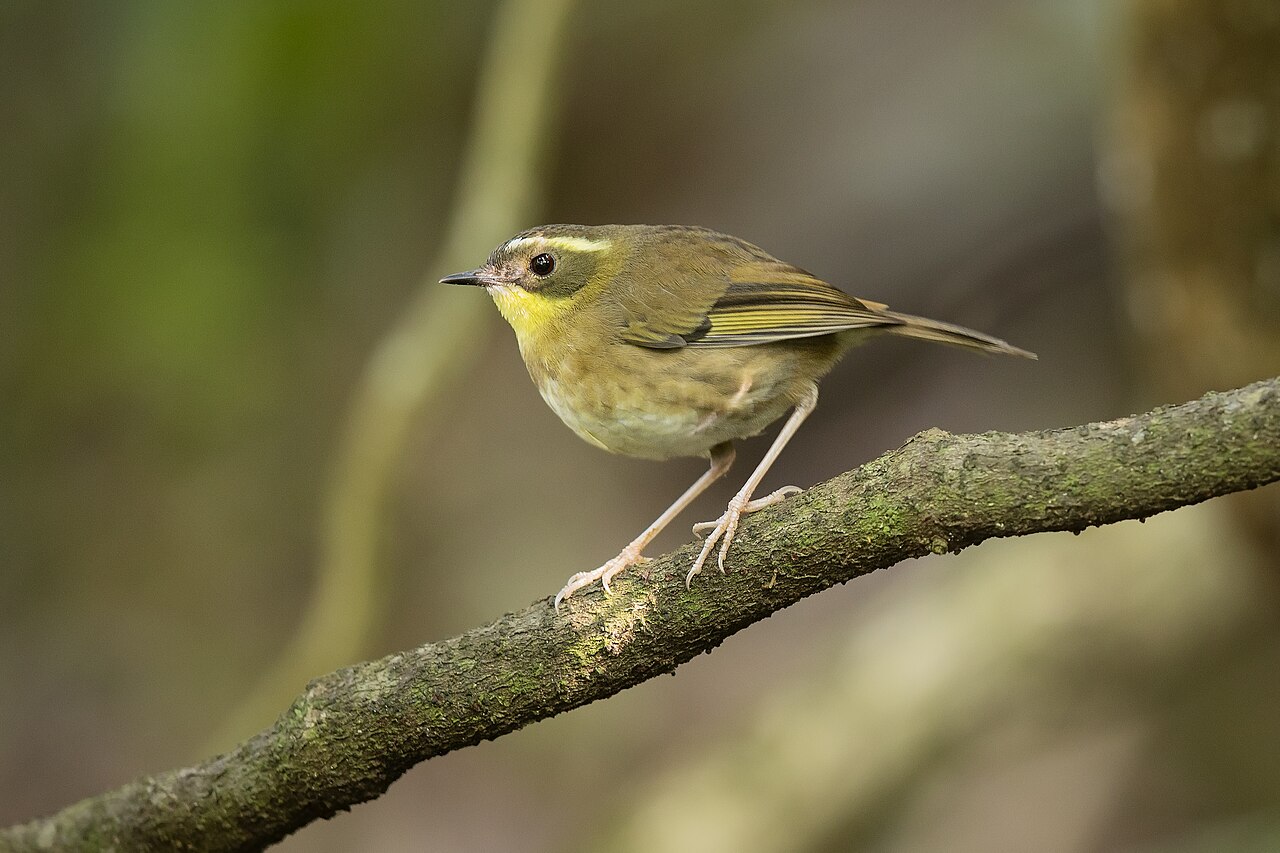
The Yellow-throated Scrubwren is the largest and most boldly marked scrubwren in Australia, and the only member of a genus of its own: a bird of the dark rainforest gullies with a black mask, a bright yellow throat and a yellow eyebrow above a red-brown eye. It finds all its food on the forest floor, among the leaves along the creek.
Voice
Melodious whistles alternating with harsh chattering, with mimicry of other birds worked in between. In a closed gully the sound carries a long way, and because the bird stays on the ground it comes from below rather than from the canopy — that alone puts you on the right track. Disturbance brings a sharp, grating rattle.
Recording: Greg McLachlan — CC BY-NC-SA 4.0 · Royal National Park, New South Wales, Australia · xeno-canto
Identification
A compact ground bird with a black mask over forehead, face and ear coverts, bordered by a white and yellow eyebrow above and a bright yellow throat below. Crown and back are dark olive-brown, the belly shades from yellow to white, the flanks carry an olive wash and the wing is dark grey-brown with yellowish outer edges. The legs are cream to pinkish grey, the bill black, the eye red-brown. The female has a brown rather than black mask, and young birds are duller throughout.
Confusion species
White-browed Scrubwren (Sericornis frontalis) shares the range but is smaller, with a white throat and a pale eye instead of a yellow throat and a dark eye. Large-billed Scrubwren (Sericornis magnirostra) is plain brown without a mask and forages high in vines and on trunks, not on the ground. Atherton Scrubwren (Sericornis keri), which lives on the ground in the same northern rainforests, is plain brown with no yellow or black. Fernwren (Oreoscopus gutturalis) from the same Queensland rainforest has a black-and-white throat and a white forehead instead. Spotted Scrubwren (Sericornis maculatus) and Tasmanian Scrubwren (Sericornis humilis) do not occur here.
Habitat
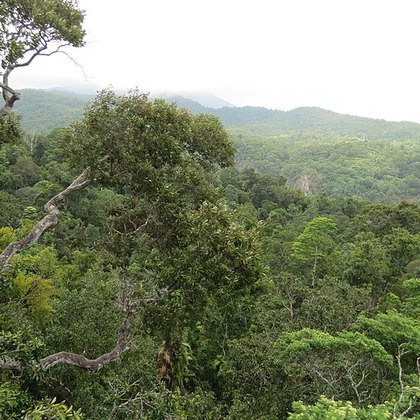
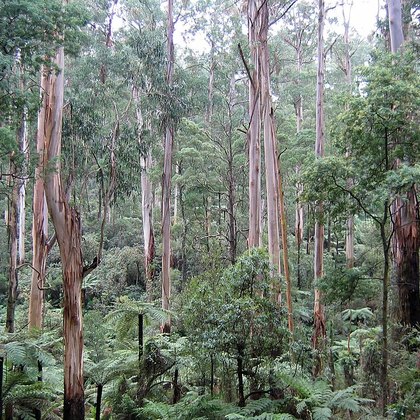
Rainforest and wet, timbered gullies with dense vegetation, usually with a stream nearby. It stays on the floor, among leaf litter, ferns and buttress roots, gathering seeds, insects and other small invertebrates. Unlike most of its relatives, which forage in the shrub layer or higher, it hardly ever leaves the ground.
Where the bird is most often found, arranged by main group and formation.
Range and movements
The east coast of Australia, in two separate populations: one in north Queensland between Cooktown and Townsville, and one from Hervey Bay in southeastern Queensland into southeastern New South Wales. Between them lies a gap of hundreds of kilometres with no suitable rainforest. The species is sedentary and holds the same territory all year.
- Resident
- dark = core range, pale = thinly spread
Where and when to look
Walk a rainforest track along a creek and look at the ground, not up: it shuffles across the path ten metres ahead of you and then vanishes back into the leaves. Its nest is a large, pear-shaped mass hanging from a branch or vine above the water and looking exactly like stranded flood debris — you will walk straight past it until you know what to watch for. Those same nests are used as daytime roosts by the Golden-tipped Bat (Kerivoula papuensis).
Conservation
Least Concern (LC) and common within its two areas, as long as the rainforest stands. The species depends entirely on closed, moist forest with an intact ground layer: it does not cross open country, and the two populations have been separated for a very long time. The remaining rainforests of Queensland and New South Wales are largely protected, so the main concerns now are drying, hotter and drier years, and the effects of fire at the edges.
Scientific name
Neosericornis citreogularis | (Gould, 1838)
Gould described the species in 1838 as Sericornis citreogularis, from a bird taken in New South Wales. Genetic work showed in 2018 that it is not closely related to the other scrubwrens, and it was therefore moved to the monotypic genus Neosericornis — a genus with this one species in it. Because the genus changed, author and year stand in parentheses. The name joins Greek neos, new, and Sericornis, itself from Greek sērikos, silken, and ornis, bird. citreogularis means lemon-throated, from Latin citreus, citron-coloured, and gula, throat — exactly what the Dutch name Geelkeelstruiksluiper and the English name Yellow-throated Scrubwren both say.