All species › Cranes, rails and allies › Rails, gallinules and coots › Dusky Moorhen
Dusky Moorhen | Gallinula tenebrosa
Zwart waterhoen | Gallineta enlutada
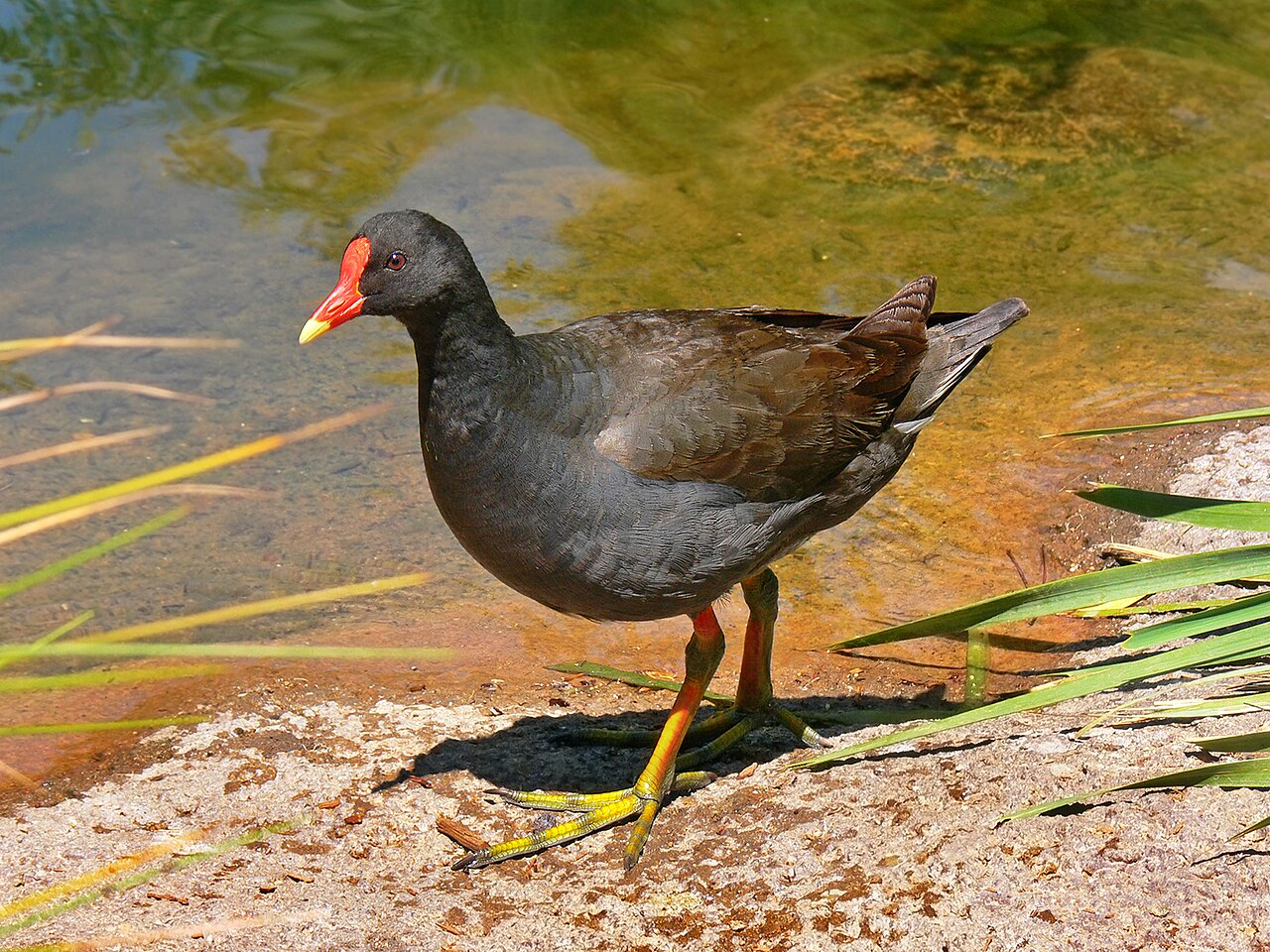
The Dusky Moorhen is the dark, red-billed rail of every Australian park pond: slate-grey to black, with a red frontal shield, a yellow bill tip and a white undertail that flashes at every step. It walks a lawn as readily as it swims, and it often breeds not as a pair but as a small party that tends a single nest together.
Voice
The territorial call is a loud, hoarse crow: a hard kurk or krik, often repeated and then run together into kurruk-uk. Disturbance adds a sharp screeching shriek that carries across the whole pond. Between partners and young come soft mewing kook notes, and at night a single hard cry gives away that the birds are still awake.
Recording: Ramit Singal — CC BY-NC-SA 4.0 · Melbourne, Victoria, Australia · xeno-canto
Identification
A stocky rail of 34 to 38 cm, evenly dark slate-grey with a browner back and a black head. The face carries a bright red frontal shield running into a red bill with a yellow tip; the legs are yellow to green-yellow with a red band above the joint. Under the cocked tail sit two white patches that light up with every stride. Young birds are duller and browner, with a greenish bill and barely any shield.
Confusion species
Eurasian Coot (Fulica atra) swims the same water but is greyer, rounder and carries a snow-white shield and white bill. Purple Swamphen (Porphyrio porphyrio) is much larger, blue and purple, on thick red legs. Black-tailed Nativehen (Tribonyx ventralis) is slimmer, stands upright, would rather run than swim and lacks the red shield; it has a blue-grey bill base and white flank streaking. Common Moorhen (Gallinula chloropus) of Eurasia does not reach Australia.
Habitat
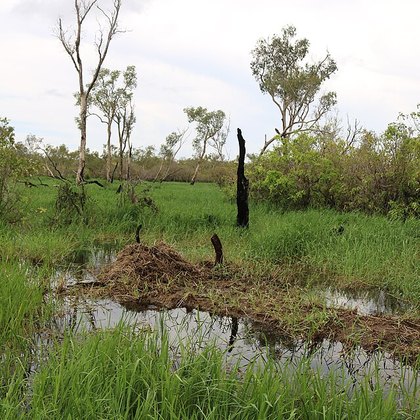
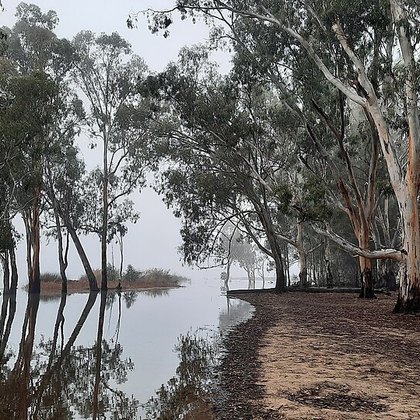
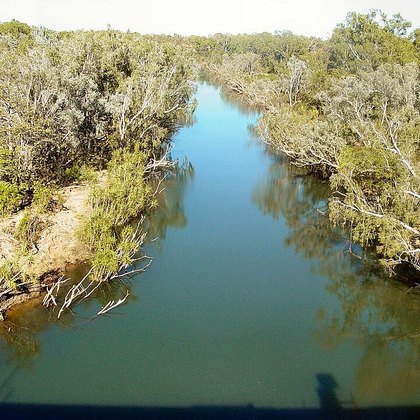
Freshwater swamp with reed, rush and waterlily, plus lakes, reservoirs, creeks, canals and practically any city pond or golf course lagoon. It needs open water to swim on and a dense margin to dive into, and feeds beyond that on lawns, banks and park grass. The nest is a mound of reed and leaves on or just above the water, usually set against the edge of the vegetation.
Where the bird is most often found, arranged by main group and formation.
Range and movements
Eastern and southwestern Australia, from Cooktown in north Queensland south along the coast into eastern South Australia, plus the southwest corner of Western Australia; beyond Australia in New Guinea and parts of Indonesia. It is absent from Tasmania and from New Zealand, and the dry interior is largely empty. It does not migrate, but in drought birds leave drying swamps and turn up on ponds and basins where they are otherwise unknown.
- Resident
- dark = core range, pale = thinly spread
Where and when to look
Read the bill, not the body: red with a yellow tip is Dusky Moorhen, white is coot, and that holds in poor light and at range. In a group on a lawn watch for the white tail patches flashing at every step — a movement you catch from the corner of your eye. From August to January stand at a pond edge and count how many adults belong to one nest; more often than not it is more than two.
Conservation
Least Concern (LC). The Dusky Moorhen is one of the few rails that takes to the city well: park ponds, canals, detention basins and golf course lagoons supply exactly the mix of open water, dense margin and short grass it needs, and on that side it has gained rather than lost. Away from town, swamp drainage and river regulation press the numbers down, and roads along water take a steady toll.
Scientific name
Gallinula tenebrosa | Gould, 1846
Gould described the species in 1846 as Gallinula tenebrosa, from a skin taken on the Murray in South Australia, and it remains in that genus, so author and year carry no parentheses. The genus Gallinula was introduced by Brisson in 1760 and is the Latin diminutive of gallina, 'hen' — a 'little hen'. tenebrosa means 'dark, gloomy', from tenebrae, 'darkness', which is exactly the impression the bird gives on the water.