All species › Waders, gulls and terns › Sandpipers and allies › Curlew Sandpiper
Curlew Sandpiper | Calidris ferruginea
Krombekstrandloper | Correlimos zarapitín
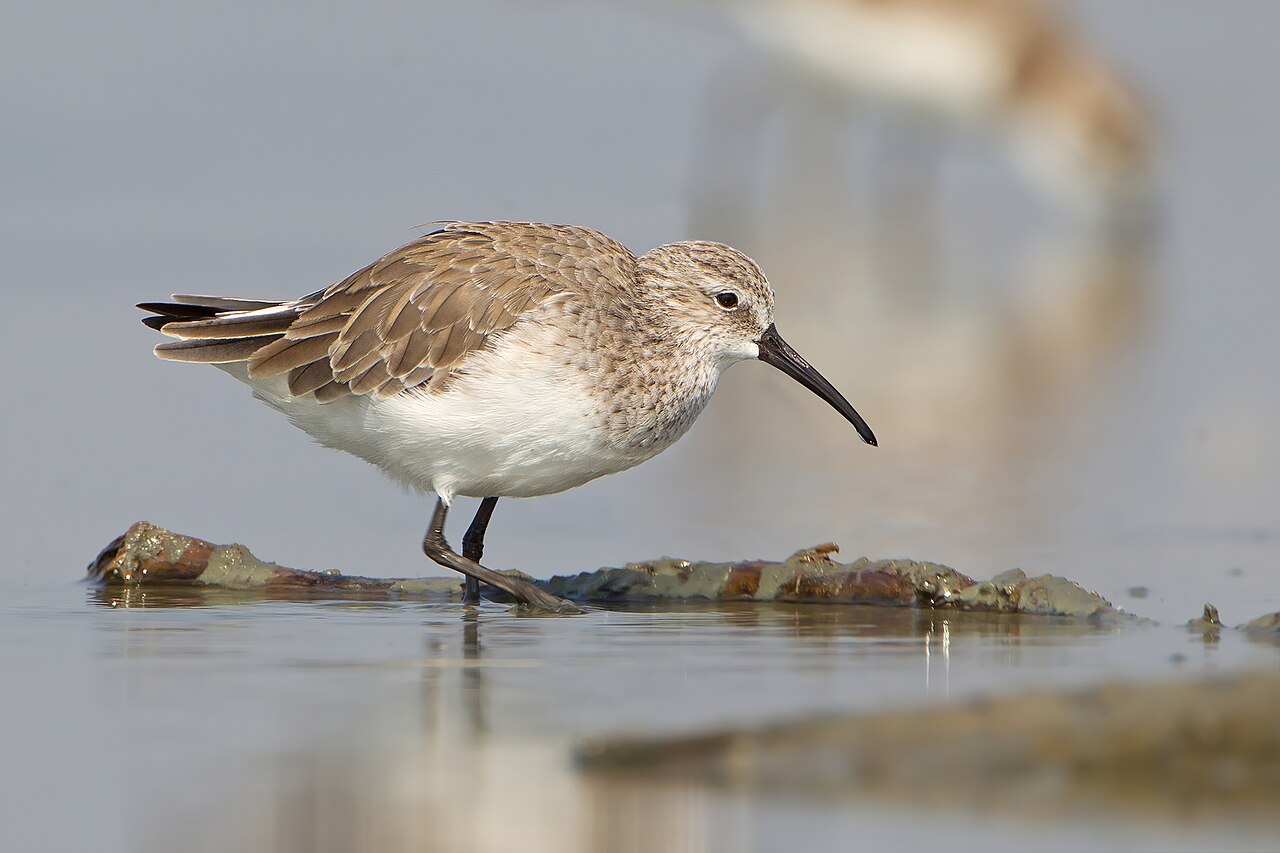
The Curlew Sandpiper is one of the medium-sized sandpipers of the region: tall on the leg, long in the neck, and with a black bill that curves evenly downward along its whole length. Flush it and the second trademark appears: a clean, square white rump patch. It once stood on Australian mudflats in flocks of thousands, and has thinned out sharply within a few decades.
Voice
A soft, rippling chirrup, often repeated two or three times on take-off; more musical and fuller than the sharp grating of the stints, and on a mixed roost often the first thing that betrays its presence.
Recording: Xavier Riera — CC BY-NC-SA 4.0 · Baix Ebre (near L'Ampolla), Tarragona, Catalunya, Spain · xeno-canto
Identification
Eighteen to twenty-three centimetres, slim and long-legged. The bill is black, thirty-two to forty-four millimetres long, and curves smoothly downward along its entire length — not with a kink at the tip alone; that is the character the bird is named for and the one that identifies it in every plumage. The legs are black and clearly longer than on any other sandpiper here, so that the feet project beyond the tail in flight. In non-breeding plumage the upperparts are plain grey-brown with pale feather edges, the underparts white, with a prominent white brow. The white rump patch runs as a broad band across the base of the tail and shows in all plumages. In breeding plumage head, neck and underparts turn deep rusty red with white feather tips.
Confusion species
The curved bill separates it from almost everything, but note the near misses. Red-necked Stint (Calidris ruficollis) is clearly smaller and shorter-legged, with a short straight bill and a grey, dark-centred rump. Broad-billed Sandpiper (Calidris falcinellus) has a bill of similar length but different shape, kinked down only at the tip, plus a split supercilium and much shorter legs. Red Knot (Calidris canutus) is dumpier, with a short straight bill and a grey barred rump. Pectoral Sandpiper (Calidris melanotos) has yellow legs and a sharply cut-off breast band. If in doubt at range: put the flock up and look at the rump — white and unbroken belongs to this species.
Habitat
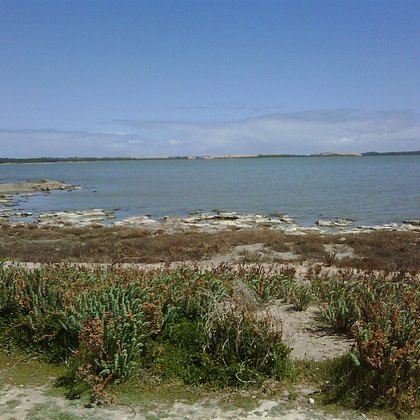
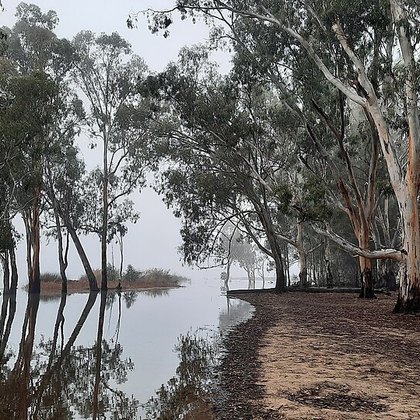
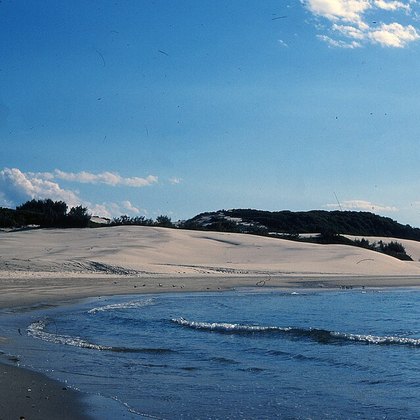
Intertidal mudflats of estuaries, lagoons and mangrove creeks, and beyond them shallow brackish pools, saltworks, samphire (low, succulent saltmarsh shrubland on tidal mud) flats and beaches. Unlike most mudflat sandpipers it also moves inland to lakes, dams and floodwaters after rain, where it wades in up to the belly.
Where the bird is most often found, arranged by main group and formation.


Range and movements
A summer visitor around virtually the whole Australian coast, concentrating in the far south-east — Port Phillip Bay with the Werribee treatment ponds, and the Coorong — and in the north-west, where counts on Eighty Mile Beach have reached around eight thousand birds. It is also readily found well inland, on wetlands of the Murray-Darling basin. In New Zealand probably fewer than forty birds reach the country each summer, with Manukau Harbour and Lake Ellesmere the strongholds and rarely more than two or three staying the winter. It arrives in September and October and, leaving in April and early May, is one of the last waders to go.
- Resident
- Breeding (summer)
- dark = core range, pale = thinly spread
Where and when to look
Work along a roosting flock of Red-necked Stints and find the bird that stands a size above them and higher on the leg; then put the scope on the bill. If that fails, wait until the flock lifts: the white rump stands out at any range. By March the first red breeding plumage is already showing.
Conservation
Vulnerable (VU) globally, and listed as Critically Endangered under Australia's national environment law. Counts at Australian sites have fallen by anything from tens of per cent to well over half since the 1980s, and in New Zealand little is left of the former flocks of hundreds. The main cause lies along the flyway: reclamation of the tidal flats of the Yellow Sea removes the staging ground. On top of that, breeding success on the Siberian tundra tracks the lemming cycle — in poor lemming years foxes and skuas switch to the nests — so that a bad season feeds straight through into the numbers arriving here.
Scientific name
Calidris ferruginea | (Pontoppidan, 1763)
Pontoppidan described the species in 1763 in his Danske Atlas as Tringa ferrugineus; the move into Calidris puts author and year in parentheses. The epithet comes from Latin ferrugo, 'iron rust', after the red-brown breeding plumage. The genus Calidris goes back to Greek kalidris, Aristotle's word for grey waterside birds. Pontoppidan fixed no type locality; his work describes the birds of Denmark. The Dutch and English names both point at the same thing: a sandpiper with the curved bill of a curlew.