All species › Waders, gulls and terns › Sandpipers and allies › Broad-billed Sandpiper
Broad-billed Sandpiper | Calidris falcinellus
Breedbekstrandloper | Correlimos falcinelo
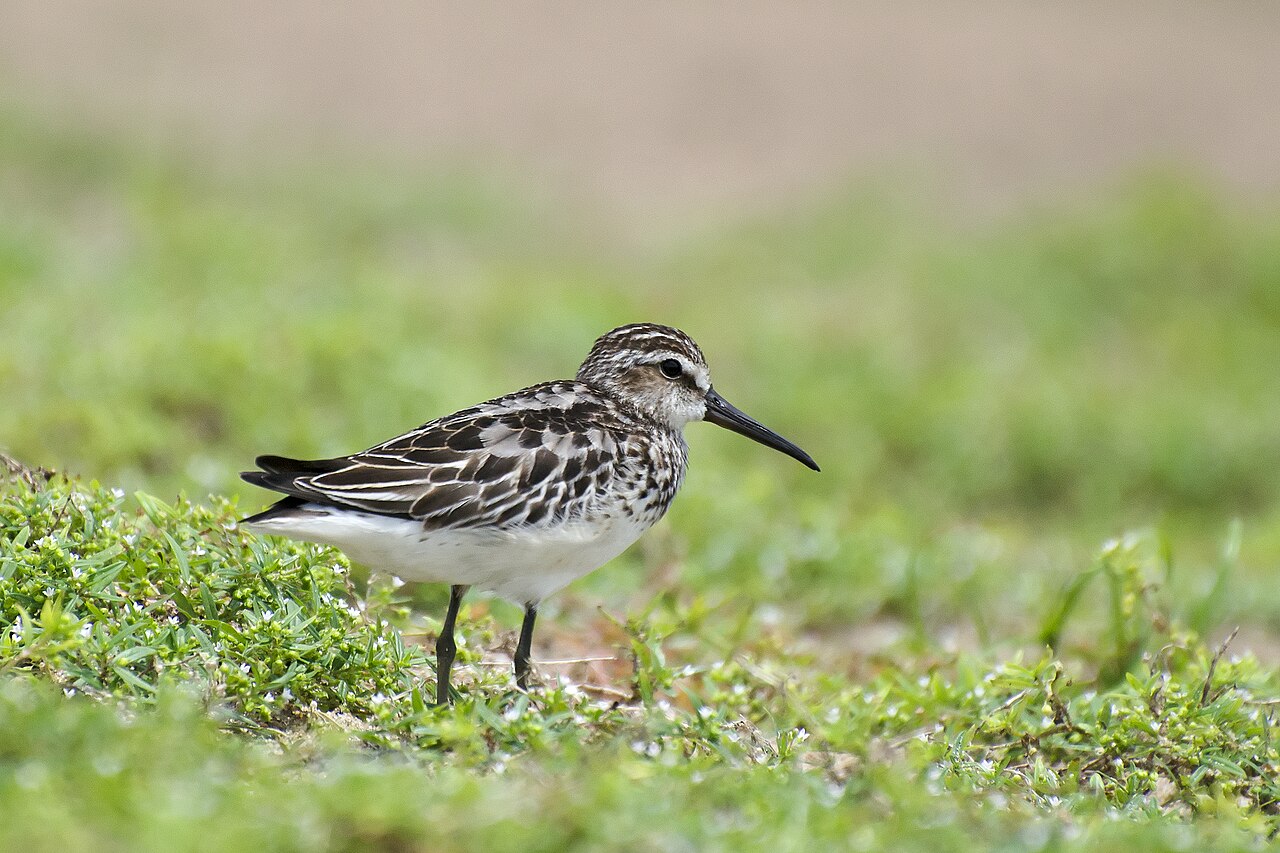
The Broad-billed Sandpiper is a small, short-legged wader with the head of a snipe: two pale supercilia meeting above the bill with a dark stripe between them. The bill is long, heavy, broad at the base and clearly kinked down at the tip — not a smooth curve but a kink. In Australia it is a bird of the northern tidal flats beside mangroves; in New Zealand one turns up every few years.
Voice
The call is a dry, buzzing chreeit, often repeated twice, with a burred, almost electric quality that can be picked out of a mixed flock. Alongside it come a low rolling prrr and a ticking dik dik reminiscent of Little Stint. Out on the flats it is largely silent; this is a sound of flushing and of the flight to the roost.
Recording: Stanislas Wroza — CC BY-NC-SA 4.0 · Kaamanen, Finland · xeno-canto
Identification
A small wader of sixteen to eighteen centimetres, low-slung and horizontal in carriage, which makes it look stockier than a Curlew Sandpiper. Two features settle it. The first is the bill: long and heavy for the size of the bird, conspicuously broad at the base, black, straight over most of its length and then sharply kinked down at the tip. The second is the head: a double, split pale supercilium that almost meets above the base of the bill, with a dark crown stripe between — the pattern of a snipe in miniature. The legs are short and greenish to olive-grey. Non-breeding plumage is grey-brown with dark feather centres above and white below, with fine dark speckling across the breast. Juveniles are much warmer, with rufous feather fringes and a clear white V across the mantle.
Confusion species
Curlew Sandpiper (Calidris ferruginea) is the main one: larger, far longer in the leg, with a bill evenly decurved along its whole length instead of kinked at the tip, a head lacking the double supercilium, and a conspicuous white rump in flight. Red-necked Stint (Calidris ruficollis) is smaller, with a short straight bill, only one supercilium and black legs. Little Stint (Calidris minuta) is likewise smaller and black-legged, with a finer bill. Sharp-tailed Sandpiper (Calidris acuminata) is larger, with a rufous cap instead of a striped head and a short straight bill. Terek Sandpiper (Xenus cinereus) has a bill that sweeps upward and orange legs, and drops out at once.
Habitat
Soft, clayey intertidal flats in estuaries and bays, especially close to mangroves, where it probes the mud with vertical, snipe-like jabs for worms, molluscs, small crabs, insects and seeds; shallow pools out on the flat are preferred. At high water it roosts on sandy beaches, shellbanks and the open edge of saltmarsh, usually among Red-necked Stints and Curlew Sandpipers.
Where the bird is most often found, arranged by main group and formation.



Range and movements
Its centre of gravity is the northern Australian coast, with the largest numbers in the northwest — Roebuck Bay, Eighty Mile Beach and the bays around Darwin — where it can stand in tens to hundreds on the mudflats beside mangroves. Australia holds an estimated eight thousand birds out of a flyway population of around eighteen thousand. Along the east and south coasts it is far scarcer and usually a matter of single birds. In New Zealand it is a vagrant with about twenty accepted records since 1960, mainly at Miranda on the Firth of Thames and in Manukau Harbour, and otherwise occasionally at Lake Ellesmere and in the Kaipara: one or two birds every few years.
- Resident
- Breeding (summer)
- dark = core range, pale = thinly spread
Where and when to look
In northern Australia work the muddy flat along the mangrove edge on a falling tide and look for a small, low-slung sandpiper jabbing with short vertical thrusts. Then put the scope on the head, not the body: in good light the double supercilium shows at fifty metres and is the one feature that does not change with wear or season. If the bill runs straight and only kinks at the very tip, that settles it. In New Zealand the species has to be searched for among the Curlew Sandpipers at the Miranda high-tide roost.
Conservation
Vulnerable (VU). The decline is put at more than thirty per cent over three generations, and the cause is the same as for the other migrants on this route: the tidal flats where it has to refuel between breeding and non-breeding grounds, above all along the Yellow Sea, have been reclaimed or polluted on a vast scale. The breeding grounds lie in wet bogs of the northern taiga and tundra, where a changing climate is altering the water regime. In Australia, disturbance at roosts counts as well, along with the fact that it uses exactly those mangrove flats that go first when a port is extended.
Scientific name
Calidris falcinellus | (Pontoppidan, 1763)
Pontoppidan described the species in 1763 as Scolopax falcinellus, from birds on Zealand in Denmark; because of the later move, author and year stand in parentheses. The epithet falcinellus is the diminutive of Latin falx, 'sickle', and refers to the curved bill tip. For a long time the bird stood alone in its own genus Limicola, 'mud dweller'; genetic work showed in 2004 that it belongs in the middle of Calidris, where it has stood ever since. The birds that reach Australia belong to the eastern subspecies sibirica, described by Dresser in 1876.