All species › Waders, gulls and terns › Sandpipers and allies › Pectoral Sandpiper
Pectoral Sandpiper | Calidris melanotos
Gestreepte strandloper | Correlimos pectoral
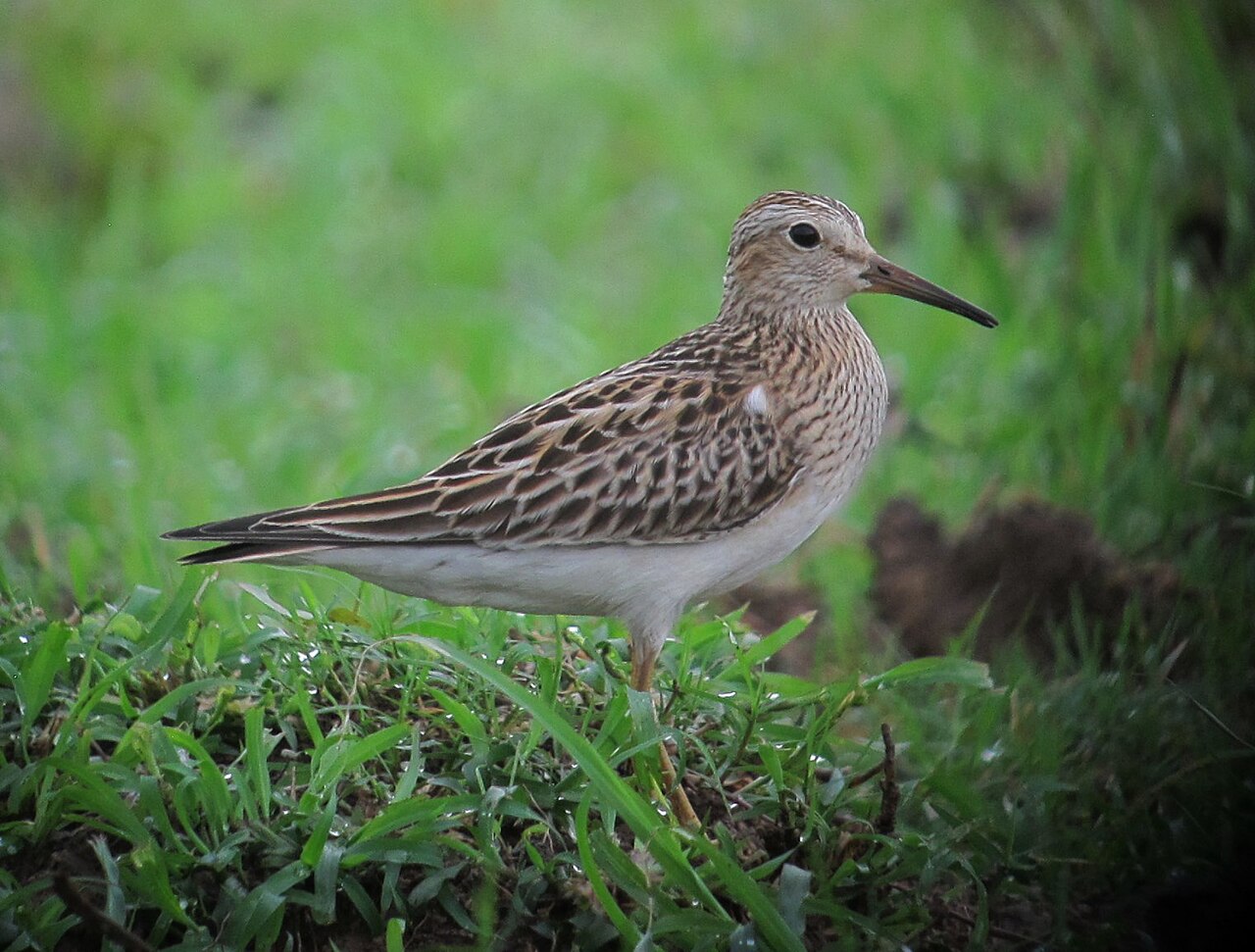
The Pectoral Sandpiper is the freshwater sandpiper of the region: a medium-sized, brown-marked bird with yellow legs, more likely to be found at the edge of a flooded paddock or a treatment pond than out on the tidal flat. Its mark is the finely streaked breast, cut off below as if with scissors against a snow-white belly.
Voice
On take-off a hoarse, dry, slightly reedy trrrip or krrrt, growing louder and harsher when the bird is alarmed; it is one of the most recognisable calls in the group. On the tundra breeding grounds, far outside this map window, the male gives a dull hooting produced with an air sac in the breast.
Recording: JAYRSON ARAUJO DE OLIVEIRA — CC BY-NC-SA 4.0 · Embrapa Arroz-Feijão, Goianira, Goiás, Brazil · xeno-canto
Identification
Nineteen to twenty-four centimetres, with males noticeably larger than females. The upperparts are brown and scalloped, with dark feather centres and pale edges; the crown is brown and finely streaked. The clinching mark is on the breast: dense fine streaking over a grey-brown ground, ending below in a straight, sharp line against the white belly, as if the bird wore a bib. The bill is short and slightly decurved, olive to yellowish at the base with a dark tip. The legs are dull yellow to olive-yellow — black on nearly every other sandpiper here. In flight the tail base is dark with white sides and there is no clear wingbar.
Confusion species
Sharp-tailed Sandpiper (Calidris acuminata) is the standing trap: the same size, also yellow-legged, and almost always in the same pool. Look first at the crown — rufous on Sharp-tailed, plain brown on Pectoral — and at the head, where Sharp-tailed has a far more prominent white supercilium and a white eye-ring. Then look at the breast: on Pectoral the streaking ends in a hard straight line, on Sharp-tailed it dissolves into arrowhead marks that run down the flanks. Ruff (Calidris pugnax) is longer in neck and leg, with a smaller head and scalloped rather than streaked upperparts. Curlew Sandpiper (Calidris ferruginea) has black legs, a curved bill and a white rump.
Habitat
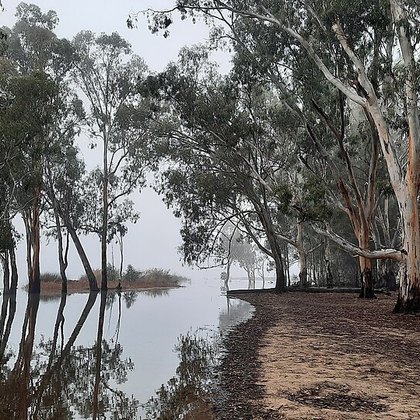
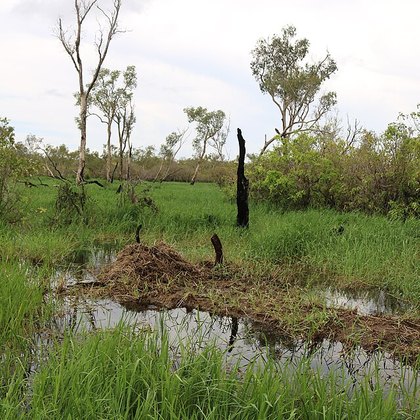
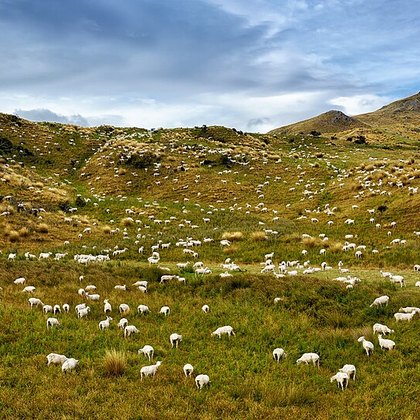
Fresh and slightly brackish margins: coastal lagoons, swamp edges, the drying rims of lakes and reservoirs, wet paddocks after flooding and the settling ponds of sewage works. It often feeds in low vegetation and grass some way back from the waterline, rather than out on open mud like most of its relatives.
Where the bird is most often found, arranged by main group and formation.


Range and movements
A regular but uncommon summer visitor. In Australia the weight of records is in the south-east — the wetlands of the Murray-Darling basin, western Victoria and treatment ponds such as Werribee — with birds arriving first on the coast and then spreading inland. They come in during August and September and leave in March and April. In New Zealand ten to twenty birds are seen a year, at estuaries, river mouths and the margins of lowland lakes; Norfolk Island also produces records with some regularity. Unlike most waders here it comes from American as well as Siberian tundra.
- Breeding (summer)
- dark = core range, pale = thinly spread
Where and when to look
Do not look for it on the mudflat but at fresh water: work the edges of settling ponds and flooded paddocks and watch for yellow legs among the Sharp-tailed Sandpipers. Once you have a bird, go straight to the lower edge of the breast streaking; that hard line reads at any range and settles the matter.
Conservation
Least Concern (LC): the species breeds across a vast belt of tundra from northern Siberia into Canada and winters mainly in South America, so what arrives here is a small share of the world population. Even so, numbers have roughly halved since the mid-1970s, probably reflecting changes on the tundra and the loss of freshwater marshes along the flyways. In New Zealand it counts as a vagrant.
Scientific name
Calidris melanotos | (Vieillot, 1819)
Vieillot described the species in 1819 as Tringa melanotos; the move into Calidris puts author and year in parentheses. The epithet is built from Greek melas, 'black', and notos, 'backed'. The genus Calidris goes back to Greek kalidris, Aristotle's word for grey waterside birds. The type locality is Paraguay: Vieillot described the bird from the notes of Azara, who had recorded it there. The English name points at the inflatable breast of the displaying male, the Dutch name at the streaked breast.