All species › Passerines › Honeyeaters › Black-eared Miner
Black-eared Miner | Manorina melanotis
Zwartoorhoningeter | Mielero orejinegro
The Black-eared Miner is Australia's rarest miner and survives only in mature mallee (low, multi-stemmed eucalypt scrub of dry southern Australia) that has not burnt for decades along the Murray. In 2016 it was assessed as probably Australia's rarest and most endangered bird. Its greatest threat is neither a predator nor the axe but a relative: the Yellow-throated Miner, which moves into the mallee along cleared ground and hybridises with it. The bird has thereby become a textbook case of a species that may cease to exist not by dying out but by being absorbed.
Voice
The same harsh, piping and scraping cries as the other miners, delivered in chorus by the whole colony; the repertoire is all but identical to that of the Yellow-throated Miner and offers no field handle for separating the two. The alarm chorus with which a colony surrounds a raptor or a snake cannot be told apart either. Anyone looking for this species must rely on the eye and not on the ear.
Recording: Martin Cake — CC BY-NC-SA 4.0 · Gluepot, South Australia, Australia · xeno-canto
Identification
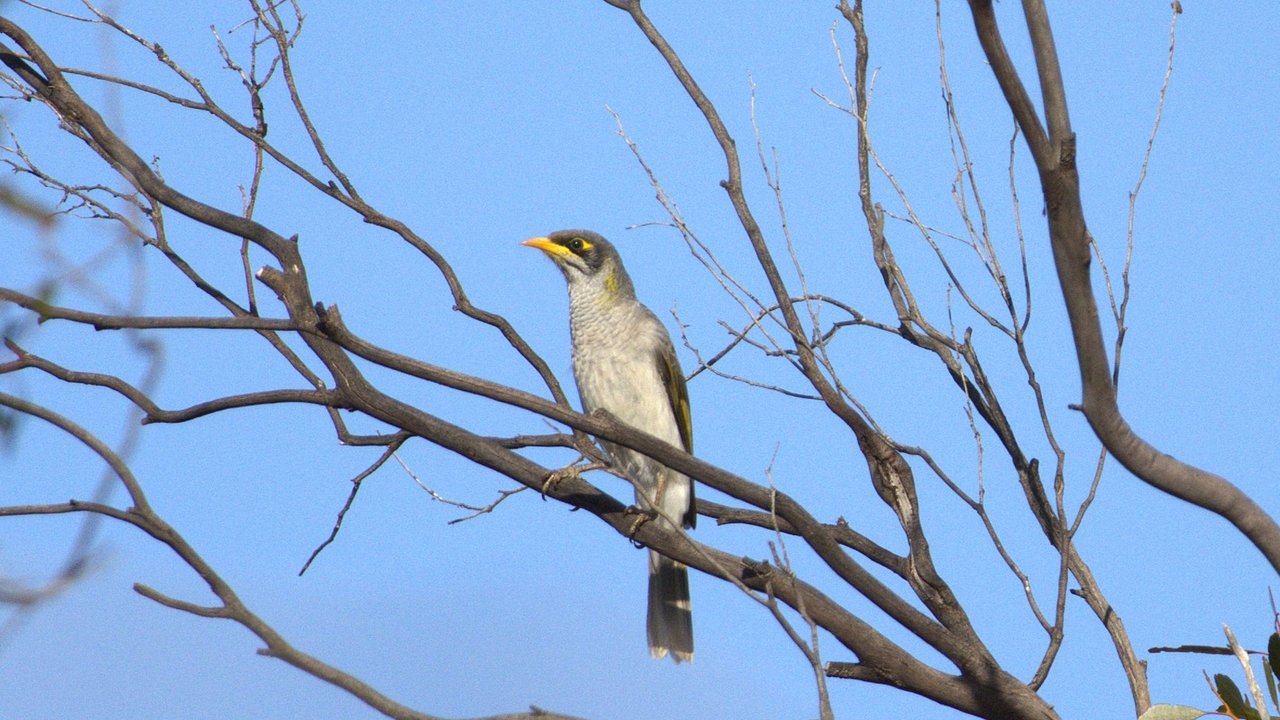
About twenty-five centimetres: a dark, long-tailed miner with an orange-yellow bill and orange-yellow legs, a black mask, bare yellow skin behind the eye and a white belly. Wings and tail carry an olive-yellow gloss. Decisive are the dark parts: the rump is brown and does not differ from the back, the throat is grey rather than clean white, and the black mask is barely flecked with silver-grey, with a superciliary line of at most one or two millimetres. The forehead is darker and more olive than yellow. The breast is finely scalloped with brown bands and narrow white feather tips.
Confusion species
The Yellow-throated Miner (Manorina flavigula) is the only species with which confusion really arises, and here that confusion is not carelessness but biology: where both occur, hybrids are present that are intermediate in every character. The pure Yellow-throated Miner has a white to off-white rump standing out sharply against the back, a clean white throat, a mask heavily flecked with silver-grey and a more extensive yellow forehead; the pure Black-eared Miner has the dark version of all of these. No single character stands on its own: only when rump, throat, mask and forehead all four show the dark form is the bird a pure one. The Noisy Miner (Manorina melanocephala) does not occur in the mallee and has a black crown.
Habitat
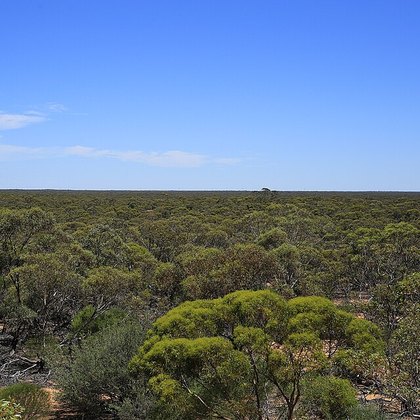
Only mature mallee that has not burnt for more than fifty years, with a dense, closed shrub layer and old hollow stems. Young regrowth after fire is unsuitable: a colony returns only after decades. Edges, roadsides and cleared patches are on the contrary the habitat of the Yellow-throated Miner, and every such intervention in the mallee brings that species closer.
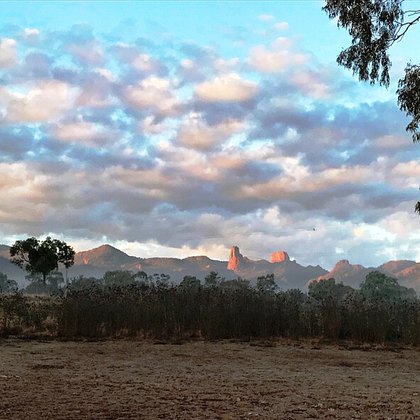
Where the bird is most often found, arranged by main group and formation.
Range and movements
Only in the mallee block along the Murray on the Victorian–South Australian border: the Riverland Biosphere Reserve in eastern South Australia, Murray-Sunset National Park and the Annuello reserve in north-western Victoria. In New South Wales an extremely small population remains at Scotia Station and the adjoining Tarawi Nature Reserve, put at a handful of birds in 2007. Resident; colonies stay together in the breeding season and disperse into the surrounding mallee outside it. Around 2022 the total was estimated at some two hundred colonies of at most twenty birds each.
- Resident
- Passage
- dark = core range, pale = thinly spread
Where and when to look
Search in old, unburnt mallee and work through every party of miners systematically: look at rump, throat, mask and forehead separately and record them separately. A bird with a dark rump but a white throat is a hybrid and not a Black-eared Miner, and that distinction matters more to management than the name on the list. Submit records with photographs, so that the characters can be checked afterwards.
Conservation
Endangered (EN) on the IUCN list and critically endangered in New South Wales, and in 2016 assessed as probably Australia's rarest and most endangered bird; a 2018 study ranked it tenth among Australian birds at risk of extinction. The main cause is the loss of old mallee to clearing and to large fires, which can erase decades of suitable habitat in a single season. On top of that comes hybridisation with the Yellow-throated Miner (Manorina flavigula), reported again in 2022: because that species enters the mallee along cleared edges, the genetic integrity of the Black-eared Miner is being eroded, and this counts as a threat in its own right beside habitat loss. Grazing by feral goats, rabbits and kangaroos at newly created watering points, and predation by cats and foxes, play a further part.
Scientific name
Manorina melanotis | (Wilson, 1911)
Francis Erasmus Wilson described the bird in 1911 in The Emu as Myzantha melanotis, from material out of the Victorian mallee; because the species was later placed in Manorina, author and year stand in parentheses. melanotis is Greek for 'black-eared', from melas (black) and ous, otos (ear), after the dark ear region that separates it from the Yellow-throated Miner; the English and Dutch names follow that word directly. For the genus Manorina, from Greek manos (thin) and rhinos (nostril), see the Yellow-throated Miner. The bird's rank has long been disputed: part of the research community has treated it as a subspecies of Manorina flavigula, and the hybridisation has not made that argument easier. This guide carries it as a species in its own right.