All species › Passerines › Thornbills, scrubwrens, gerygones and allies › Atherton Scrubwren
Atherton Scrubwren | Sericornis keri
Athertonstruiksluiper | Sedosito de Atherton
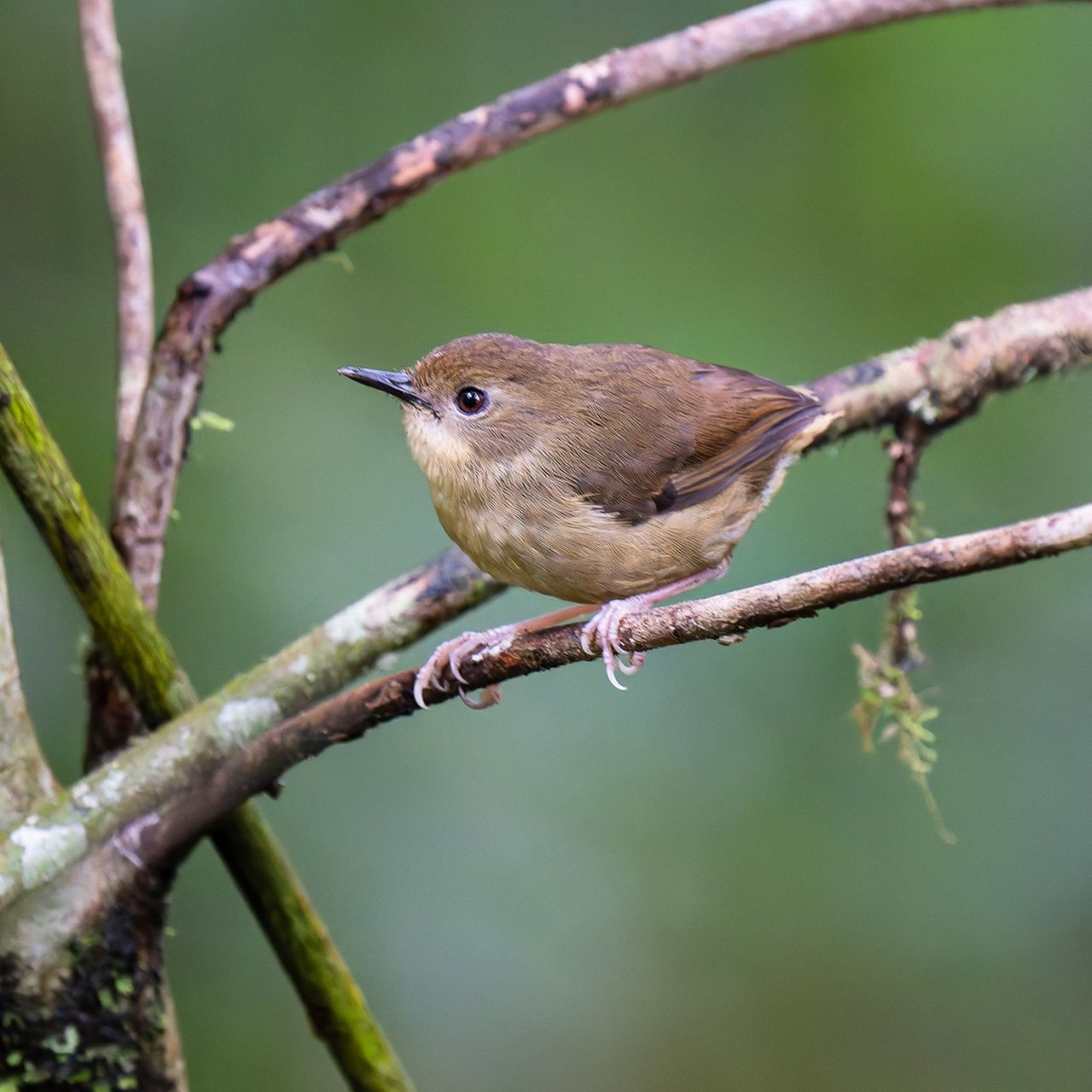
The Atherton Scrubwren is the ground-living scrubwren of the upland rainforest of the Wet Tropics and occurs nowhere but in that handful of mountain blocks in north-eastern Queensland. It is dark brown above and dull greyish yellow below, with no eyebrow, no wing spotting and no conspicuous mark at all: a bird you know by its place and its behaviour, not by its pattern.
Voice
A series of short, slightly grating notes and a soft, low contact chirping between two birds keeping close together in the litter; the whole is quieter and less chattering than in the Large-billed Scrubwren, which shares these forests. Also a hard, scolding rattle in alarm. The sound carries badly in closed mountain forest and is easily lost in the noise of creeks and leaves; to hear this species you must stand still.
Recording: Zebedee Muller — CC BY-NC-SA 4.0 · Watsonville, Mareeba Shire, Queensland, Australia · xeno-canto
Identification
About thirteen centimetres. The upperparts are dark reddish brown, the underparts a greyish yellow-brown. The bill is long and pointed, the legs conspicuously long and pinkish, and a narrow off-white ring surrounds the eye. What is absent counts for most here: no white eyebrow, no black-and-white wing covert pattern, no pale iris, no black bib. It moves mainly over the ground and in the lowest branches, hopping with the tail held low.
Confusion species
Large-billed Scrubwren (Sericornis magnirostra) is the real problem: it shares the forest, is slightly smaller, clearly paler and lighter below, and — decisively — it forages in the lower and middle branches among hanging leaf litter and vines and seldom comes to the ground, while its call is more twittering. White-browed Scrubwren (Sericornis frontalis) reaches the Atherton Tableland but has a sharp white eyebrow above and below the eye and a pale cream iris. Fernwren (Oreoscopus gutturalis) is the other litter bird of these mountains, but wears a white mask with a black bib. Yellow-throated Scrubwren (Neosericornis citreogularis) is large, with a yellow throat and a black mask. A plain, dark scrubwren shuffling on the floor of upland rainforest is this species.
Habitat
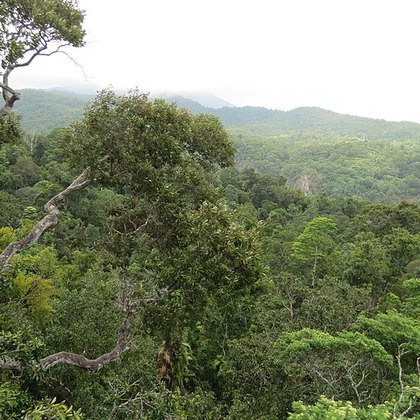
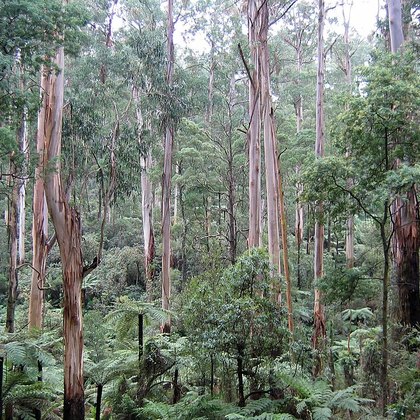
The floor and lowest shrub layer of closed mountain rainforest, locally also wet eucalypt forest at the upper edge, in gullies with ferns, moss and a thick damp layer of litter. The weight of the population lies above about seven hundred metres; in the lowlands it is absent and the Large-billed Scrubwren stands alone. It takes its food — insects and small snails — on the ground and on low branches, usually alone or in a pair, and nests close to the ground. The breeding season runs from September, sometimes as early as July, to January.
Where the bird is most often found, arranged by main group and formation.
Range and movements
Only the uplands of the Wet Tropics in north-eastern Queensland: the Atherton Tableland, the Bellenden Ker and Bartle Frere massifs, Mount Lewis, the Carbine Tableland and the Paluma Range. Those blocks are separated by warm lowland and exchange between them is slight. It is sedentary and does not migrate. The total occupied area is small, and it is also a narrow altitudinal band: below it the heat of the lowlands, above it the summits.
- Resident
- dark = core range, pale = thinly spread
Where and when to look
Take a rainforest track above seven hundred metres in the first hour after sunrise — Mount Lewis, Mount Hypipamee, the road up Bellenden Ker — and watch the ground rather than the canopy. You separate it from the Large-billed Scrubwren with your eyes, not with your binoculars: what shuffles on the floor flicking leaves aside is almost certainly this species, what rummages among hanging leaves and vines over your head almost certainly the other. Be patient: it is dark, quiet and moves in shadow.
Conservation
Vulnerable (VU). The rainforest itself is World Heritage and no longer logged, but the range is small, lies almost wholly in a narrow altitudinal band and is divided over separate mountain blocks. The warming of the Wet Tropics pushes that band upward, and above the summits it ends — that, and not logging, is why the species has moved up the Red List. Cyclones that open the canopy and feral pigs that turn the litter over do the rest.
Scientific name
Sericornis keri | Mathews, 1920
Mathews described the species in 1920. Sericornis is formed from Greek serikos (silken) and ornis (bird), after the soft plumage of the group. The specific name keri points to the type locality, the Bellenden Ker Range in northern Queensland, and so indirectly to the British politician those mountains are named for. The Dutch and English names both cite the Atherton Tableland, the best-known part of the range.