All species › Ericales › New World pitcher plant family › Sarracenia jonesii
Sarracenia jonesii
Jones' trompetbekerplant
Sarracenia is a coastal plain genus, but not this species: Sarracenia jonesii lives in the mountains, in a handful of bogs and seeping rock faces on the Blue Ridge escarpment along the North Carolina–South Carolina line. It is one of the rarest carnivorous plants in North America. At the most recent count fifteen populations survived out of the thirty-one ever known, and the total number of plants is put at seven hundred to twelve hundred.
Identification
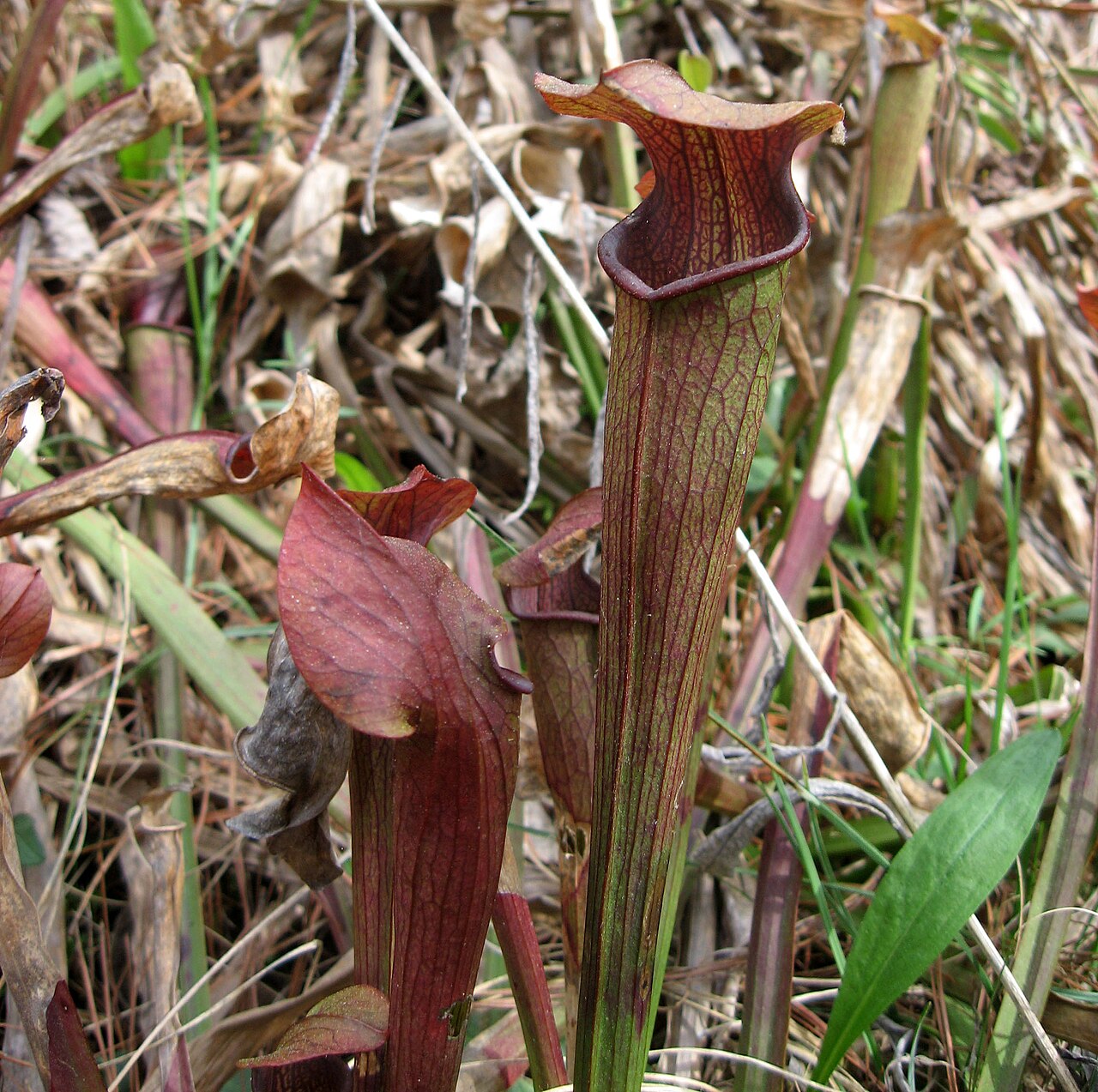
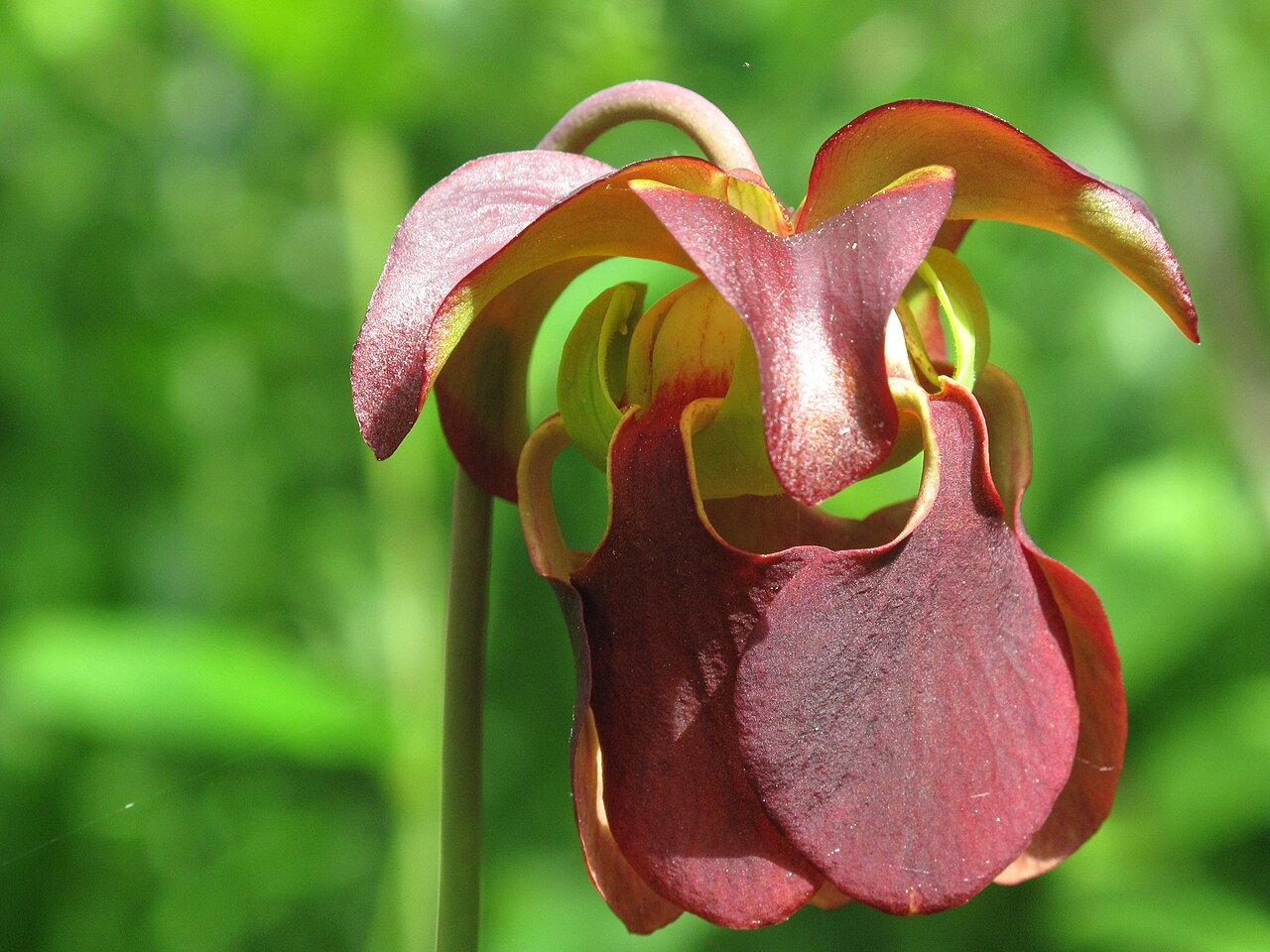
A rosette of erect, slender, trumpet-shaped pitchers usually 40 to 50 cm long, the whole plant measuring 21 to 73 cm. The pitchers are strikingly narrow — roughly twenty times as long as the mouth is wide — and dull green with a net of crossing crimson to purple veins that grows denser towards the mouth. The hood is held ascending, leaving the mouth open; it is seldom more than 4 cm wide and lacks the white or translucent windows found in the hoods of some relatives. From April to June a single nodding flower appears on a scape about as tall as the pitchers: five persistent sepals, five deep maroon petals some 2.5 cm long that curve inwards and fall after flowering, and beneath them the umbrella-shaped style characteristic of the genus.
Similar species
Its closest relative is Sarracenia rubra, of which some authors treat this plant as a subspecies; that species is smaller, with pitchers rarely exceeding 35 cm, and lives on the coastal plain rather than in the mountains. Sarracenia purpurea occurs in the same uplands but is unmistakable: decumbent, swollen, water-holding pitchers with an erect hood that does not cover the mouth. Sarracenia oreophila, the genus's other mountain species, has yellow flowers and far broader, less slender pitchers, and grows further west.
The trap and how it works
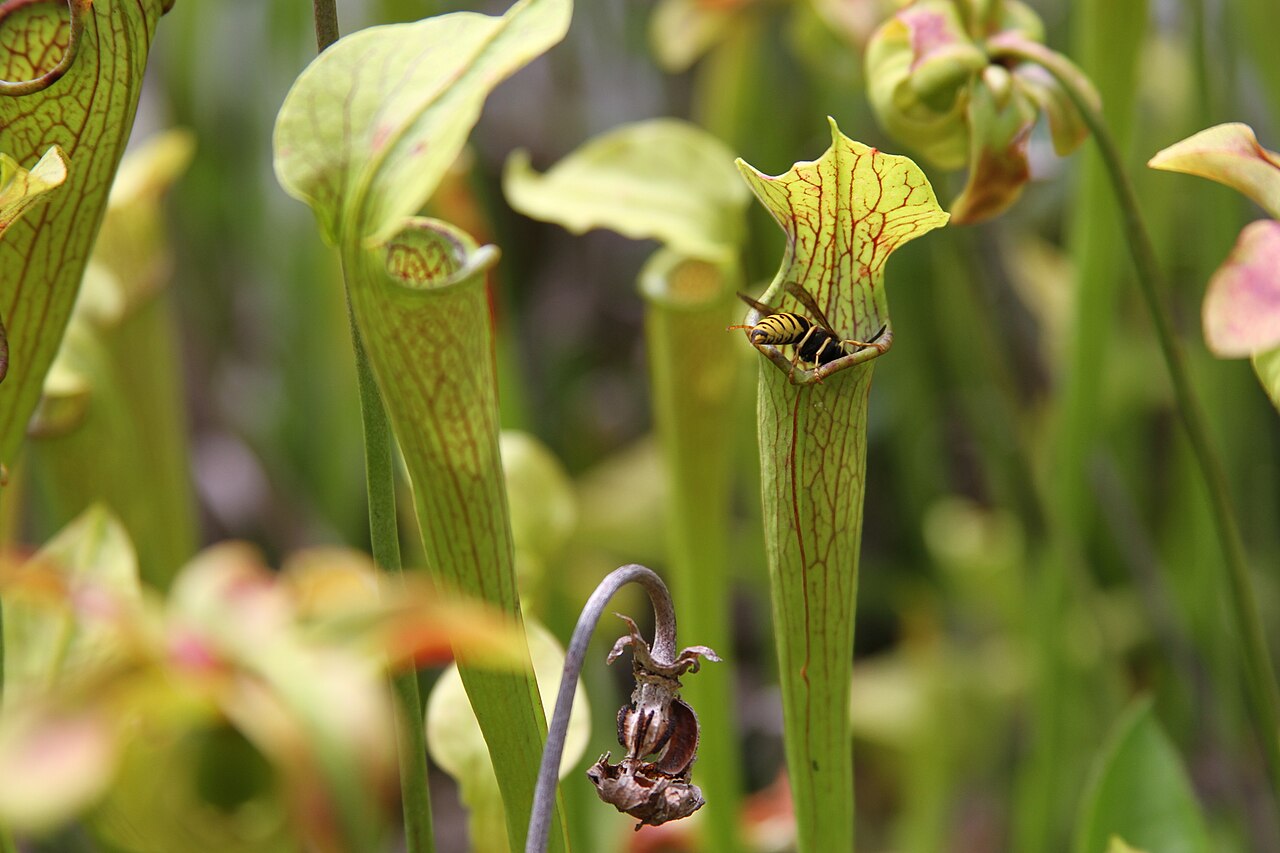
A classic pitfall trap, in which the whole leaf is rolled into a tube with the seam left standing at the front as a narrow wing. The rim of the mouth secretes nectar; insects come to it, and it is exactly there that the surface is smooth and curved inwards. Immediately below the rim lies a waxy zone that flakes away under insect feet, and below that a zone of downward-pointing hairs that works against every step back up. At the bottom stands a shallow pool of fluid carrying digestive enzymes. Because the hood is held clear of the mouth and the tube is so narrow, little rainwater enters and the fluid stays concentrated. The catch is mostly flies, ants and wasps.
Habitat and ecology
Two very different sites, both scarce. The first is the mountain bog: a flat, poorly drained depression in a stream valley with deep, acidic, highly organic soil kept wet by groundwater seepage and periodically flooded (W3, on the peat build-up of W1). The second is the so-called cataract bog: a sloping granite face carrying a thin skin of peat and moss over which water glides permanently (D4). In both the plant depends absolutely on full sun; once alders, willows or shrubs close over, it goes. Beaver, fire and the stream itself once kept those openings open, and all three processes have largely dropped out of this landscape.
Distribution and elevation
Endemic to a small area of the Blue Ridge escarpment in south-western North Carolina and north-western South Carolina, and found nowhere else. Every known site lies within the catchments of a few adjacent rivers, together covering ground you could cross in a day. No reliably published elevation figures exist for the species as a whole, so the elevation field is left empty here; in every case this is middle-elevation mountain country rather than high summits. Because of poaching this guide gives no finer locality than the two states.
- Recorded (one-degree cells)
Forms and variation
No wild varieties or colour forms are recognised. The variation you see is mostly a matter of site: plants on a sunny rock slope are shorter and more strongly flushed with red than plants in a sheltered bog, where the pitchers stay longer and greener. The vein pattern differs from plant to plant, but no one has attached a name to that which holds up in the field. Natural hybrids with Sarracenia purpurea do occur where the two grow together, recognisable by the shorter, broader pitcher and the wider hood; in this guide they belong with the parents rather than as a species of their own.
Where and when to see it
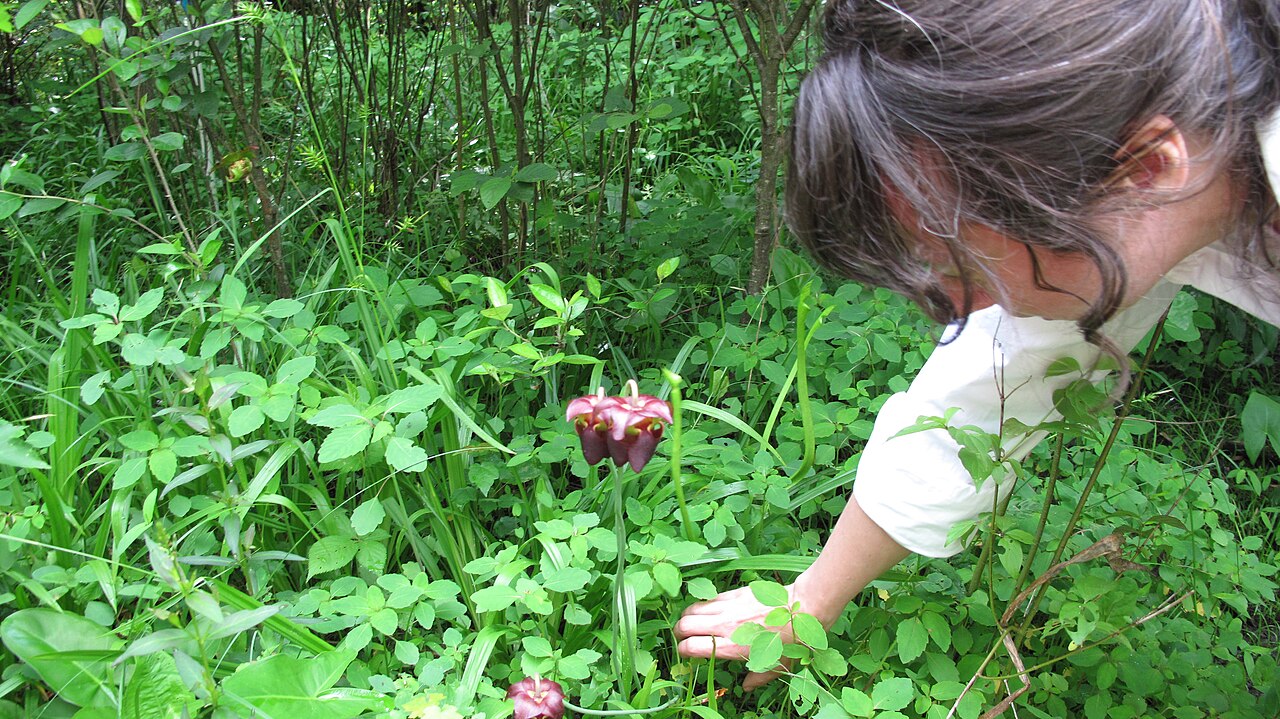
May is the moment: flowers are open and the new pitchers are fully grown but still unblemished. Practically, visiting this species differs from most plants in this guide — nearly all populations are on land with managed access or in private ownership, and searching on your own yields little. The workable route is a guided outing run by a botanical garden, a land manager or a regional plant society, often offered during the flowering season. Stay on the marked line: the peat is soft, the rosettes sit loosely in it, and one footfall costs a plant that took decades to reach that size.
Conservation status
The species has not been assessed for the IUCN Red List, so there is no international category for it. What is known, however, is plain enough. In the United States it has been listed as endangered under the Endangered Species Act since 1988, and it is included in CITES Appendix I, the strictest, which bans international commercial trade in wild-collected plants outright. Sixteen of the thirty-one known populations have been lost; of the fifteen that remain only a handful are regarded as stable, and the total is estimated at seven hundred to twelve hundred plants. The causes are the draining and conversion of mountain bogs, the closing-in of the open sites now that fire and beaver are gone, and poaching for the plant trade.
Scientific name
Sarracenia jonesii | Wherry, 1929
Edgar T. Wherry described the species in 1929 in the journal Bartonia. The type locality lies in the mountains of south-western North Carolina and north-western South Carolina. The species epithet jonesii probably honours the American entomologist and Sarracenia researcher Frank Morton Jones (1869-1962), though this is not fully documented with certainty.
World Checklist of Vascular Plants (WCVP), via Plants of the World Online (POWO), Royal Botanic Gardens, Kew.
Natural hybrids of this genus
These ten species can cross with one another. See the nineteen named natural hybrids of Sarracenia, with photographs where available.