All species › Lamiales › Bladderwort family › Pinguicula zecheri
Pinguicula zecheri
A large-flowered butterwort of the mountains of Guerrero, around the Puerto del Gallo pass at two and a half thousand metres, where it grows on damp mossy banks along the road — sometimes even among sphagnum. Pinguicula zecheri is at the same time one of the contested species of this guide: not everyone accepts it as a species in its own right, which makes its page a lesson in just how variable the Pinguicula moranensis complex is.
Identification
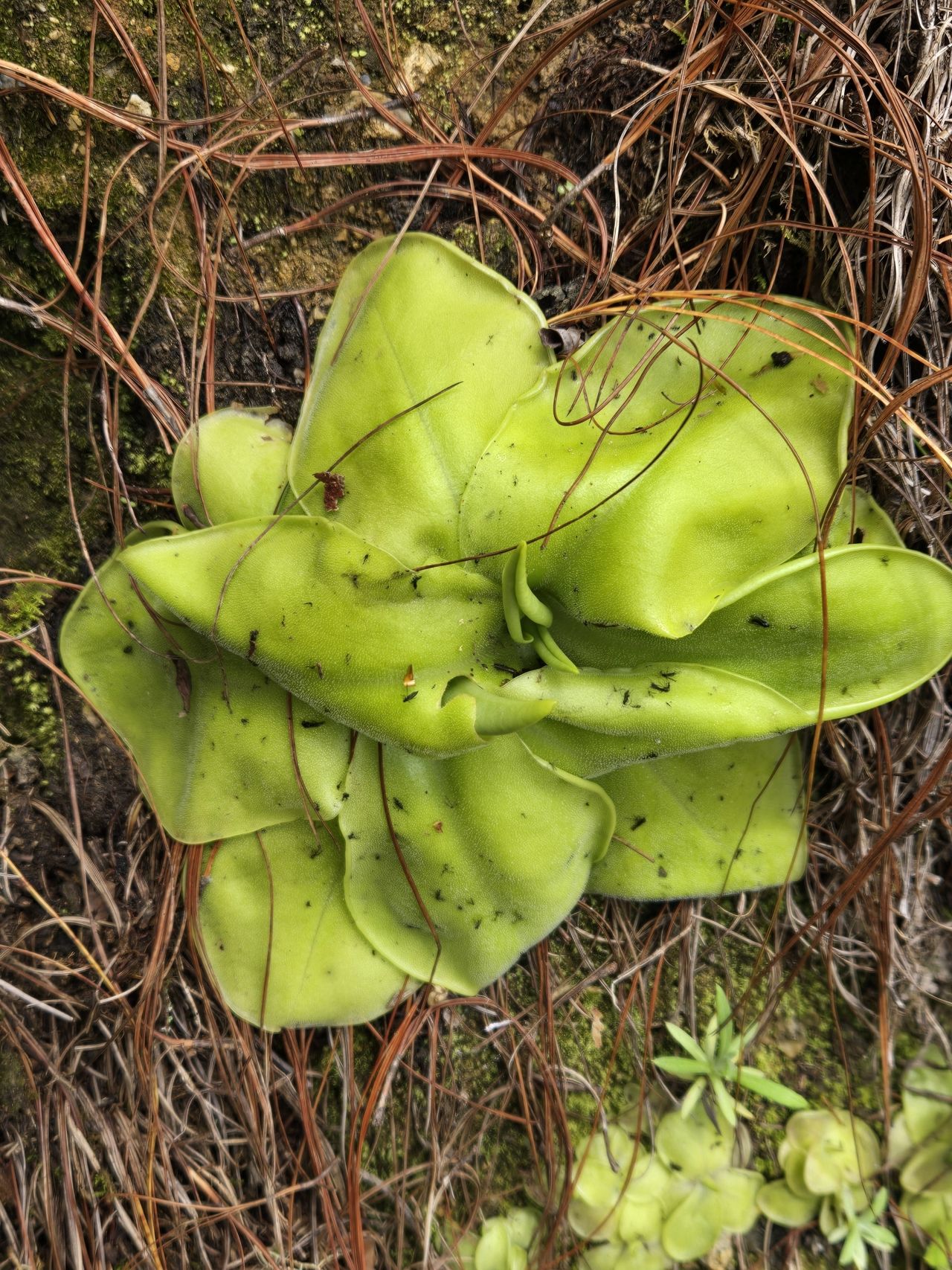
A butterwort of the large-flowered Mexican group, with a flat rosette of sticky summer leaves and a more compact rosette of thick leaves in the dry season. The flowers are light purple to pink, with white and sometimes darker purple streaks at the base of the lower lip; in the field the colour variation within one population is strikingly wide, from dark purple to almost pale pink, and the size and shape of the corolla lobes vary strongly as well. For the exact dimensions of rosette, leaf, scape, flower and spur we could find no testable statement from the original description; those fields have therefore been left empty on the fact card.
Similar species
This is precisely the problem with this species. Pinguicula moranensis grows in the same Guerrero mountains, near Chilapa and at Puerto del Gallo itself, and P. orchidioides occurs there too. Some workers therefore regard P. zecheri not as a separate species but as a large-flowered form within the highly variable P. moranensis complex. The international checklists do accept the name and this guide follows them, but the reader would do well to treat a field identification as provisional and above all to record the site and the floral characters carefully.
The trap and how it works
The trapping is that of the whole genus: stalked glands on the upper surface of the summer leaf carry a clear viscous droplet, sessile glands between them release digestive enzymes only once prey is lying there, and over the course of a day the leaf margin bends over the catch so that the fluid pools in a shallow dish. On damp mossy road banks in pine forest at two and a half thousand metres the catch consists of midges, small flies and winged ants. The thick winter form does not feed and bridges the dry months.
Habitat and ecology
Damp mossy banks along mountain roads — sometimes with sphagnum — in an area of mainly pine forest, at 2250 to 2400 m, with montane cloud forest alongside in which Quercus, Pinus and Abies occur. The road bank is the habitat par excellence here: an artificial, permanently wet, nutrient-poor face offering exactly what these plants need — plenty of light, running water and hardly any competition (H1, R1, B5). That makes the species easy to find, but also directly dependent on how those roads are maintained.
Distribution and elevation
Endemic to the Mexican state of Guerrero, in the mountains around Puerto del Gallo in the Sierra Madre del Sur — in agreement with the entry in our species list. The known range is small and concerns a few passes and mountain roads in otherwise hard-to-reach country. Guerrero is among the least explored Mexican states as far as butterworts go — it is the same state in which P. imitatrix has been lost since 1939 — so the distribution picture here should be read with more than usual caution.
- Recorded (one-degree cells)
Forms and variation
No wild varieties have been described, but the variation within populations is exactly the issue with this species. In the field the flower colours within a single site run from dark purple through pink to almost pale pink, and the corolla lobes differ in size and shape from plant to plant; the white and purple throat markings vary too. It is that very breadth which raises the question whether this is a species of its own or an extreme of the P. moranensis complex. Many clones circulate in the plant trade under this name; they do not belong in this guide, being no forms distinguished in the wild.
Where and when to see it
Drive the mountain roads around Puerto del Gallo and stop at every north-facing wet bank with thick moss — that is the habitat. Look at both the face and the ditch edge below it. The large light purple to pink flowers show from the road. Photograph every plant's flower from the front and the side, with the spur to scale, and record altitude and site; given the taxonomic uncertainty, a well-documented series of observations is worth more here than a name. Leave the plants alone and keep off the banks.
Conservation status
The species has not been assessed for the global IUCN Red List and is not listed in CITES. What is known points to a small range in one mountain district and to habitats that coincide entirely with road banks. The threats named for this area are deforestation for commercial logging and conversion of forest to coffee plantations; both erode the forest climate on which the damp banks depend. Road works — widening, concreting, ditch clearing — can remove a population in a single season. The taxonomic uncertainty also makes it harder to include the species in conservation plans; a formal assessment is missing.
Scientific name
Pinguicula zecheri | Speta & Fuchs, 1982
Named by Franz Speta and Franz Fuchs; the name was already proposed in 1982, but appears to have been validly published only in Phyton (Horn) 56: 158, with a year (2016) that differs from the earlier mention — this discrepancy could not be clarified with certainty. The species occurs in southern Mexico (including near Puerto del Gallo, in Guerrero state, at 2000–3000 metres altitude); the precise type locality could not be established with certainty. Who exactly is honoured by the species name could not be established with certainty.
World Checklist of Vascular Plants (WCVP), via Plants of the World Online (POWO), Royal Botanic Gardens, Kew.