All species › Lamiales › Bladderwort family › Pinguicula vulgaris
Pinguicula vulgaris | Common butterwort
Vetblad | Grasilla común
The butterwort owes its name to its leaf: yellow-green, glossy and greasy to the touch, as though buttered. Anyone meeting it in a calcareous fen or beside a mountain stream sees the violet flower on its thin stalk first, and only then the rosette beneath it with the midges stuck to it. In the Netherlands it has all but gone; in northern Europe and in the mountains it is still ordinary.
Varieties
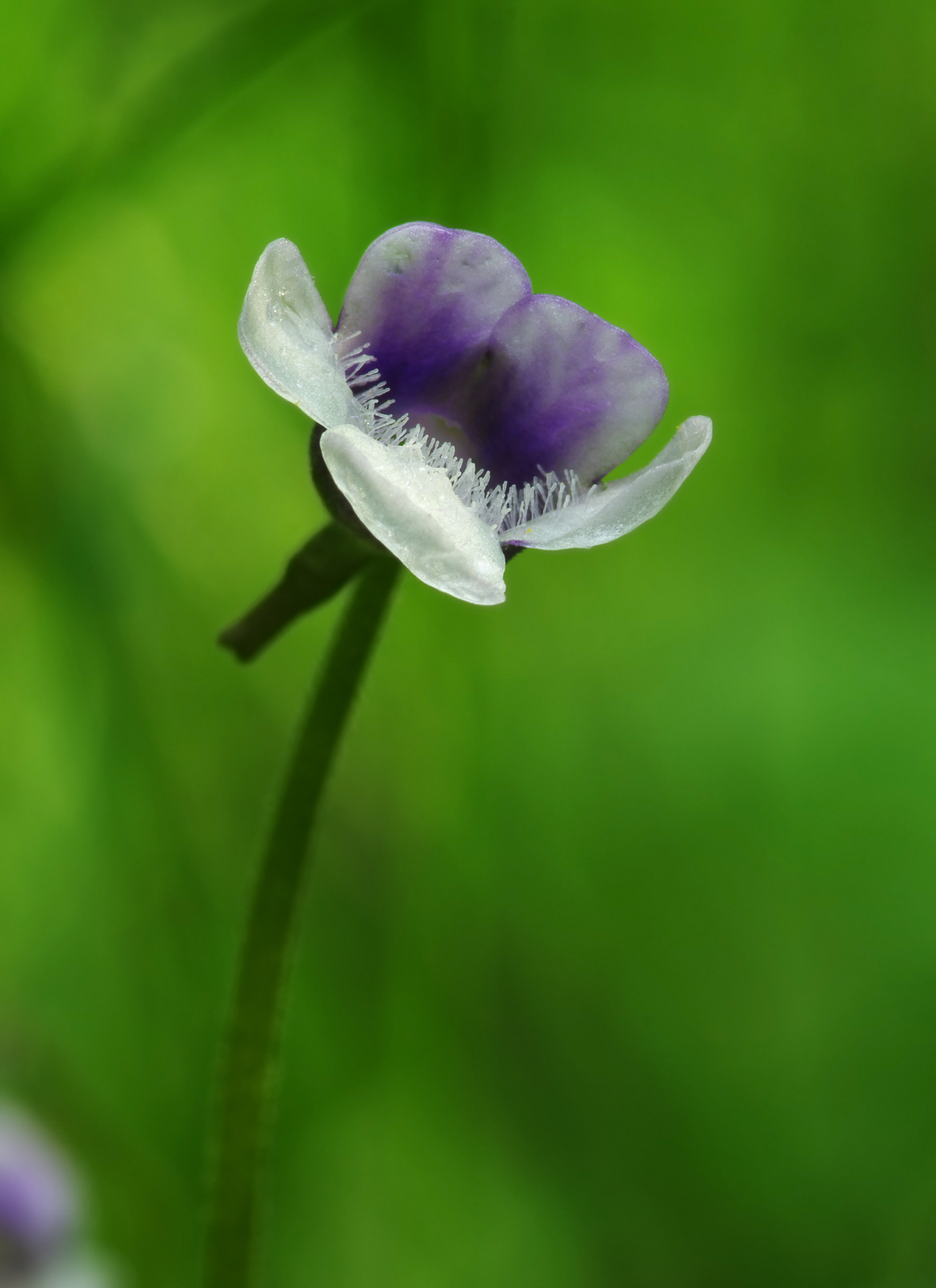
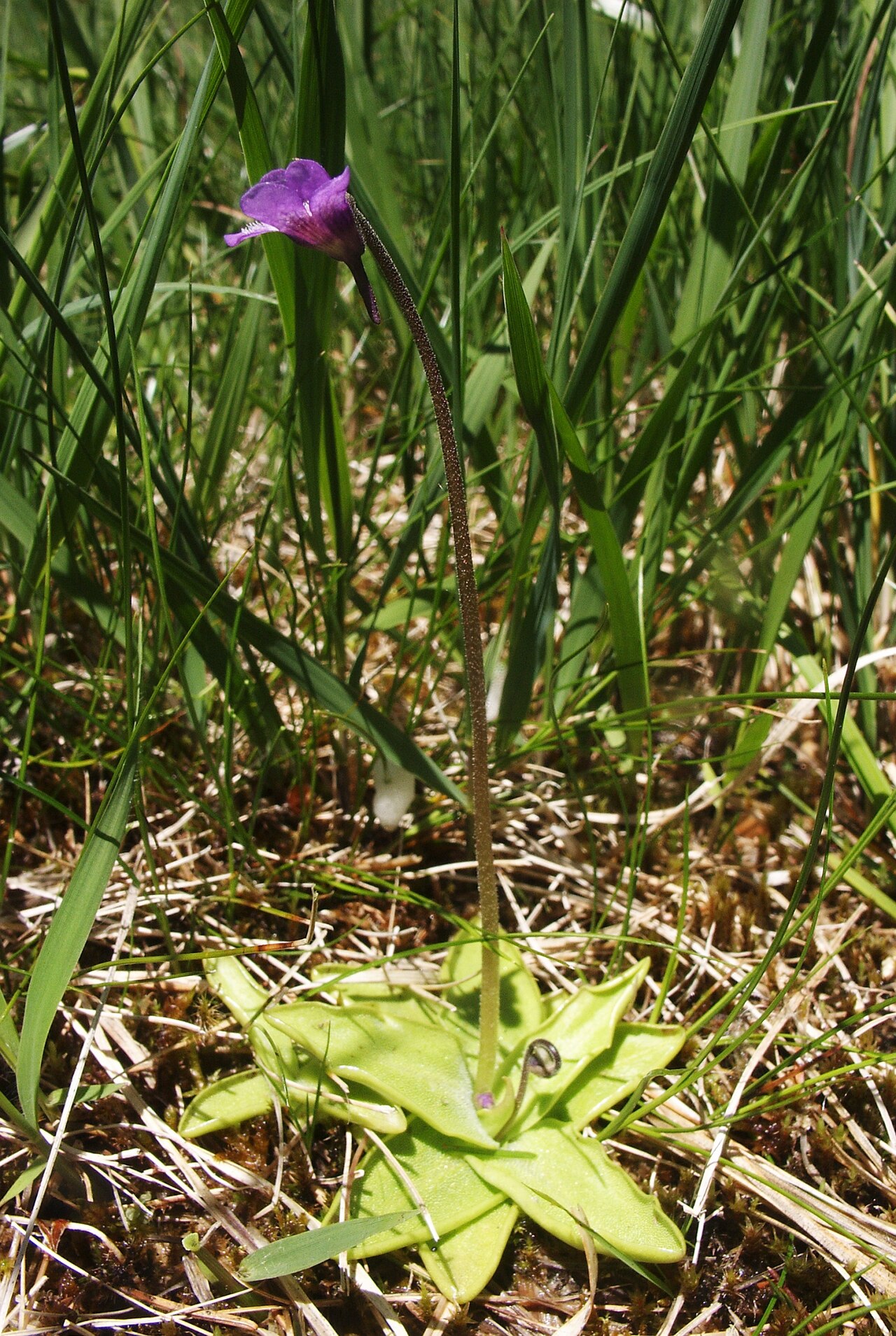
Identification
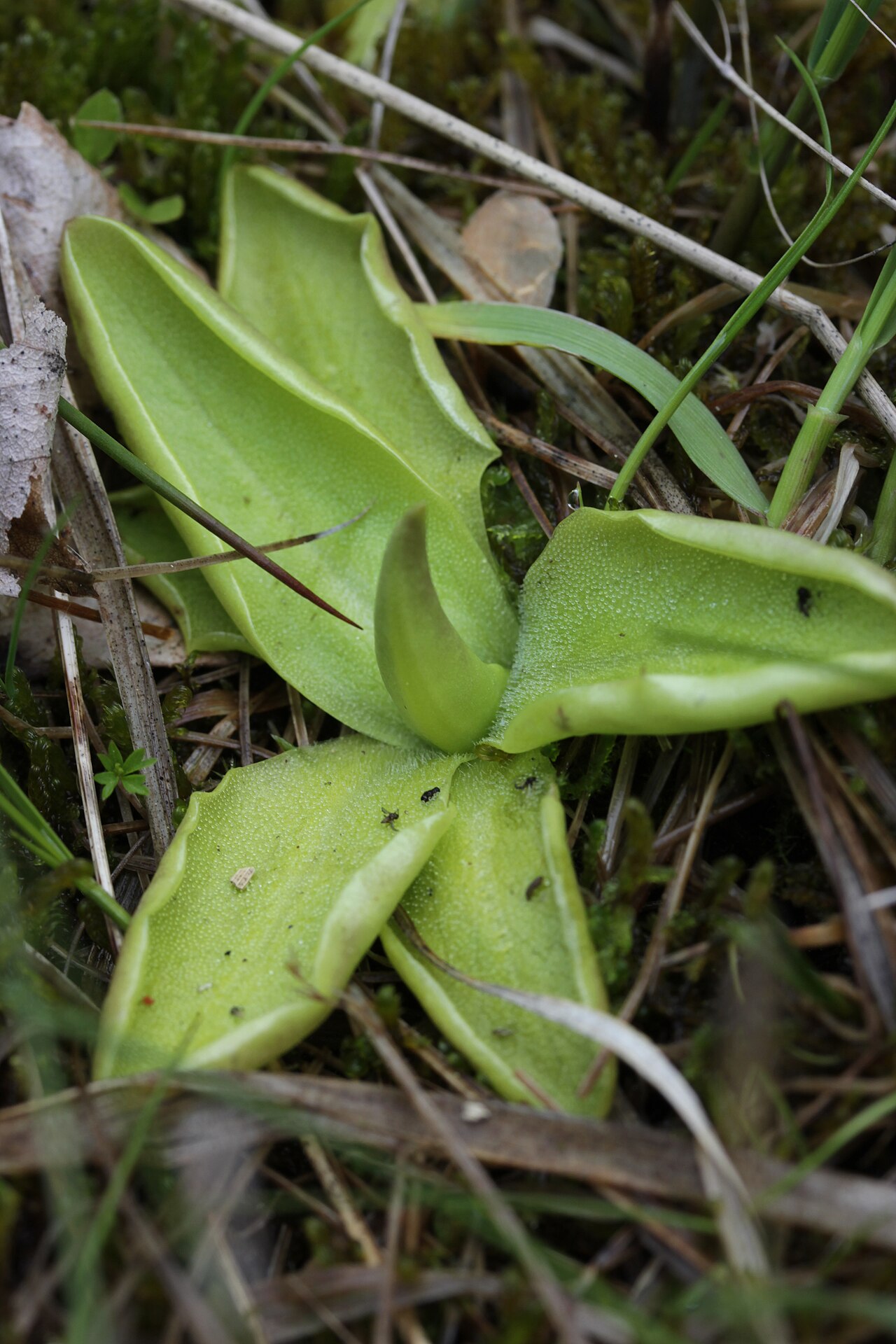
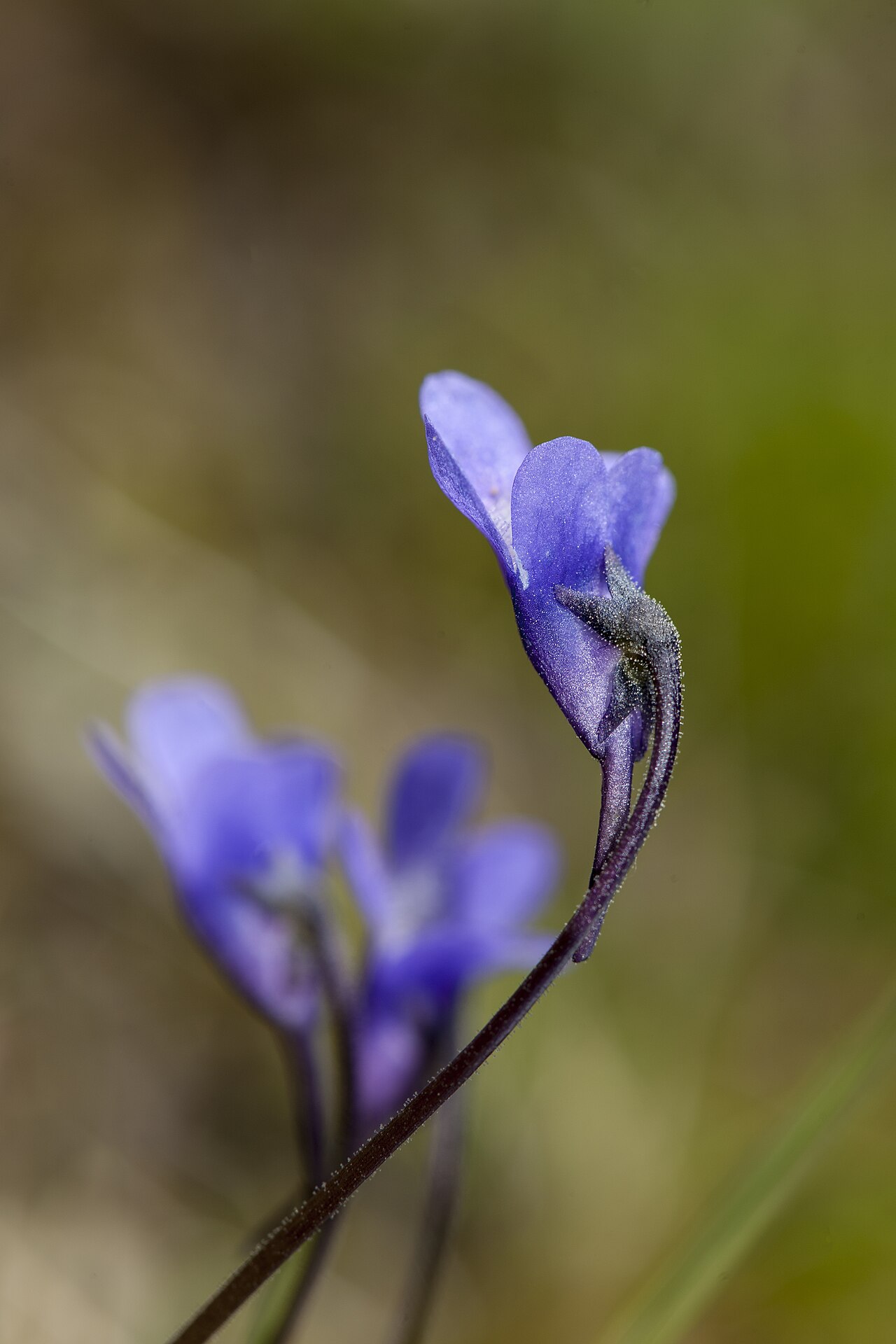
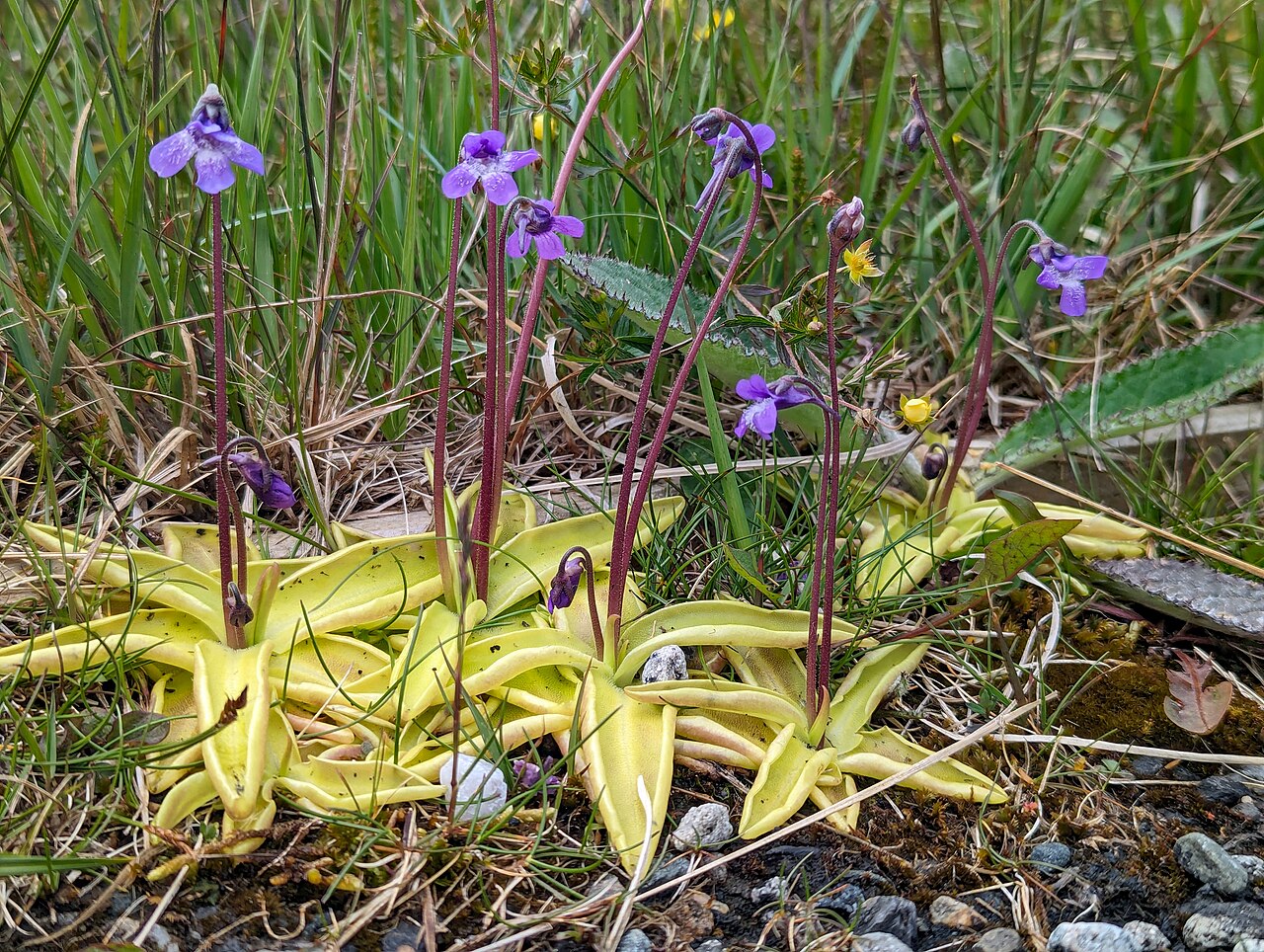
A flat rosette of yellow to yellow-green, oblong-ovate leaves with inrolled margins, greasily glossy and sticky on the upper side. From the rosette rise one or several bare, slender scapes 5 to 15 cm tall, each with a single flower. The flower is violet with a white hairy patch in the throat; the corolla is 10 to 15 mm long, longer than wide, and the lobes of the lower lip are distinctly longer than broad and do not touch one another. The spur is straight and pointed and reaches a third to a half of the corolla's length. The fruit is a pear-shaped capsule. In winter nothing remains but a bud with small brood-buds at its base.
Similar species
The species to confuse it with is the large-flowered butterwort (Pinguicula grandiflora). That has a distinctly larger flower: a corolla 15 to 20 mm long, about as wide as long, with broad overlapping lobes so that the flower reads as one round disc, and a stout straight spur reaching at least two thirds of the corolla. In the common butterwort the narrow lobes stand apart and the spur is slender and shorter than half. The leaf rosette of the large-flowered species is generally more substantial. Where the two meet in Ireland the natural hybrid P. ×scullyi arises, intermediate in size. In the mountains there is also the alpine butterwort (P. alpina), white with a yellow spot and a short blunt spur, and in Iberia, western France and Ireland the small pale-lilac P. lusitanica. Distribution helps as well: of all these, the common butterwort has by far the widest and most northern range.
The trap and how it works
An active flypaper trap, and the word active refers to the leaf margin. Two kinds of gland stand on the leaf surface: stalked glands with a drop of glue that hold the prey, and sessile glands that only secrete digestive fluid once something is genuinely lying on them. With prey stuck fast, the margin of the leaf curls slowly inwards over the course of hours, so that the animal comes to lie in a shallow dish of fluid and nothing runs off. This is nothing like the speed of the Venus flytrap, but it is real movement, and it is exactly what separates the butterworts from passive flypaper traps such as Byblis and Drosophyllum, where nothing moves at all. The catch consists mainly of small two-winged flies: midges and gnats that land on the shining leaf.
Habitat and ecology
Wet, nutrient-poor and usually calcareous ground: quaking bog and fen, seepage patches and stream banks, wet dune slacks, poor wet grassland and dripping rock faces in the mountains. It tolerates no competition from tall grass and disappears as soon as fertiliser increases or the water table falls; grazing and mowing keep the ground open for it. From the lowlands up into the subalpine zone.
Distribution and elevation
Circumboreal, and with that the most widely distributed species in this guide: from Iceland, Greenland and Scandinavia through northern and central Europe, across Russia and Siberia to Canada and the northern United States. Southwards it reaches the Pyrenees, the Alps, the Carpathians and the north-western Balkans, where it is confined to the mountains. The Netherlands and Belgium lie on the western edge of that range, and it is precisely there that it stands worst. The source followed here gives no altitudes.
- Recorded (quarter-degree cells)
Forms and variation
For a species with such a range the variation is small: pale and white-flowered plants occur, but hardly any varieties are recognised in Europe. Part of what once fell under this name has been split off, though: the plants of the Pacific coasts of Asia and North America, with a stouter conical spur, are now usually treated as a species of their own. In Ireland and locally in France it crosses with the large-flowered butterwort to give P. ×scullyi, recognisable by the intermediate size of flower and spur.
Where and when to see it
May to July, while the flower is up: the rosette vanishes into the moss, but the violet flower on its thin stalk carries ten metres. Look in calcareous fens, on seepage slopes beside mountain streams and in wet dune slacks; in the Alps and Pyrenees it stands beside almost every path where water seeps over rock. Do not count on it in the Netherlands — Ireland, northern England, Scandinavia or the mountains are the places for that. Go down on your knees and watch the leaf margin: on a leaf that has just caught something you can see it curling over.
Conservation status
Not globally at risk on the Red List, because the range is enormous. Regionally the picture is entirely different. In the Netherlands it has all but gone: almost nothing remains of the former sites in dune slacks and fens, and the causes are drainage, acidification and above all nitrogen, which feeds the grass that grows over it. In Belgium, north-western Germany and England it has declined severely as well. Where it still stands it depends on management: holding seepage water, mowing or grazing, and no fertiliser.
Scientific name
Pinguicula vulgaris | Linnaeus, 1753
Linnaeus described the species in 1753 in Species Plantarum; the plant had already been distinguished as a blue-flowered form by Carolus Clusius in 1583, and Conrad Gesner had given it its name as early as 1561. No precise type locality was given; the species occurs naturally in temperate and arctic regions of Europe and North America. The genus name Pinguicula comes from the Latin pinguis ('fat'), referring, as Gesner already noted, to the glistening, greasy-feeling leaves. The species epithet vulgaris means 'common, ordinary', reflecting the species' wide distribution.
World Checklist of Vascular Plants (WCVP), via Plants of the World Online (POWO), Royal Botanic Gardens, Kew.