All species › Lamiales › Bladderwort family › Pinguicula nevadensis
Pinguicula nevadensis
High above the last pines of the Sierra Nevada, on the waterlogged slopes just below the summits, grows a butterwort found nowhere else on earth. Pinguicula nevadensis is small, rarely wider than a palm, and flowers only briefly: the snow lets the ground go in June and by August it is over. It is the only species in this guide carrying an Endangered listing.
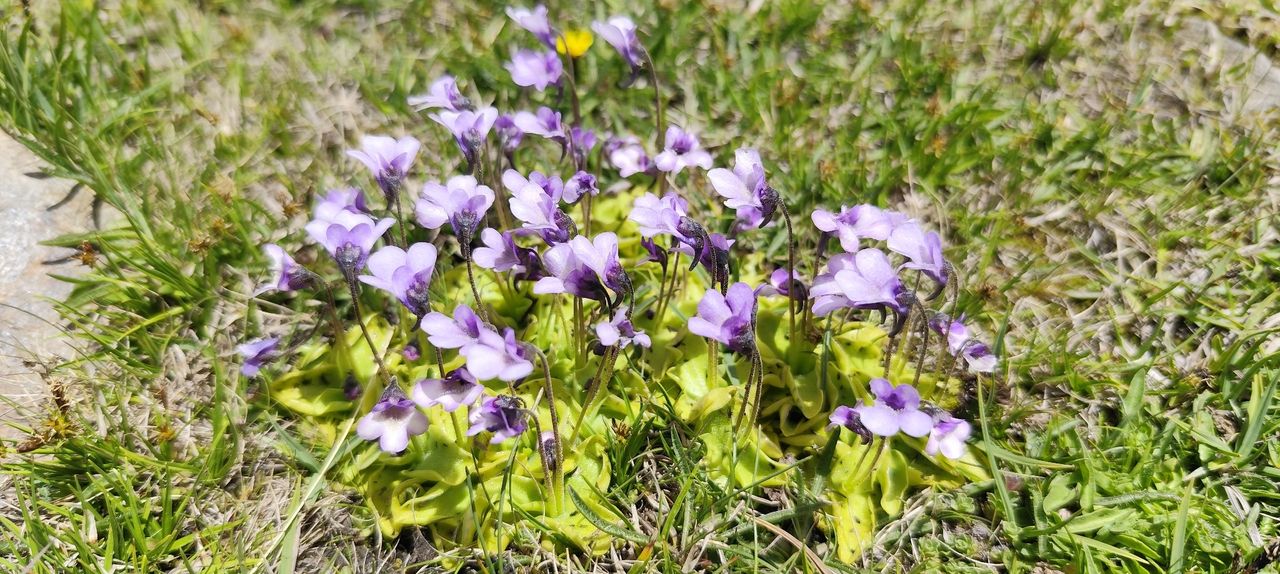
Identification
A flat rosette of five to eight leaves, nearly circular to ovate, 1.5 to 4.5 cm long and up to 2.5 cm wide, greasy to the touch and with inrolled margins. In flower the plant stands 3 to 7 cm tall, rarely eleven; each rosette carries one to three, at most four scapes, each with a single flower. The corolla is 10 to 16 mm long and lilac; the lower lip is pale lilac to almost white with three lobes distinctly longer than broad, which gives the flower a narrow, almost spidery look. A dark lilac blotch marks the throat. The spur is 3 to 5 mm, straight and fairly short. Fruiting follows from July to September, with roughly sixty seeds to a capsule.
Similar species
Within its own mountains confusion is barely possible: no other Pinguicula occurs above two thousand metres in the Sierra Nevada. Lower down in the Baetic ranges grows Pinguicula vallisneriifolia, but that is a quite different plant — far larger, with long strap-shaped leaves hanging over wet limestone and with stolons. Comparing photographs with P. vulgaris shows that the lower-lip lobes of P. nevadensis are narrower and longer, so the flower reads as thinner. In the end the deciding character is the habitat: a soaked, short-cropped alpine sward on schist, above the treeline.
The trap and how it works
A flypaper trap without rapid movement. The leaf carries stalked glands with a glistening mucilage droplet and, between them, sessile glands that release digestive enzymes only once prey is lying on them. What sticks here is mostly very small: midges, gnats and springtails living in the sodden turf. In response to prey the leaf margin rolls a little further inward, so the digestive fluid stands in a shallow gutter. At this altitude that is no luxury: the growing season barely lasts three months, the soil is poor and acid, and the nitrogen from a few hundred midges is the difference between flowering and not flowering.
Habitat and ecology
Permanently soaked, short-grazed swards on mica schist, fed by meltwater that keeps seeping all summer — in Spanish these are the borreguiles. The plant grows among sedges and mosses in turf that never dries out, on ground that lies under snow well into June. Unlike most southern European butterworts this is not a lime plant: the rock is siliceous and the water soft. At the top of its range the habitat grades into wet stony slopes just below the ridges, at the bottom into grazed mountain pasture, where trampling by livestock and Spanish ibex is the chief threat.
Distribution and elevation
Only the highest parts of the Sierra Nevada in southern Spain, province of Granada. There it forms an interrupted ring of subpopulations around the central crest, between roughly 2,150 and 2,950 metres, locally a little above three thousand. The entire world range fits into a few tens of square kilometres. The total population was last estimated at more than twenty-five thousand individuals spread over a few hundred grid squares — not a small number of plants, but all of them on a single massif, and that is exactly the problem.
- Recorded (one-degree cells)
Forms and variation
No wild subspecies or varieties are recognised. Across the range the subpopulations differ mainly in plant size and in how many scapes a rosette produces: in the wettest, most sheltered spots more rosettes flower and three scapes at once are common, while on bare, wind-scoured slopes one is the rule. Corolla colour ranges from pale lilac to fairly saturated; white-flowered plants are rare but occasionally reported. Only about a quarter of the plants flower in any given year, which can badly skew what you see in the field.
Where and when to see it
July is the most reliable month: the snow has left most sites and flowering is at its peak. Search not on the dry ridge but on the wet, level ground where meltwater drains across the turf and the soil springs under your boot. The plant is small and the flower sits just above the grass, so sit down and look into the slope; light coming through the lilac corolla betrays it sooner than the rosette does. Keep to paths and to rock: trampling of the soaked sward is a documented threat, and one careless step costs more here than elsewhere.
Conservation status
The species is listed as Endangered, making it the most severely assessed butterwort in Europe. The reason is not that plants are few but that all of them sit on one massif, in small separated patches of wet grassland, with a range of at most a few tens of square kilometres. The threats named are grazing pressure and trampling by livestock and Spanish ibex, erosion and slope failure, and recreational pressure around the high paths. On top of that comes climate: the species depends entirely on meltwater that keeps running all summer, and shorter snow seasons take that supply away. It is protected under the European Habitats Directive and under Andalusian legislation; CITES does not apply.
Scientific name
Pinguicula nevadensis | (Lindberg) Casper, 1962
Originally described in 1932 by Harald Lindberg, initially (incorrectly) as a subspecies of Pinguicula vulgaris. Only in 1962 did Siegfried Jost Casper recognise the plant as a distinct species in his monograph, yielding the current combination Pinguicula nevadensis (Lindb.) Casper. The species occurs in the Sierra Nevada, in southern Spain, in wet meadows dominated by sedges and mat-grass, at 1400 to over 3000 metres altitude. The name refers to the Sierra Nevada, the Spanish mountain range where the species occurs.
World Checklist of Vascular Plants (WCVP), via Plants of the World Online (POWO), Royal Botanic Gardens, Kew.